





A row of illuminated white colonial houses with black shutters and a stone wall along a road at dusk.

Mini Split Installation in Newark, NJ

Tell us about the job

Takes about a minute. No obligation.

New system or replacementMini-splitEssex County, NJ
Step 1 of 2

What ZIP code is the job in?

Electricity in New Jersey ran 19.34 cents per kilowatthour in 2024, well above what most states pay. A mini split earns its keep in that kind of market because it moves heat instead of generating it, so it uses less power to do the same job as a furnace or a window unit. The efficiency rating on the unit you choose matters more here than it would somewhere with cheap power, since every point of efficiency shows up on your bill month after month. Look at the SEER2 and HSPF2 numbers when you're comparing systems, not just the upfront price.

8 months
October through May, your system heats
3 months
June through August, it cools
25°F
the average winter night it heats against
84°F
the average summer afternoon it cools against
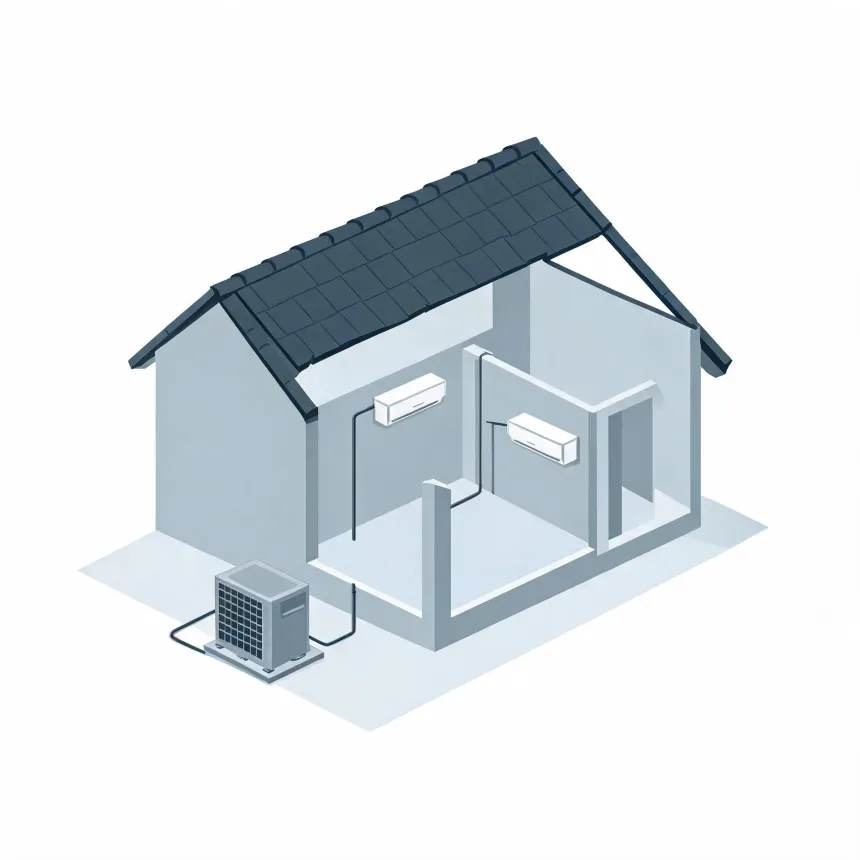
Isometric illustration of a cutaway house with a dark tiled gable roof, showing two wall-mounted indoor split air conditioning units connected by lines to an outdoor condenser unit on the ground outside.
Your system heats October through May and cools June through August.

NOAA nClimDiv, 1991–2020 normals

Summer here only runs three months, June through August.

A mid-range mini split holds up fine on a season that short, so the top-tier model is not the one you need to chase.

Half the homes in Newark were built by 1958. A mini split has to work with the walls you've got, not a blank slate.

Half the homes here were built by 1958
Cooling runs June through August
Summer afternoons average 84°F

Gas heats 72.1% of homes in Essex County, more than all other fuels combined. If your place is one of them, a mini split isn't replacing that furnace, it's working next to it. Most installs here lean on the gas furnace through the cold months and use the mini split for cooling, or to take the edge off a shoulder-season day when the furnace is more than you need. That's a simpler job than carrying a Newark winter start to finish, which is part of why a mid-range unit fits most homes here.

Any mini split installed here has to clear this region's efficiency floor

Zone 4A is the federal government's way of saying this region asks real work of both heating and cooling systems. Any mini split installed new has to clear the federal minimum for a split-system heat pump, 14.3 SEER2 for cooling and 7.5 HSPF2 for heating. That's the floor for every unit on the market now, so the real comparison is how far above it a given model sits and what that difference costs on a New Jersey power bill.

Find a contractor
A man in a dark long-sleeved shirt, cap, and tan work pants walks up concrete steps toward a teal front door, carrying a canvas tool bag in his right hand, with a potted shrub beside the porch.
A white mini-split air conditioner outdoor condenser unit mounted on metal brackets against a beige stucco exterior wall, with a blue sky and scattered clouds in the background.

What stays and what goes

A furnace or boiler doesn't get pulled out when a mini split goes in. It usually stays put and keeps carrying the coldest months while the mini split takes over cooling and the shoulder seasons. Window units are a different story. Those come out for good once the mini split is running, and whatever gap they left in the window or wall needs to get closed up properly. If the job is replacing a central air system outright, the old condenser comes off its pad outside and the indoor coil and refrigerant lines come out too, since the new system runs its own line set start to finish. None of this forces a change on the rest of the house. The mini split adds onto what's already heating and cooling the place, and only the piece it's standing in for actually leaves.

How many zones, and who controls each one

Every indoor head run off the same outdoor unit works on its own thermostat. That means the bedroom can run cooler than the living room without a word exchanged between them. Ask how many heads a given outdoor unit can carry before performance starts to suffer, and whether the system you're looking at is a single zone or multi-zone setup, since that changes both the equipment and how it gets installed.
What happens when it breaks

Ask who stocks parts for the brand you're considering and how far out a service call usually runs. A mini split that sits for a week without its indoor coil or control board is a real problem in the months it's carrying the load alone. Some manufacturers sell through a limited network of trained installers, which can mean a wait if something fails outside that group.

The equipment is only one part of what you're paying for. Where the outdoor unit sits, how far it is from the indoor head, and whether the line set has to run through framing or along an exterior wall all change how much labor the job takes. A straight shot through a wall to an outdoor unit a few feet away is a different job than routing lines up through a second floor or across a long run to reach the only spot outside with clearance. Multi-zone systems add to this fast, since every indoor head needs its own line set and its own power run back to the outdoor unit, and the outdoor unit itself has to be sized up to carry that many heads. Electrical work is its own factor. Some systems need a dedicated circuit, and if the panel doesn't have room or capacity for that, the panel work gets added to the job before the mini split itself goes in.

Installation day starts outside and in, at the same time. One crew member mounts the outdoor unit on its pad or brackets while another marks where the indoor head goes on the wall, usually high up and away from direct sun or drafts that would throw off the thermostat reading. The line set connecting them runs through a single hole drilled through the wall, insulated and sealed where it passes through. Once the indoor head is mounted and the lines are connected on both ends, the system gets evacuated with a vacuum pump to pull out any air and moisture before refrigerant goes in. That step matters more than it looks like it would. Moisture left in the line set causes problems down the road that are harder to fix than they would have been to prevent. After the refrigerant is charged and the electrical connections are made, the crew runs the system through both heating and cooling to check that it responds to the thermostat and holds its temperature before calling the job done.