
Mini split leaking water in Newark, NJ
Water dripping or pooling under your mini split is almost always a drain problem. The condensate line that carries water away from the indoor unit has gotten clogged with algae or dirt, or it's sitting at the wrong pitch, so the water backs up and spills out of the unit instead of draining outside. It can also mean the filter is dirty enough that air can't move across the indoor coil right, which lets ice build up and then melt faster than the drain can handle. In Essex County, where the unit runs hard through humid summers, that drain line has a lot of moisture passing through it, and it's common for growth to build up inside over a season or two. A tech needs to clear the line, check the pan and the slope of the unit, and make sure the coil and filter are clean so this doesn't keep happening.
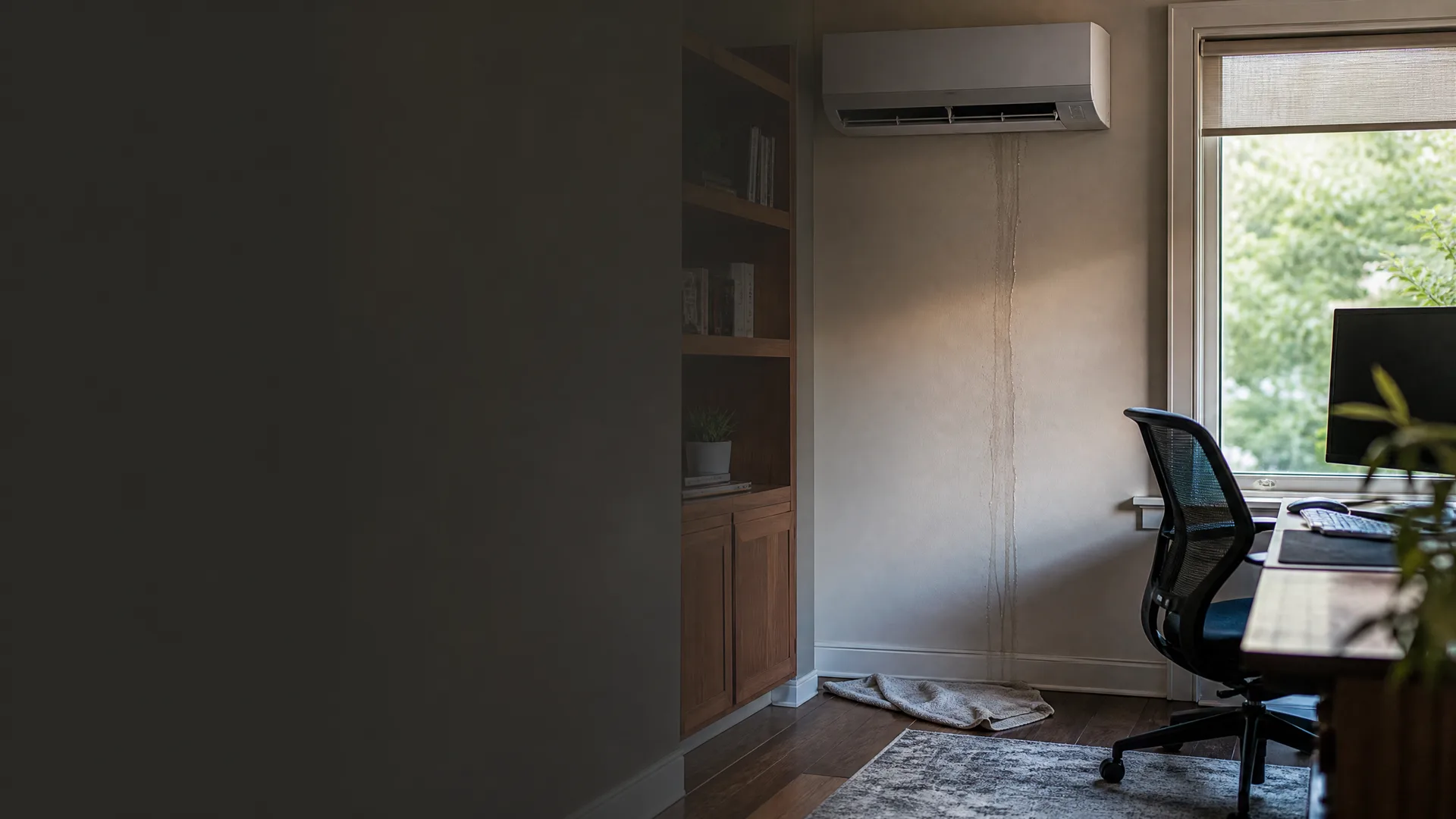
You're working at the desk this afternoon, laptop open, the mini split humming against the Essex County heat outside. You catch a drip out of the corner of your eye. A streak has already run down the wall under the indoor unit, soaking into the paint. By the time you grab a towel and get it on the floor, the carpet underneath is damp too. You wipe the unit's casing where the water is beading and check the wall again a minute later. It's still wet. The towel is already soaked through at one corner, and you're not sure yet if it's still dripping or just settling.
How much does your mini split actually run in Newark?
Cooling runs June through August
Cooling runs June through August, so a clogged drain line gets found fast, right when the unit is working hardest against the heat.
Heat runs October through May
Heat runs October through May, which means that indoor unit sits idle for stretches, and a slow drain clog can build unnoticed until spring.
Power here costs 24.38 cents per kilowatt-hour
Power here costs 24.38 cents per kilowatt-hour, so a unit fighting a clogged line or low refrigerant runs longer than it needs to.
NOAA nClimDiv 1991-2020 · EIA-861 2025






Water doesn't come from nowhere. Your indoor unit pulls humidity out of the air, and that moisture collects on the evaporator coil as condensate. It drips down into a plastic pan built into the bottom of the unit, which is supposed to catch every drop and funnel it toward a drain outlet. From there a hose carries the water to the condensate line, which runs out through the same wall sleeve as the refrigerant lines and the power cable before exiting the house. Any one of those steps can fail. Dust and algae build up inside the tube over months and choke it down until water backs up faster than it can drain. A pan that's cracked, or was never mounted level, lets water slide past the outlet instead of into it. Some units add a float switch meant to cut power before the pan overflows, but if that switch sticks, it won't catch the problem, and water keeps coming regardless.
How the drain actually works
- Condensate forms on the evaporator coil and drips into a plastic pan mounted underneath it inside the indoor unit.
- That pan slopes toward a drain outlet, and a small hose or tube carries the water from there to the condensate line.
- The line runs through the wall sleeve alongside the refrigerant lines and power cable, then down to an exit point outside.
- Algae and dust collect inside the tube over time and narrow it until water can no longer pass through fast enough.
- If the pan itself cracks or sits unlevel, water misses the drain outlet entirely and spills over the side instead.
- Some units have a float switch in the pan that should shut the system off before it overflows, but a stuck switch won't.


No calling every shop in Essex County

A licensed pro who repairs mini splits in Essex County gets your request.
There's no charge for the request.
Why algae grows in the line
The condensate line stays wet and dark almost the entire time your mini split runs, and that combination is exactly what algae needs to take hold. It starts as a thin film on the inside wall of the line, then thickens over weeks into a layer that narrows the path water has to travel. Once it builds up enough, water stops draining fast enough to keep up with what the coil produces, especially on a humid July afternoon when the unit is pulling moisture out of the air nonstop. The line doesn't have to be fully blocked to cause a problem. A partial clog is enough to back water up into the pan and send it over the edge.
Why pitch matters as much as clogs
Water only moves through the condensate line by gravity, since there's no pump pushing it along in most setups. That means the line has to run downhill the entire way from the indoor unit to wherever it empties outside. If the line sags anywhere along its run, even an inch, water pools at that low point instead of continuing on. Standing water sits there and gives algae a place to grow even faster than it would in a line that drains properly. A contractor checking a leak will look at both things together, because a line that's clear but mounted wrong will back up just the same as one that's pitched right but clogged.
Cooling runs June through August
Three months of steady cooling is enough for a slow drain clog to turn into standing water. Once June hits, your mini split runs long stretches without a break, and a line that was draining slow in May can back up fast under that kind of load.
NOAA nClimDiv 1991-2020
What the Leak Comes Down To
- A dripping or pooling mini split almost always means a clogged or poorly pitched condensate line, not a refrigerant problem.
- Algae and dirt build up inside the line over months of steady summer use, eventually blocking the water's path out.
- A unit mounted slightly off level sends condensate the wrong direction instead of out through the wall.
- Clearing the line and resetting the pitch stops the leak at its source rather than just wiping up the water.
- Left alone, the backup spreads from a drip to standing water and stained drywall under the indoor unit.
- A local contractor who services mini splits all season knows which part of the line usually fails first.
A mini split leaking water in Newark almost always traces back to the condensate line, not the refrigerant side of the system. Water forms on the coil, drips into the pan below it, and should travel out through a line that stays clear and pitched downward the whole way. Months of steady cooling, June through August here, give algae and dirt time to build a film inside that line until the water has nowhere to go but back into the unit or down your wall. A unit that sits even slightly off level works against the pan the same way, sending condensate toward the wrong edge instead of out to the drain. None of this fixes itself. What starts as a drip under the indoor unit turns into standing water and a stain in the drywall if the line and the mount aren't both corrected. The fix itself is straightforward for someone who does it regularly: clear the blockage, check the pitch, reset the unit if it's sitting wrong, and confirm the water is moving again before leaving. A contractor who works on mini splits all season in this area has usually seen the same failure enough times to know where to check first. Getting that done means you're not the one pulling the indoor unit apart or guessing at what's clogged. One licensed contractor, local to Essex County, takes the call and handles it, rather than you sorting through several.


Explain it one time
A leaking mini split needs someone to clear the line, check the pitch, and confirm the pan and hose are doing their job, not a guess over the phone. Instead of searching around Newark, calling a few companies, and explaining the drip under your unit over and over, you get matched with one licensed local contractor who works on these systems every summer and knows how an Essex County drain line clogs. One call, one visit, one person already familiar with the problem.
The pro who gets in touch is licensed in New Jersey and works in Essex County.
You only hire the pro if you want to.