







An outdoor air conditioning condenser unit mounted on a concrete pad next to a residential house at sunset.

Heat Pump Repair in Salem, NJ

Tell us about the job

Takes about a minute. No obligation.

RepairHeat PumpSalem County, NJ
Step 1 of 2

What ZIP code is the job in?

Heat pumps in Salem County earn their keep through a long stretch, cooling from June through September, then switching over to heat from October through April. That changeover in the fall is when weak parts tend to fail. A reversing valve that was sticking a little in spring can quit once the unit leans on it to pull heat from cold air. A capacitor that got the system through summer sometimes doesn't have another season left in it. If your heat pump is struggling in September or acting up once it starts heating in October, that timing isn't a coincidence. It's usually the first real load finding the part that was already going.

7 months
October through April, your system heats
4 months
June through September, it cools
28°F
the average winter night it heats against
85°F
the average summer afternoon it cools against
Isometric line illustration of a cutaway single-story house showing interior rooms, ceiling ductwork and an indoor air handler, connected by a line to an outdoor condenser unit on a pad beside the building.
Your system heats October through April and cools June through September.

NOAA nClimDiv, 1991–2020 normals

Salem County doesn't put extreme heat or extreme cold on a heat pump. Winter lows average 28°F, not the deep cold that pushes a system to its limit.

So when a heat pump here is struggling, the cause is usually a worn part or a unit that's getting old, not a machine that's been overworked.

A heat pump that's struggling here costs more every month it runs that way

Power costs 19.34 cents a kWh statewide
73 damaging wind events from 2015 to 2024
12 winter storms from 2015 to 2024
A heat pump costing you more every month it's offNew Jersey electricity ran 19.34 cents per kilowatt-hour in 2024. Get the part fixed before it runs up another bill.

That makes repair worth calling first, before replacement. A heat pump that's kept up with mild winters and normal summer loads for years usually has more life in it than its symptoms suggest. If it's short-cycling or not switching over cleanly, a tech can often trace that to one part, a contactor, a reversing valve, a low charge, and get it running right again. Age still matters. A unit that's old and now failing in more than one way may not be worth sinking money into. But here, where the system hasn't been pushed hard, a single failure is usually just that.

It's usually worth repairing

It has an easier job here than in most places, so your heat pump is often in decent shape. Repair is usually worth it.

Find a contractor
A man in a cap, dark T-shirt and tan work pants climbs porch steps toward a dark green paneled door, carrying a worn canvas tool bag in his right hand.
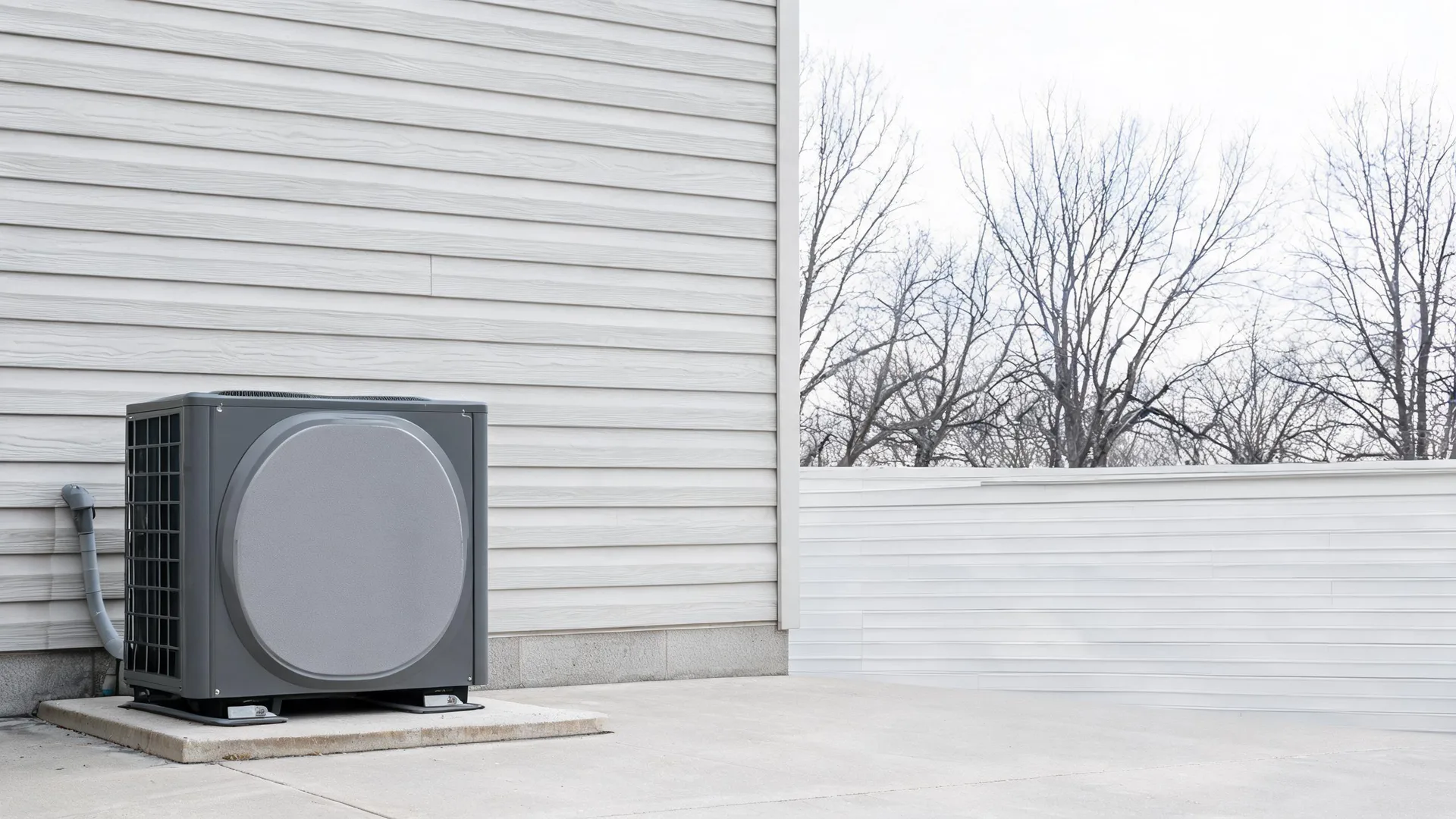
A gray heat pump outdoor unit mounted on a concrete pad next to the stone-accented exterior wall of a house.

Running a bad part doesn't rest it

A heat pump that's struggling doesn't rest just because it keeps running. A reversing valve that's sticking will keep sticking, and every cycle it fails to switch cleanly puts more strain on the compressor, which is the part you don't want to lose. A weak capacitor doesn't recover either. It gets weaker until the compressor can't start at all. Low refrigerant charge works the same way from a different angle. The system keeps running to satisfy the thermostat, the compressor works harder to make up for the missing charge, and heat that should be happening in the coil starts happening in the compressor instead. None of this gets better with runtime. The part that's going bad is going bad whether the system is running or not.

What you can check before anyone comes out

Look at the outdoor unit first. If the coil is packed with leaves or caked in ice outside of a normal defrost cycle, that alone can make a heat pump struggle. Check the thermostat is set to heat and the temperature is actually set above room temperature, since a setting left on the wrong mode after the fall switchover looks exactly like a broken unit. Walk around the house and check that supply vents are open and not blocked by furniture or rugs. Last, check the breaker box. A tripped breaker will shut the whole system down and is worth ruling out before anything else.
What to leave alone

Don't open the outdoor unit's cabinet or touch the wiring inside it. Don't pour water or chip at ice built up on the coil, since that can bend fins or damage the coil itself. If the system is making a new noise, a hard clicking, a hum that doesn't turn into a start, or a buzz from the outdoor unit, turn it off at the thermostat rather than let it keep trying to start. Running a unit that's failing to start can burn out the compressor, and that turns a repair into a replacement.

Most heat pump failures trace back to a handful of parts, and they fail for ordinary reasons. A capacitor loses its charge over years of starting the compressor and the fan motor, and once it's weak the motor struggles to start, hums, or doesn't turn at all. A contactor's contacts pit and burn from years of making and breaking the circuit until the connection gets unreliable. The reversing valve, which is what switches a heat pump between cooling and heating, has a coil that can fail and a valve body that can stick from wear, so it quits moving or gets stuck partway. Refrigerant charge doesn't get used up, but a leak at a fitting or coil will let it drop slowly, and a system low on charge makes the compressor work harder to move the same heat. The outdoor coil itself fails less often, but years of dirt, grass clippings, and dryer lint packed into the fins choke off airflow until the system can't do its job. None of these are mysteries. They're the parts that wear from use, and a tech checking a struggling heat pump usually starts with exactly this list.

A repair and a replacement aren't really being weighed against each other so much as a single part is being weighed against the whole unit. If a tech traces the problem to one component and the rest of the system is holding up fine, fixing that part is the right call almost every time. It's a different question when a unit needs one thing fixed this year and needed something else fixed last year. That pattern means the system as a whole is wearing out, not that it has one problem. A heat pump nearing the end of its life often announces itself this way, through a string of unrelated failures rather than one big breakdown. The compressor is the part that matters most in this decision, since it's the most expensive to replace and the hardest to justify replacing on its own. If the compressor is still healthy and something else has failed, repair almost always makes sense.