Defrost cycles run all winter
Every time frost builds on the outdoor coil, the system switches over to melt it off before it can ice over and shut down.
 I'm done searching
Send the request today and let a heat pump pro reach out to you.
A heat pump that won't start usually means something stopped it on purpose. The system has a safety that shuts it down rather than let it run and get worse, or power isn't reaching it the way it should. New Jersey winters push a heat pump hard, and most homes here back it up with gas, so when it quits in January it's easy to assume the furnace will just take over. It often doesn't catch everything, and a system sitting idle for days isn't doing you any favors on a bill that's already among the higher ones in the country.
There's a thermostat setting worth a quick look, and a breaker worth checking before anything else. Past that, it's not something to keep poking at. Outdoor units here deal with ice, salt air near the coast, and wide temperature swings between seasons, and what shuts one down in Cape May isn't always what shuts one down in Sussex County.
That's where a local contractor matters. Someone who services heat pumps in New Jersey all year, through the muggy summers that run the compressor hard and the winters that lean on the reversing valve and the defrost cycle, has likely already seen what's wrong with yours. They know which failures show up after a hard freeze and which ones show up after a July heat wave, and that means less time spent guessing.
Send the request and you're done with the part that's hard to do alone, which is finding the right person. It goes to one licensed contractor near you, not a handful of companies competing for the job, so your phone isn't the one that gets busy. From there, getting the heat pump running again is their job, not yours.
A heat pump that won't start is usually protecting itself or not getting power. Thermostats lose their settings, breakers trip, and outdoor units ice over when a cold snap hits and the defrost cycle can't keep up. If your home backs up the heat pump with a gas furnace, the system may be sitting idle because it switched over on its own, which can look like a failure when it's working as designed. Check the breaker panel and the thermostat first. If those are fine and the unit still won't run, something inside has told it to stop, and that's not something to leave alone through a cold week. A unit that sits off can let pipes near it freeze or push you onto backup heat you weren't planning to rely on. Catching it now, before the next cold stretch, is easier than catching it after something else fails.


A heat pump starting up is really a short chain of checks, and any broken link stops the whole thing. The control board sends a low-voltage signal out to the compressor, and that signal runs through a fuse that's meant to blow if something downstream is wrong. The reversing valve has to be in the right position before the system commits to heating, and a bad solenoid there can lock the unit out rather than risk running the wrong way. Even with a good signal, the compressor needs a jolt from the run capacitor to actually start turning, and a weak one leaves you with a hum and nothing else. Refrigerant pressure gets watched too, and if it's low, a switch cuts power before anyone sees ice or feels warm air. The indoor and outdoor units also have to agree with each other over a control wire, and a corroded connection there breaks that conversation before it starts. Any one of these stopping the unit looks the same from inside the house: it just won't run.




Your request stays with one local pro.
Get the heat pump repair search off your mind today.
Sending the form costs nothing.


Every time frost builds on the outdoor coil, the system switches over to melt it off before it can ice over and shut down.
Snow piled against the cabinet or ice on the coil blocks airflow, and that's often what trips the unit out until someone clears and resets it.
At 22.48 cents per kilowatt-hour, a heat pump that short-cycles or runs on a stuck backup heater shows up fast on your bill. Fixing a stalled unit now instead of leaving it on emergency heat is what keeps the cost of a cold snap from following you into next month.
EIA-861 2025 statewide residential average

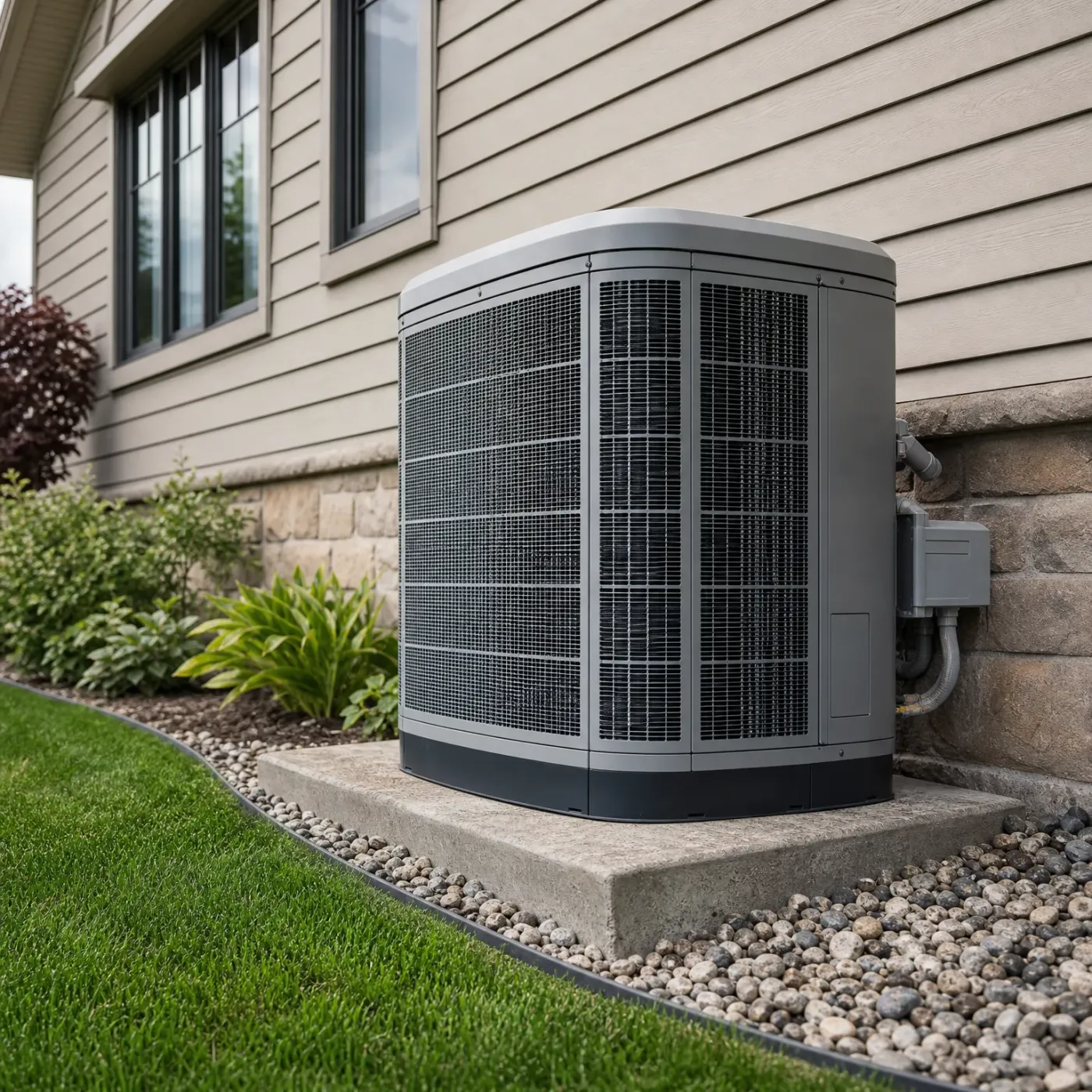
This unit sits on its pad with nothing crowded against it. The rock border and the mulch bed stay back from the cabinet, so air moves through the coil fins and out the top the way the unit was built to pull it. It can run its defrost cycle and shut off clean.

Here the fins are packed with dirt and debris, coat after coat of it. Air can't get through a coil like that, so the unit works harder to move the same amount of heat. That's usually when it trips its safety and won't start back up.
The outdoor unit sits quiet when the thermostat calls for heat. No hum, no fan, nothing. Or it starts, runs a few minutes, then shuts off on its own. Inside, you might feel air coming from the vents that isn't warm, or no air at all. Some homeowners notice the outdoor coil caked in ice that isn't melting off between cycles. Others hear a click from the unit followed by silence, which usually means it's trying to start and can't. If your home leans on the heat pump for most of its heat, a few hours of this is a different problem on a cold night than on a mild one, and it's worth knowing which kind of night you're having before you wait it out.
NOAA puts the summer dew point here at an average of 63°F across June, July and August. That's the sticky, heavy air you already know from July afternoons. For a heat pump, humidity that thick means the outdoor coil works harder to shed heat and moisture at the same time, and the indoor coil stays wetter longer between cycles. If yours is struggling to start or keeps cutting out on a muggy day, that extra load is often what pushes a weak part past its limit. A unit that ran fine in spring can hit trouble once the air gets this heavy.
NASA POWER T2MDEW county cells weighted by homes
Thermostat calls for heat and sends a signal to the control board.
Control board checks safety switches before it starts the compressor.
Compressor and outdoor fan start, and refrigerant begins moving.
Defrost sensor monitors the coil and reverses the cycle if frost builds.


Most of the time, a heat pump that won't start hasn't broken down. Something tripped a switch meant to protect it, or power isn't getting to it the way it needs to. A frozen coil, a tripped breaker, a control board that lost its signal. Each of those has a clear cause, and each one gets cleared the same way: someone who knows the equipment finds the one thing that stopped it and fixes that thing.
Left alone, the unit sits there while your backup heat carries the load, and at New Jersey's electric rates that adds up fast. A delay doesn't make the problem smaller. It just runs the bill higher while the actual fault waits.
That's the gap a local contractor closes. Someone who works on heat pumps all winter in this state has likely already run into your exact symptom, whether it's a unit that hums and never starts or one that shuts off a few minutes in. You're not handed off to a general call center or put on a list for several companies to chase. One licensed contractor takes the job, looks at what your system is actually doing, and gets it sorted.
Once that happens, the heat pump goes back to doing the work it's built for, and the backup heater goes back to being backup. Nothing left running that shouldn't be, nothing quietly costing you more than it needs to.
The pro who reaches out is licensed in New Jersey.