
Repair or replace a heat pump in New Jersey

New system or replacementHeat PumpNew Jersey
Step 1 of 2

What ZIP code is the job in?

Should I repair or replace my heat pump in New Jersey?

Your heat pump is giving you trouble again and you're trying to figure out whether it's worth paying for another repair or if you should just replace it. In New Jersey, that decision matters more than it might elsewhere. The unit has to work hard both directions, pulling humidity out of the air all summer and still pulling its weight on cold nights before the gas furnace or backup heat kicks in.

Repair it if the unit is still under 10 years old and the repair is minor. Replace it if it's older and the compressor or coil is failing.

A heat pump works year round here, not just in summer, so it logs more hours than almost anything else in the house. That shortens how long the big parts last. A compressor or coil failure on a unit that's already seen a decade of New Jersey summers usually isn't worth fixing, since the rest of the system is wearing out at the same pace. A cracked capacitor or a bad contactor on a newer unit is a different story and a straightforward repair. Where you live, electricity is expensive, and an aging heat pump loses efficiency before it quits outright. A licensed contractor who services heat pumps locally can tell you from the compressor's condition and the age on the nameplate which side of that line you're on.

A gray outdoor heat pump unit on a concrete pad beside a house with horizontal lap siding, with a conduit running to a wall-mounted disconnect box and a green shrub to the left.

Still running the way it should

A heat pump that's cycling on and off at normal intervals, keeping the house even, and not running up your power bill more than usual is one worth repairing. Jersey summers are hard on these units, and a unit that's keeping up with that load is doing its job.


An outdoor air conditioning condenser unit with dusty coils sits on a concrete pad against light horizontal siding, with an electrical disconnect box and refrigerant lines on the wall and a shrub and mulch at left.

Struggling to keep up

Heavy grime on the coil, ice forming where it shouldn't, or a unit that runs constantly without catching up are signs of a heat pump losing ground. If it's also pushing your electric bill higher each month, replacement is worth weighing against another repair.

Is your heat pump telling you something right now?

Maybe it's running longer than it used to, or the air coming out doesn't feel as warm as it should on a cold morning. Maybe you've noticed the outdoor unit icing up and not defrosting on its own, or it's making a noise you don't remember from last year, a clicking or a grinding when it kicks on. Your power bill might be higher than it was the same month last year, even though nothing else changed. Short cycling, where it shuts off a few minutes after starting, wears on the compressor and tends to get worse, not better, if it's left alone. If the house feels uneven, some rooms fine and others never quite comfortable, that's worth paying attention to as well.

A gray outdoor condenser unit on a concrete pad beside a house with horizontal lap siding, with a wall-mounted disconnect box, conduit and insulated refrigerant lines, a shrub at left and gravel at right.

Running clean and quiet

The unit sits level on its pad, lines and wiring running neat up the wall to the disconnect. No ice on the coil, no oil spots on the concrete, no rattle when it kicks on. A heat pump that looks like this usually runs the way it should too.

An outdoor air conditioning condenser unit on a concrete pad beside a house with horizontal lap siding, with a green shrub to the left and a wide concrete slab in the foreground.

Worn down and struggling

The pad has shifted, the coil fins are bent, and the unit sounds labored when it starts. Nothing visibly dangerous, but the strain shows. If it's also running longer cycles or tripping its breaker, the outside wear usually matches what's going wrong inside.

A gray-haired man in a dark long-sleeve shirt sits on a gray sofa in a living room, looking toward a sunlit window with sheer curtains.
A gray-haired man in a dark green sweatshirt sits on a sofa in a living room, looking toward a bright window, with a houseplant, lamp, fireplace and framed art behind him.
A gray-haired bearded man in a dark green collared sweater sits on a sofa in a living room with a window, houseplant, floor lamp and bookshelves, looking off to the side.
A gray-haired man in a dark green sweater sits on a sofa in a sunlit living room, looking off to the side, with a framed landscape painting, dining table and shelving behind him.

How a heat pump actually fails

  • A heat pump in defrost mode runs the outdoor fan backward briefly and should return to normal heating within ten minutes.
  • The reversing valve is what switches the system between heating and cooling, and a stuck valve is a common reason a unit blows the wrong temperature air.
  • Refrigerant charge affects both sides of the system, so a low charge shows up as weak heat in January and weak cooling in July.
  • The auxiliary or backup heat strips kick in when outdoor temperatures drop too low for the heat pump alone to keep up, and they pull a lot more power to do it.
  • A failing capacitor often shows up first as the outdoor fan or compressor struggling to start, not as a total shutdown.
  • Ice that builds on the outdoor coil and doesn't clear on its own points to a defrost control or sensor problem, not just cold weather.

A heat pump does two jobs a furnace never has to, and most of what goes wrong traces back to that. It moves heat into the house in January and pulls it out in July, using the same refrigerant loop for both. The reversing valve is what flips the system between those two modes, and when it sticks, you'll feel it right away: cool air blowing in the winter, or warm air in the summer, on a system that otherwise sounds fine. Refrigerant charge matters just as much, because a slow leak doesn't pick a season. It shows up as a unit that struggles to heat the house on a cold morning and struggles just as much to cool it in August.

Cold weather adds another layer. Below a certain outdoor temperature, the heat pump alone can't keep up, so backup heat strips kick in to cover the gap. That's normal, but it's also where New Jersey power bills take a hit, since those strips use far more electricity than the compressor does on its own. Frost on the outdoor coil during a cold snap is normal too, as long as the unit goes into defrost, runs the outdoor fan briefly, and clears itself within about ten minutes. Ice that sits there and doesn't melt means the defrost control or a sensor isn't doing its job. And if the outdoor fan or compressor hesitates before starting, especially on hot start-up, that's often a capacitor on its way out, well before the unit stops running altogether.

A gray outdoor condenser unit sits on a concrete pad against a house wall with horizontal siding above a stone veneer base, with an electrical disconnect box and conduit on the wall and a leafy shrub in mulch to the left.
Condenser clear, pad level, disconnect box mounted clean against the wall.
An outdoor air conditioner condenser unit on a concrete pad beside a house with beige vinyl siding, with a gray electrical disconnect box and insulated refrigerant lines on the wall and river rock to the right.
Clogged fins choke airflow across the coil, and the compressor works harder to move the same heat.
  1. Technician measures refrigerant charge and checks pressures against the manufacturer's chart.

  2. Technician tests the reversing valve by switching the system between heating and cooling.

  3. Technician checks defrost board timing and sensor readings at the outdoor coil.

  4. Technician inspects the compressor's amp draw against its rated load.

An outdoor air conditioner condenser unit on a concrete pad beside a light gray vinyl-sided house, with an electrical disconnect box and conduit on the wall and bare soil in the foreground.
Before you get your heat pump installation
A gray outdoor condenser unit sits on a concrete pad beside a house with horizontal lap siding, with a wall-mounted disconnect box and refrigerant lines, mulched beds and a shrub nearby, and a concrete walkway in the foreground.
After you get your heat pump installation

10 to 15 years

That's the span a heat pump in New Jersey usually covers before repairs start outweighing what it's worth to keep fixing.

Reach a local pro

Two New Jersey winters left

A compressor or reversing valve failure on an older unit often means it makes more sense to replace it than to repair it again.

Reach a local pro
A middle-aged woman with shoulder-length dark hair, wearing a gray cardigan over a cream top, sits in an upholstered armchair and looks toward a sunlit window, with a shelf holding framed pictures and a plant behind her.
A woman and a child wrapped together in a thick knitted blanket on a sofa, both with eyes closed, with a lit table lamp and houseplant in the dim background.

Finding a pro stops being your job

The pro who reaches out is licensed in New Jersey.

No fee to send it, and nothing to sign.

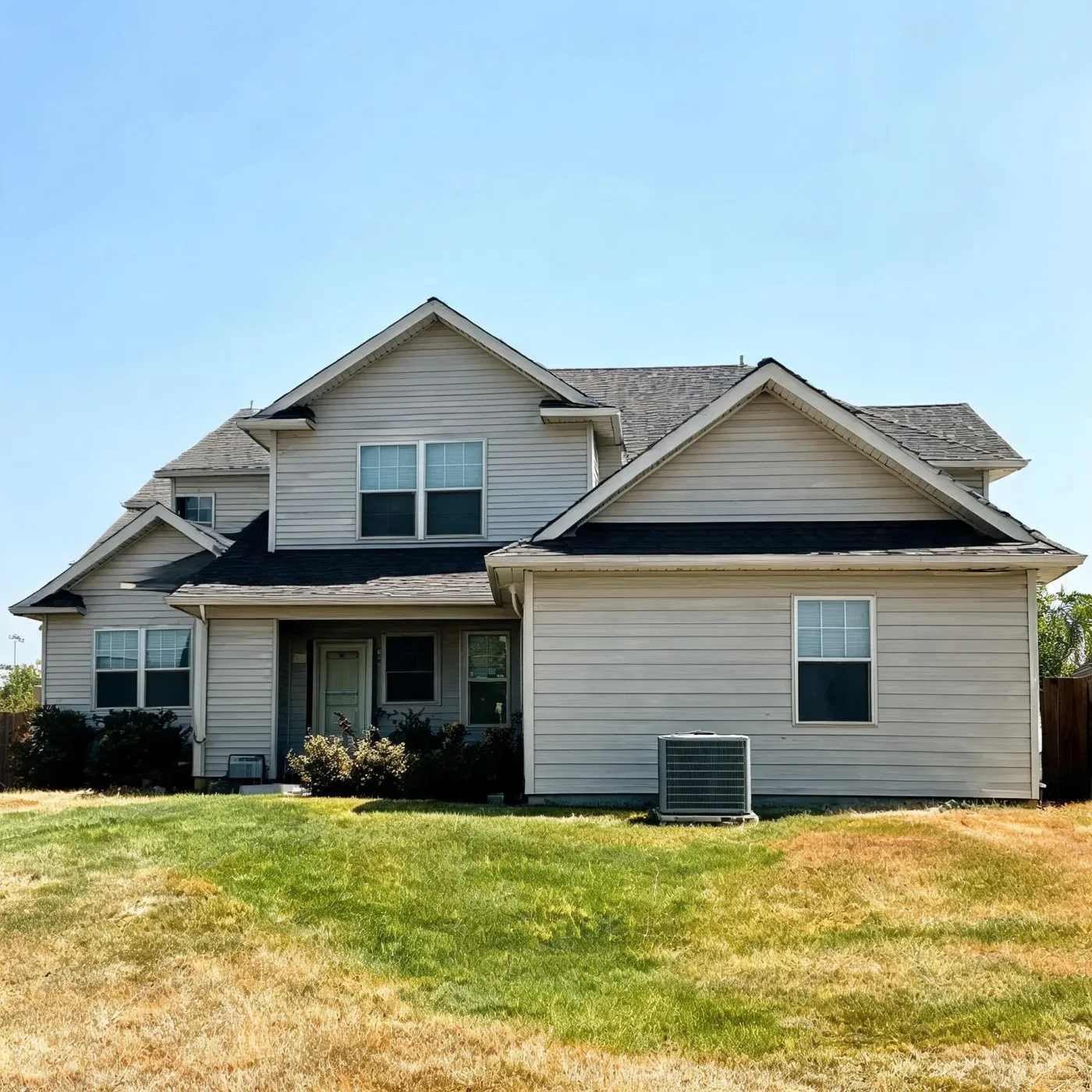
Two-story house with beige horizontal siding, gray shingled gable roofs and a covered front entry, with an outdoor air conditioning unit beside it and a partly dry grass lawn in front under a clear blue sky.

New Jersey summers hold a dew point around 63°F on average through June, July and August, according to NOAA climate data. That's heavy, sticky air, and your heat pump has to pull more moisture out of it than a dry climate would ever ask of it. The coil stays wet longer, the system runs longer to get the humidity down, and if the charge is even a little low, you'll feel it as clammy air at the registers even when the temperature reads fine. A heat pump sized and installed right for that kind of load keeps the house feeling dry. One that isn't will run long hours and still leave the air feeling damp.

NASA POWER T2MDEW county cells weighted by homes

Repair the Unit or Replace the System

Repair

  • A single failed part, like a capacitor or a contactor, is a cheap fix on a unit that's otherwise sound.
  • If the compressor and reversing valve are still good, there's no reason to walk away from the rest of the system.
  • A unit under ten years old has usually got enough life left to make the repair bill worth paying.
  • Parts under manufacturer warranty can bring the cost of a repair down to just the labor.
  • Repairing keeps you on the same refrigerant and the same electrical setup, so there's nothing else to adjust in the house.

Replace

  • A failed compressor on a unit past ten years old usually costs more to replace than the system is worth keeping.
  • A new unit is sized and charged correctly for your house, instead of working around whatever's drifted off over the years.
  • Newer heat pumps hold up better against a New Jersey summer's humidity, pulling moisture out of the air without straining the coil.
  • If you've had more than one repair in the past two years, that pattern tends to continue and get more expensive.
  • A new system comes with a fresh warranty, so you're not paying out of pocket again if something fails in the first few years.
  • With power costs in New Jersey among the highest in the country, a more efficient unit shows up directly in your monthly bill.
A gray outdoor air conditioner condenser unit on a concrete pad beside a house with horizontal siding and an electrical disconnect box, surrounded by grass.

Calling someone in for a repair

A tech comes out, checks the charge, tests the reversing valve, looks at the defrost board. Most of the time the fix is one part and the unit runs another few winters. You already pay more for power than most of the country, so a heat pump that cycles right and holds the house even is worth keeping. There's no case for replacing a system that's doing its job just because it's a few years old.

A white outdoor heat pump unit on a concrete pad beside a house with horizontal lap siding, with a plain light wall and grass lawn to the left.

Calling someone in for a new system

If the compressor's gone or the reversing valve has failed on a unit that's already past 10 years, a tech will usually tell you straight that putting more money into it doesn't make sense. A new heat pump installed correctly, sized right for your house, matched to the ductwork you have, costs you less to run through a Jersey summer and won't leave you without heat in January while parts get ordered.

Power costs 22.48 cents per kilowatt-hour statewide

A heat pump runs on electricity all year, not just in summer, since it handles your heat in winter too. At 22.48 cents a kilowatt-hour, a unit losing efficiency costs you more here than it would almost anywhere else, which makes a tired compressor or a weak capacitor worth fixing fast.

EIA-861 2025 statewide residential average

A heat pump that's cycling normally, keeping the house even, and not spiking your power bill is worth repairing. One that's icing up, running constantly, or needs a new compressor or reversing valve after ten or more winters is telling you it's done. Either way, the fix starts with someone qualified looking at the actual unit outside your house, not a guess made over the phone. Submit a request and you're matched with one licensed New Jersey contractor, not a handful of companies competing for the job, someone who works on heat pumps all summer and all winter in this state and knows what a unit like yours tends to need at this point. They'll check the charge, test the valve, look at the coil, and tell you straight whether it's a part or a replacement. From there, finding that person stops being something you have to manage.

Elevated view over a dark standing-seam metal roof with a stone chimney and wood-sided gable, surrounded by conifers and autumn-colored trees with forested hills under an overcast sky.

Let someone else find the pro

Get one local pro

Sending the form costs nothing.

A heat pump that's struggling through a Jersey summer isn't going to fix itself, and every week spent waiting is a week of your power bill climbing at 22.48 cents a kilowatt-hour. Send the request and let a local contractor who knows these units tell you what's actually wrong.