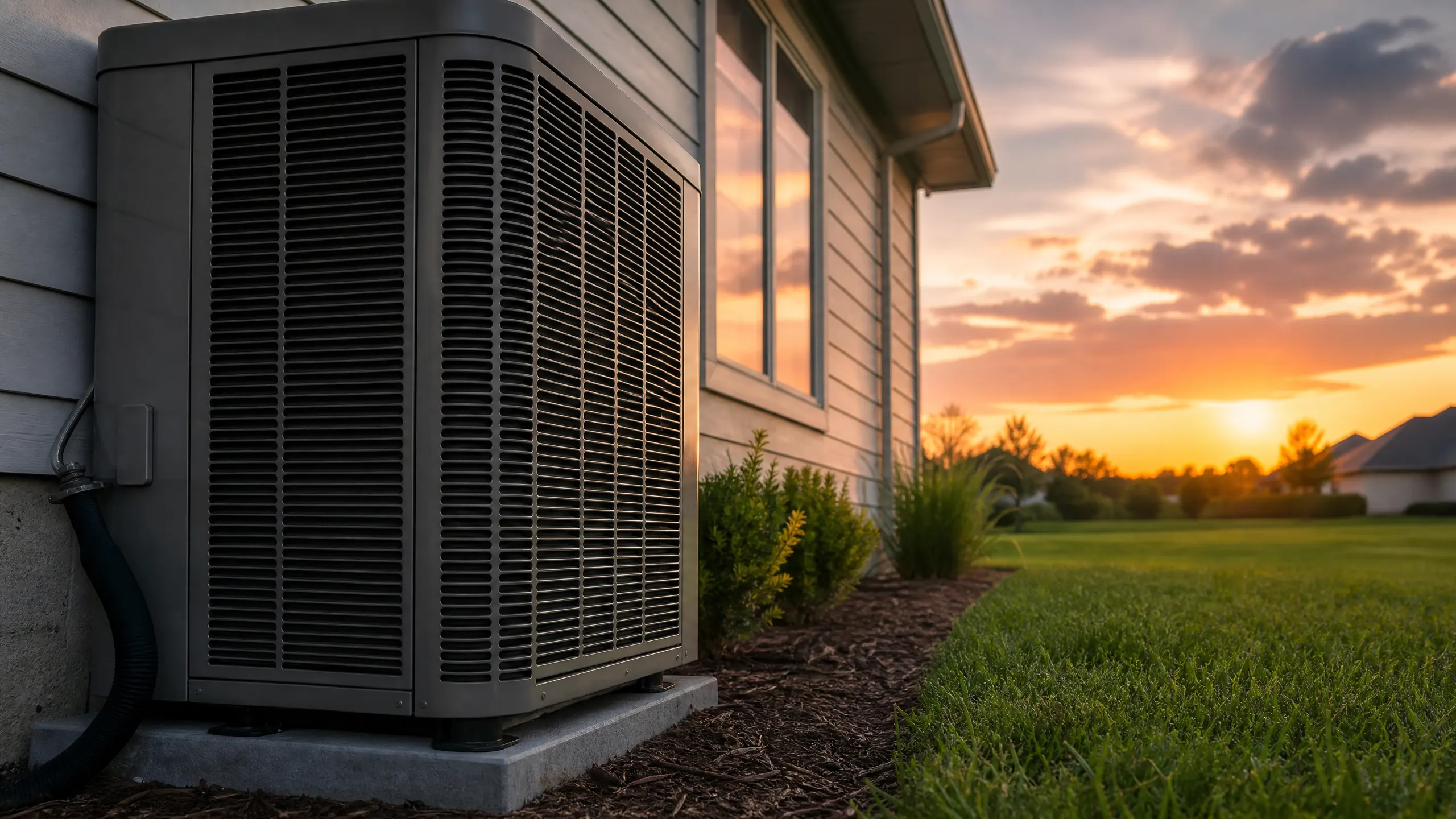







An outdoor air conditioning condenser unit mounted on a concrete pad beside a house at sunset.

Heat Pump Repair in Newark, NJ

Tell us about the job

Takes about a minute. No obligation.

RepairHeat PumpEssex County, NJ
Step 1 of 2

What ZIP code is the job in?

A heat pump that struggles usually shows it in the first cold stretch of October, right after sitting idle all summer. Whatever was already marginal in it, a weak capacitor, a low charge, a reversing valve that sticks, tends to give out once it has to carry the heat. Homes here run heat from October through May, about eight months straight, so a unit that starts the season weak stays weak through most of the winter. A contractor can check the refrigerant charge and the reversing valve in September, before that first cold night, instead of after it fails.

8 months
October through May, your system heats
3 months
June through August, it cools
25°F
the average winter night it heats against
84°F
the average summer afternoon it cools against
Isometric illustration of a cutaway single-story house showing interior ductwork and vents connected to an outdoor condenser unit beside the building, on a white background.
Your system heats October through May and cools June through August.

NOAA nClimDiv, 1991–2020 normals

Newark asks a heat pump to heat and to cool, but neither job runs it into the ground.

A heat pump in decent shape here is usually worth repairing, not replacing.

Half the homes in Essex County date to 1958 or earlier, old enough that the heat pump itself is the question

Half the homes here were built by 1958
61 damaging wind events from 2015 to 2024
36 winter storms from 2015 to 2024
Newark runs this heat pump into real moneyA stuck valve or low charge burns extra power at 19.34 cents a kilowatt-hour, every day it waits.

When a repair tech opens one of these units up, age and wear tell the real story, not the climate. Winters here bring the overnight cold down to 25°F on average, and summers push back the other way, but neither extreme is pulling the system apart. Wind and snow are the bigger threat to anything mounted outside, and the county has seen damaging wind 61 times in the past decade. That argues for a tech checking the outdoor unit itself, the cabinet, the fan blade, the line set, for storm damage or a season of built-up grime, before writing off a problem as something worse. A unit that looks rough on the outside can still have good bones underneath.

A struggling heat pump costs more to run here. Get it checked.

At 19.34 cents a kilowatt-hour, a heat pump that's low on charge or running a stuck reversing valve burns more power to do the same job, every day it's left that way. Have it looked at now.

Find a contractor
A man in a cap, navy T-shirt and brown work pants, seen from behind, carries a worn canvas tool bag up steps toward a dark teal front door beside a potted shrub.
A white mini-split heat pump outdoor unit mounted on a concrete pad beside a gray-sided house, surrounded by gravel and green shrubs.

Left alone, small problems don't stay small

A heat pump that's struggling doesn't fail all at once. A low charge makes the compressor work harder to move the same amount of heat, and that extra strain wears it down faster. A reversing valve that sticks partway tends to stick worse over time, not better, because the same deposits and wear that caused it in the first place keep building. Ice on the outdoor coil shows this clearly. Frost blocks airflow across the coil. The coil gets colder, and colder coils grow frost faster, until the unit can barely pull heat from the air at all. None of that resets when the unit shuts off for the night. It picks up again the next time it runs, a little worse than before.

What you'll actually notice first

The heat comes on but it's not warm, or it runs and runs without catching up to the thermostat setting. Some rooms stay cold while others are fine. The outdoor unit might be caked in ice, or you'll hear it clicking as it tries to switch between heating and cooling and doesn't quite make it. None of these fix themselves.
What those signs tell a tech

Warm air that isn't warm enough usually means the charge is low or the reversing valve isn't sealing right. Short cycling or a unit that won't shut off points to a stuck valve or a failing sensor. Ice that doesn't clear during the defrost cycle means the defrost board, the sensor, or the reversing valve itself isn't doing its job. Each symptom narrows down to a specific part, not a vague tune-up.

Most heat pump failures trace back to a handful of parts, and they fail for reasons that have nothing to do with how cold it gets outside. The reversing valve is usually first. It's what switches the unit between heating and cooling, and the seals inside it wear from being thrown back and forth every time the mode changes. Once it starts sticking, it sticks worse, not better. The run capacitor is another common one. It gives the compressor and fan motors the jolt they need to start, and it weakens gradually until the day it doesn't deliver enough. A low refrigerant charge is different, because it's not wear, it's a leak somewhere in the line set or coil, and it gets worse on its own over time. Defrost board failures show up as ice that never clears, because the board isn't telling the unit when to run its defrost cycle. None of these are tied to a hard freeze or a heat wave. They're wear parts and seals, and they give out on their own schedule.

A diagnostic call starts outside, at the unit itself, before any gauges come out. A tech pulls the cabinet and looks at the coil, the fan blade, and the reversing valve housing, checking for ice, debris, or a valve that's visibly stuck. Next comes the refrigerant charge, checked against the pressures the system is supposed to run at, not just topped off by guess. The capacitor gets tested under load, too, since a weak one can still show voltage sitting idle but fail the moment the compressor tries to start. If the complaint is ice that won't clear, the defrost board and its sensor get checked directly. That's the only way to tell if the board is calling for defrost when it should. Every step points at one part, not a general sense that something's off.