Why your mini split isn't heating in a New Jersey winter

Tell a local repair pro what your mini split is doing.

Get matched

Why isn't my mini split heating my house in winter?

Cold nights here put real weight on a mini split. You want heat moving the second you walk in the door, and when it's blowing cool or barely keeping up, you start to wonder if something's wrong with the unit or if it was just never meant for a New Jersey winter in the first place.

It's likely losing capacity in the cold, or it's low on refrigerant, or the outdoor unit is iced up

Every mini split loses heating capacity as the temperature outside drops, because it pulls heat from the outdoor air to move it inside, and there's less heat out there to grab on a 20 degree night. Most units are sized and rated for exactly this, so a steady drop in output as it gets colder is normal. What isn't normal is a unit that can't keep up at all, blows cold air, or has ice building up on the outdoor coil. That points to low refrigerant, a defrost cycle that isn't completing, or a compressor that's struggling. In a New Jersey winter, with gas heat as the backup most homes have and electricity costing what it does here, a mini split that's underperforming gets expensive fast.

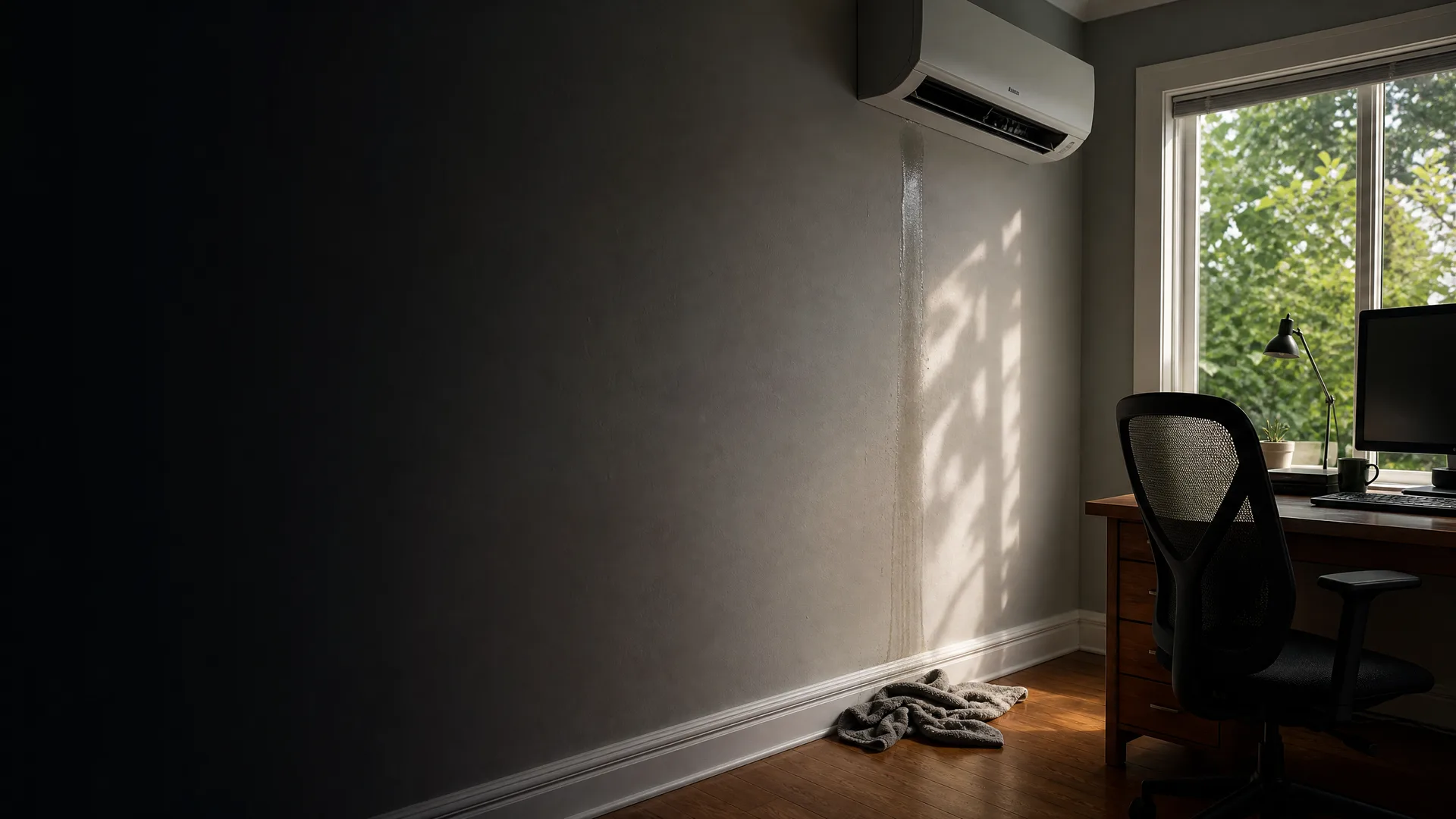
A wall-mounted mini-split air conditioner in a dim room, with a water streak running down the wall below it to a towel on the floor near the baseboard, beside a desk, office chair and monitor by a window.

It's July, and you're at the desk in the home office, trying to get work done before the heat sets in for the afternoon. You notice the carpet feels damp under your chair. Then you see it: a dark streak running down the wall beneath the indoor unit, the paint starting to bubble at the edge of it. You grab a towel from the hall bathroom and lay it on the floor where the water keeps collecting. The unit is still blowing cold air, same as always, like nothing is wrong with it. You stand there for a minute, watching the wall, wondering how long this has been happening behind the drywall before it showed up where you could see it.


A smiling man in an olive T-shirt and jeans stands in an open front doorway holding the door, facing a person in a navy polo and cap seen from behind in the foreground, with horizontal wood-look siding and a potted white flowering plant nearby.

How a mini split makes heat

A mini split doesn't burn anything to make heat. It pulls heat out of the outdoor air, even cold air, using refrigerant, and moves it inside through the line set to the indoor head. That's the reverse cycle, and it's the same refrigerant loop that cools your house in summer, just running backward. Below a certain outdoor temperature the unit has to defrost itself, and you'll see the outdoor fan stop and feel a short pause in heat while it clears frost off the coil. That's normal. What isn't normal is a unit stuck in defrost, a reversing valve that won't switch over, or a refrigerant charge that's too low to pull heat out of cold air at all.

A tech who works on these units all winter in New Jersey knows which of those three it usually is, because the symptoms look alike from the couch but not up close at the outdoor unit. Getting matched with one contractor near you who handles this equipment regularly, instead of sending the same request to several companies, means someone who already knows what tends to go wrong in a New Jersey winter is the one looking at your system.

A dark ceramic vase holding a leafy green branch sits on a round wooden table, with a blurred cushioned wooden armchair, woven basket, window and shelving with pottery in the background.
A white wall-mounted mini-split air conditioner on a light gray wall in an empty room with dark wood flooring, white baseboards, a tray ceiling with recessed lights, and a window at the left.

Keeping up with the cold

The head runs quiet and the air coming out feels warm against your hand. Rooms hold their heat from one cycle to the next. The outdoor unit cycles on, does its work, and shuts off again without you noticing. That's a mini split pulling its weight on a January night in New Jersey.

A wall-mounted mini-split air conditioner indoor unit with a yellowed plastic casing and dark horizontal vent louvers, installed on a plain light-gray wall.

Falling behind

Dust sits thick across the top of the indoor unit, and dark streaks mark the vents where it's been drawing dirty air through for a while. Air comes out lukewarm at best. The outdoor unit runs longer than it used to and the rooms still don't hold heat. That buildup is often part of why.

A woman with long blonde hair in a light blue shirt leans back on a beige sofa with her eyes closed, in a softly lit living room with cushions and a blurred plant and shelf in the background.
A woman with long dark hair in a gray knit sweater sits on a gray sofa with a cushion, looking toward a window in a living room with framed pictures and a lamp in the background.
A woman with long dark hair in a light grey knit sweater sits on a sofa indoors, looking to her right, with a framed landscape picture, a potted plant and a curtained window behind her.
A woman with long dark hair leans back against a gray sofa with her eyes closed, in a living room with a curtained window, a potted plant, and a dark screen in the background.

The right pro for this job

A mini split that won't heat on a January night in New Jersey is usually dealing with one of a short list of problems: a refrigerant leak, a failing defrost cycle, a board that's lost communication with the outdoor unit, or an outdoor coil so iced over it can't pull heat from the air anymore. None of those are things you fix by turning the system off and on again, and running it in that state can push a compressor toward a failure that costs a lot more than the repair would have. Finding which one you've got means someone opening up the outdoor unit and checking it with gauges, not guessing from the thermostat. A local contractor who services mini splits all winter has seen which of these shows up most in this cold, and matching you with one means a single licensed tech looking at your specific unit, not a parade of different companies calling about a job you described once online.

Defrost, charge, and signal

  • The outdoor coil runs a defrost cycle every so often, reversing briefly to melt off frost before switching back to heating.
  • A failed defrost sensor or control board can leave the unit stuck in defrost, or stuck ignoring the frost altogether.
  • Refrigerant charge has to be close to exact, since a mini split in heat mode depends on it to pull heat from air well below freezing.
  • The indoor head reads room temperature at the unit itself, so a head mounted near a cold window can call for heat the room already has.
  • Communication wire between the outdoor unit and indoor head carries the signals that tell the compressor to ramp up or slow down.
  • Below a certain outdoor temperature, most mini splits lean on a backup heat strip or lose capacity, which is normal and not a sign of failure.

Every mini split heating a home through a New Jersey winter has to deal with frost building up on the outdoor coil. The unit handles this on its own, switching briefly into cooling mode to melt the frost off, then switching back. You might notice the outdoor fan stop or see steam rising off the unit. That's normal. What's not normal is a unit stuck in that cycle, or one that never triggers it at all and keeps running with a coil caked in ice. Either points to a defrost sensor or control board that isn't doing its job. Refrigerant charge matters more in heat mode than in cooling, since the system is pulling warmth out of air that might be well below freezing, and even a small loss of charge shows up fast on a cold night. The indoor head adds another variable: it reads the temperature right where it's mounted, so a head near a drafty window can think the room is colder than it is and push the system harder than it needs to run. None of this works without the communication wire running between the indoor head and outdoor unit, carrying the signal that tells the compressor to speed up or ease off. And once the temperature outside drops far enough, most systems shift to a backup heat strip or just put out less heat than usual. That's built into how the equipment works, not a breakdown.

A wall-mounted mini-split air conditioner indoor unit with a dusty, discolored cover, installed near the ceiling on a plain light-colored wall.
Before you get your mini split repair
A white wall-mounted mini-split air conditioner unit installed high on a light gray interior wall below crown molding, with a bamboo-shaded window at the lower left.
After you get your mini split repair

Below about 5 degrees outside, most mini splits lose real heating capacity, and some models add a backup heat strip to cover the gap. If yours doesn't have one, that's the point in the night it starts losing ground.

So a unit that kept the house warm in November can fall behind on the coldest nights of January, and that's not always a sign it's broken. Sometimes it's a sign the defrost cycle or the refrigerant charge needs a closer look.

Power costs 22.48 cents per kilowatt-hour statewide

At 22.48 cents a kilowatt-hour, a mini split stuck running flat out all night to make up for a bad defrost cycle or a low charge shows up fast on your bill. A unit that's struggling isn't just leaving you cold, it's paying full price to do it.

EIA-861 2025 statewide residential average

A mini split that won't heat on a cold New Jersey night usually comes down to one thing: a refrigerant leak, a defrost cycle stuck or ignored, a board that's stopped talking to the outdoor unit, or a coil so iced over it can't pull in heat anymore. None of those get better by waiting. The unit will keep running, keep pulling power at New Jersey rates, and keep falling short while the house gets colder around it. A licensed contractor who works on these systems all winter can look at the outdoor unit, check the charge, and tell you which of those it is. From there you're looking at a repair, not a guessing game. Once it's fixed, the unit goes back to doing what it did before, pulling heat out of the cold air outside and moving it in through the line set, quietly, without you needing to think about it again until next winter.

An older woman with grey-blonde hair in an updo and a beige turtleneck sweater smiles while looking to the side in a warmly lit kitchen, with a round loaf of bread on the counter in front of her and a dark window showing snow outside.
A woman holds a sleeping boy wrapped in a gray knit blanket on a couch, with a lit table lamp and houseplant blurred in the background.

Mini Split Repair

Matched to your mini split job

Your request goes to one pro, not a list of companies.

A black smartphone standing upright against a plain light gray background, its screen filled with solid green.
RepairMini-splitNew Jersey
Step 1 of 2

What ZIP code is the job in?