What emergency heat means on a New Jersey heat pump
Describe what your heat pump is doing once, in one form.
The thermostat says "emergency heat" and your heat pump has switched to it on its own, or you flipped it there yourself because the house felt cold. Either way, you want to know what that setting actually does before you leave it running on a New Jersey electric bill.
Emergency heat means the heat pump has stopped trying to pull warmth from the outside air and the backup heat strip is doing the work instead. That backup heat draws a lot more power than the heat pump does. Power in New Jersey already costs more than in most of the country, so a system stuck on emergency heat for days will show up on the next bill.
If the setting kicked on by itself, something is wrong with the heat pump side of the system, usually the outdoor unit. That's a repair, not a setting to adjust and forget. Left alone through a cold stretch, you're paying for backup heat the whole time while the actual problem sits there.
Finding someone to look at it is its own chore. You'd normally be searching for heat pump contractors near you, calling a few, explaining the same symptoms each time, then waiting on quotes to compare before you even know who's showing up. Submit a request here and that part is done. It goes to one licensed contractor local to New Jersey, someone who works on heat pumps all season and has a good idea what sends a system into emergency heat before they even pull up to the house. No flood of calls from competing companies, no repeating yourself. Just the one contractor, and the actual repair to get the heat pump running the way it's supposed to.
Why did my heat pump switch to emergency heat?
The thermostat says "emergency heat" and your heat pump has switched to it on its own, or you flipped it there yourself because the house felt cold. Either way, you want to know what that setting actually does before you leave it running on a New Jersey electric bill.
It means the heat pump stopped and backup electric heat took over
Emergency heat shuts off the heat pump's outdoor unit entirely and runs the backup heat strips instead. A heat pump switches to it on its own when something stops the outdoor unit from working, often a frozen coil that won't defrost or a system that senses it can't pull heat from the outside air. Some homeowners flip it manually during a cold snap, thinking it helps, but it just means the outdoor unit isn't running at all. Those backup strips are electric resistance heat, the most expensive way to heat a house, and with New Jersey electric rates what they are, running on emergency heat for more than a short stretch shows up fast on the bill. It's meant to get you through until the outdoor unit is fixed, not to replace it.
Emergency Heat vs. Auxiliary Heat
Emergency heat
This setting locks out the compressor entirely and runs the backup heat strips or furnace as the only source of heat.
It costs more to run because electric resistance heat draws far more power than the heat pump does to produce the same warmth.
It's meant to carry the house for a short stretch while the heat pump itself is down, not to run through a cold snap.
Power here is expensive, so leaving it on emergency heat for days adds up fast on the bill.
Nothing about this setting fixes what made the heat pump stop working in the first place.
Auxiliary heat
This kicks in on its own, alongside the heat pump, when outdoor temperatures drop low enough that the heat pump can't keep up by itself.
You'll see it light up on cold mornings or during a hard freeze, then shut off once the heat pump can carry the load again.
It uses the same backup strips or furnace as emergency heat, but only as a supplement, not a replacement.
Seeing it come on now and then in winter is normal and doesn't mean anything is wrong with the system.
If it's running constantly rather than in short bursts, that points to the heat pump losing capacity, not the cold outside doing it.
The heat pump running as it should
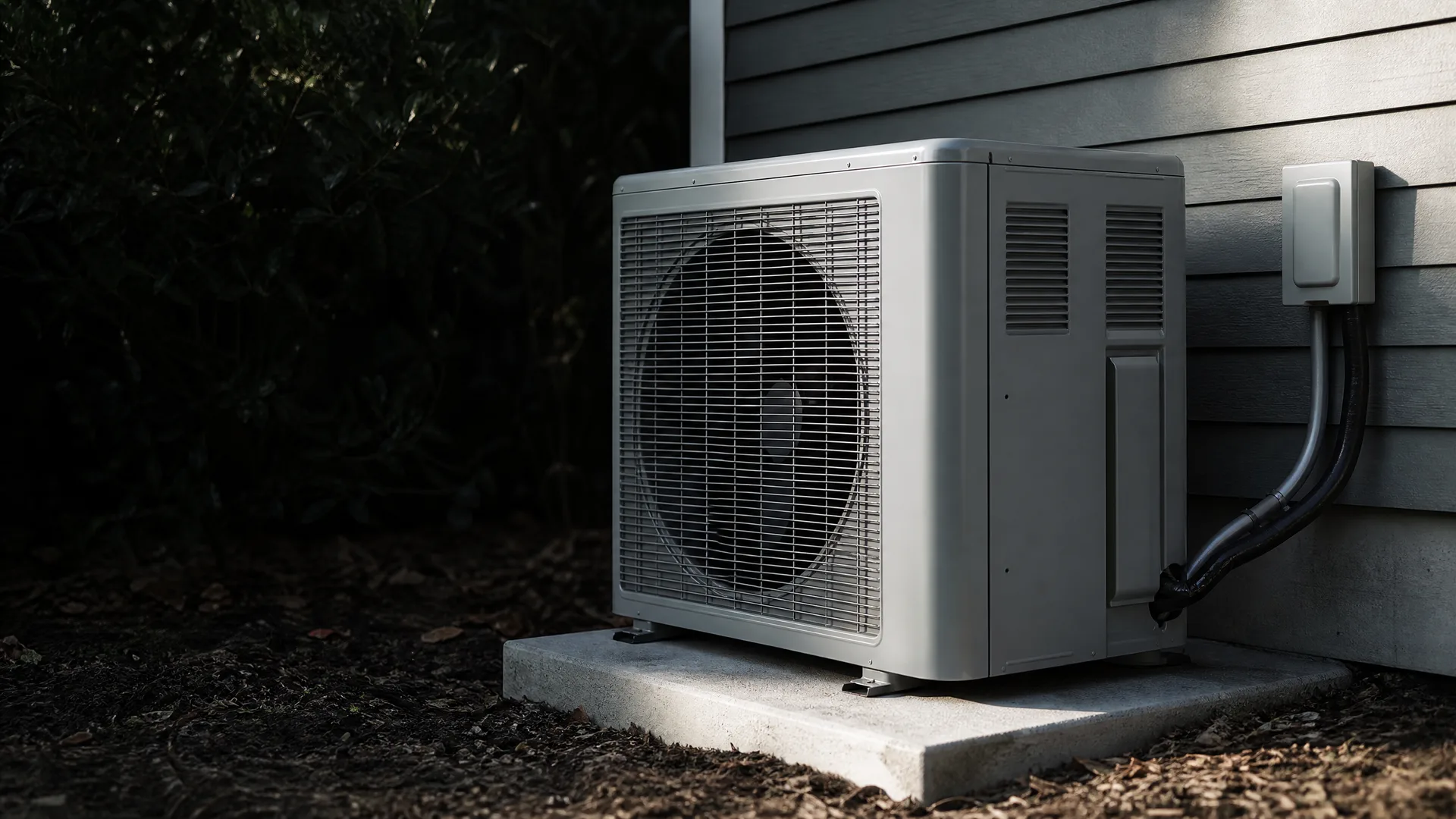
This is a heat pump moving heat the way it's built to, drawing from the air outside and sending it into the house without the backup strips kicking in. The lines and conduit stay intact, the pad stays clear, and nothing forces the system into its expensive backup mode.
The heat pump in trouble
Grime like this on the grille and top panel blocks airflow across the coil, and a coil that can't move air can't pull in enough heat to keep up on a cold night. That's often what pushes the thermostat into emergency heat on its own, and it will keep happening until someone clears what's choking it.
Running on emergency heat for days gets expensive fast
If your heat pump has been stuck on emergency heat for more than a day, check your electric bill before you check anything else. Electric resistance heat pulls far more power than the compressor does, and power in New Jersey isn't cheap. A house that heats fine on emergency mode in January can still rack up a bill nobody wants to pay in March, which is usually the first sign something's wrong and not just a thermostat switched by accident.
The other thing at risk is time. Heat pumps that stay locked in backup mode usually have a reason, a frozen coil, a dead sensor, a compressor that won't start, and that reason doesn't fix itself. Instead of calling around to find someone who actually works on heat pumps and not just furnaces, explaining the same problem to three different companies, and sorting through quotes that don't mean much without seeing the unit, you get matched with one licensed contractor near you who services this equipment all year and knows what tends to fail first.
New Jersey summers run humid. Averaged across homes statewide, NOAA puts the summer dew point at 63°F for June, July and August. That kind of moisture load keeps your heat pump's compressor working through most of the afternoon and evening to pull the damp out of the air, which is normal and not a sign of trouble by itself. What matters is what happens when that same system is asked to switch roles and heat the house in January. A unit that's been running hard all summer and has a weak capacitor or a low charge going into winter is more likely to trip into emergency heat when the cold hits it hardest. If you're searching around for someone to look at it, this page connects you to one licensed New Jersey contractor who works on heat pumps in this climate all year, rather than leaving you to call several companies and explain the same problem each time.
A heat pump stuck on emergency heat usually means something has failed outside: a frozen coil that isn't defrosting, a compressor that won't start, a reversing valve stuck in the wrong position. None of that is something to leave alone while the backup strips carry the house on New Jersey electric rates. Finding someone who works on heat pumps specifically, rather than furnaces alone, takes some calling around. A contractor who services this equipment all year, through the humid stretch when the compressor runs for hours and through the cold snaps that test the defrost cycle, has likely already seen whatever tripped yours into backup mode. Send the request once and it goes to one licensed local contractor, not five companies competing for the job, so you're not stuck fielding calls and repeating the same description of what the thermostat is doing. That part gets handled so you can get back to the actual problem, which is a heat pump that needs to run on the compressor again, not the strips.
The defrost cycle and why it matters
Your heat pump pulls heat from outside air even when it's cold, but below freezing the outdoor coil picks up frost. Every so often the system reverses itself for a few minutes, melts that frost, then switches back. You might see steam coming off the outdoor unit during this and think something's wrong. It isn't. If the coil stays frosted and the defrost cycle never kicks in or never finishes, that's often what pushes the system into emergency heat on its own.
What a tripped breaker tells you
The backup heat strips draw a lot of current, enough that they sit on their own breaker separate from the heat pump itself. If that breaker trips, the strips stop producing heat even while the thermostat still shows emergency heat selected. A furnace used as backup instead of strips has its own ignition system and venting, and a problem there, a failed igniter or a blocked vent, will stop it the same way without the thermostat knowing.
Why does the house feel different since this switched on
You probably noticed the house running warm but your bill climbing, or the outdoor unit sitting quiet with frost on it while heat still comes through the vents. Maybe the air coming out feels different, less warm than the heat pump normally delivers, because strip heat or a furnace is carrying the whole load now instead of just helping out on the coldest nights. If the outdoor unit has been off for days and nobody's looked at it, whatever tripped it over to emergency heat is still broken. It won't fix itself, and the longer it runs this way, the more it costs you to heat the same rooms.
A heat pump like this is still drawing from the outside air and sending it in through the ducts, with the outdoor coil clean and clear of frost.
A coil caked with dust and debris like this can't shed heat properly, and that's often what pushes a system into emergency heat to begin with.
Power costs 22.48 cents per kilowatt-hour statewide
At 22.48 cents per kilowatt-hour, every hour your heat pump runs on emergency heat instead of the compressor shows up fast on your bill. Those electric strips pull a lot more current than the compressor needs to heat the same house, so a stuck system costs you more the longer it's left running that way.
EIA-861 2025 statewide residential average
It's just past seven on a January morning, still dark enough that the porch light is doing the work. You're in the side yard in your coat because you heard the vents running warm all night and wanted to see the unit for yourself. It's not running. It's not even humming. The whole cabinet is wrapped in ice, thick over the coil fins and down across the lines, a crust of it on the pad underneath where water refroze overnight. No fan turning. No steam off a defrost cycle, nothing melting. Just the unit sitting there under a skin of ice while the house stays warm on electric heat alone, and your breath fogging as you look at it.
Emergency heat is a stopgap, not a fix. It keeps the house warm while the real problem, a frozen coil, a dead compressor, a reversing valve stuck in place, sits outside waiting on someone to find it. That part of the job takes a technician who knows heat pumps specifically, not just furnaces, since most homes around you heat with gas and plenty of contractors rarely see this equipment. The match made for you is local and licensed, someone who works on heat pumps all winter in New Jersey and has a good idea what's wrong before they even get the panel off. You'll hear from one contractor, not a handful of companies competing for the callback, and you won't need to explain the frost on the coil or the strips running nonstop more than once. Once it's fixed, the compressor goes back to doing the work it's built for, and the house stops running up your electric bill to stay warm.