Profile view of a bearded man wearing a dark green baseball cap and a dark gray T-shirt against a plain light background.

Should you cover your AC unit in a New Jersey winter

Tune-up, service, or cleaningCentral ACNew Jersey
Step 1 of 2

What ZIP code is the job in?

Should I cover my AC unit for the winter in NJ?

New Jersey winters bring snow, ice, and months of a condenser unit sitting outside doing nothing while the furnace runs. It seems like it should have some kind of protection, and a lot of homeowners wonder whether leaving it exposed all winter is asking for trouble.

No, and a full cover can cause more harm than leaving it bare

Your outdoor unit is built to sit outside in every season, including the ice and snow New Jersey gets from December through March. A full cover traps moisture against the coil and the cabinet, and that moisture encourages rust and gives mice and other small animals a dry place to nest over the winter. Either one can mean a repair call in the spring that a bare unit wouldn't have needed. If you want to protect it, a flat piece of plywood or a small cover sized just for the top works better than something that wraps the whole cabinet, since it keeps heavy snow and ice off the fan without sealing in moisture.

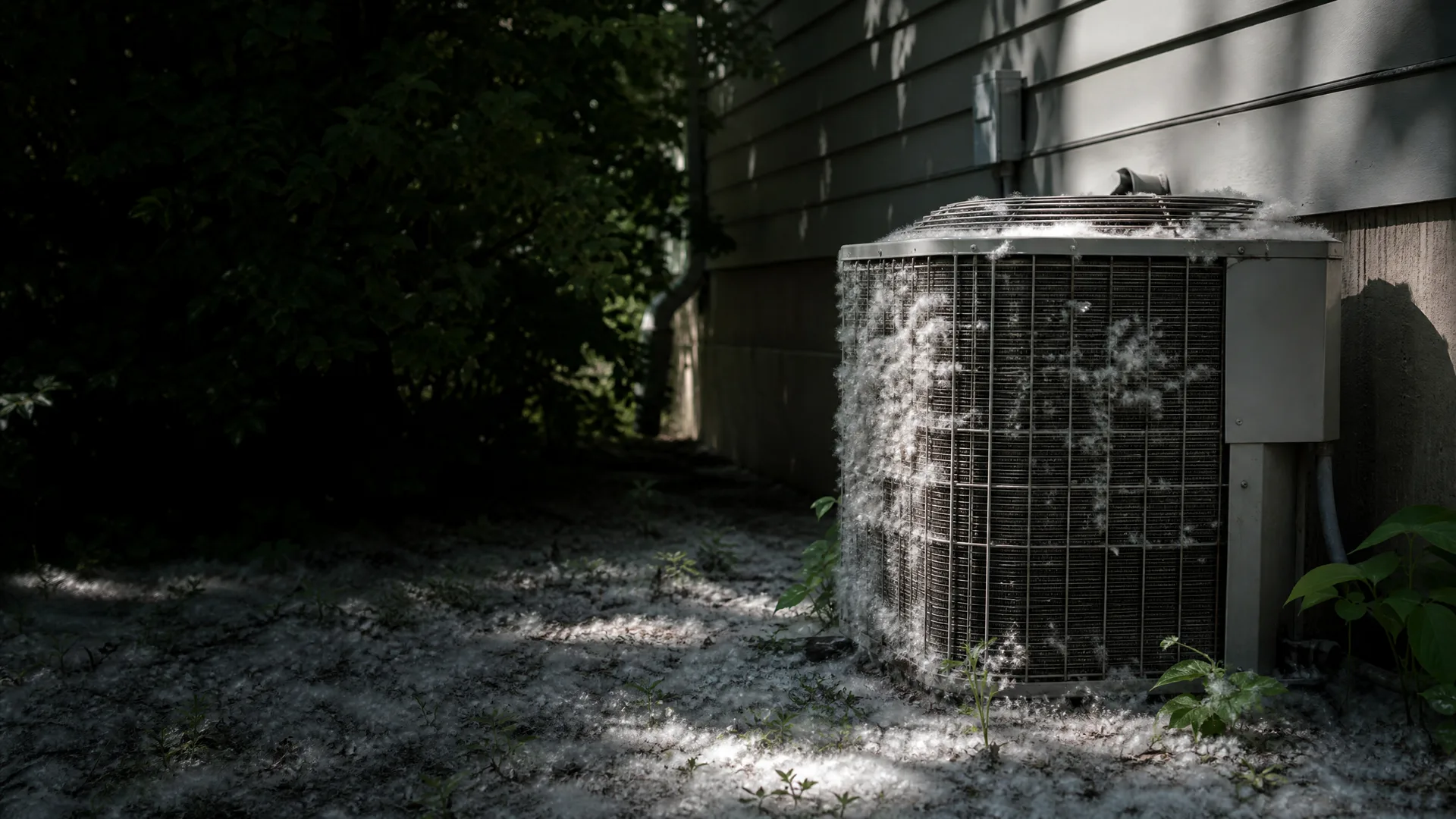
An outdoor air conditioner condenser unit beside a house with horizontal siding, its coil covered in white cottonwood fluff that also blankets the ground around it.

You're out checking the yard in late May, grass already needing a second cut this week, when you walk past the condenser and see the fins packed with white fluff. The cottonwoods have been dropping it for days, and it's caught in the coils like snow that won't melt. You didn't think about this unit all winter. No cover, no issue, just sitting there while the furnace carried the house through January. Now summer's close, the AC will need to run most days, and this is the first sign it's been sitting outside through every season since last fall. You make a mental note to clear it before the heat really sets in.

An outdoor air conditioner condenser unit on a concrete pad beside a house with beige horizontal siding and a stone-veneer base, with refrigerant lines running to a gray wall-mounted electrical box, surrounded by dark mulch, a flowering shrub and an evergreen on the left.
Left bare, the unit sits open to the weather, and nothing about that stops it from running fine come April.
An outdoor air conditioning condenser unit on a concrete pad beside a house with light vinyl siding, an electrical disconnect box and conduit on the wall, bare shrubs and mulch to the right, and a concrete walkway in the foreground.
A full winter cover trapped against the cabinet holds moisture against the coil and gives mice a dry place to nest.

What Actually Needs Covering

  • A condenser is built to sit outside all year, with a cabinet and coil rated for rain, snow, and ice directly on it.
  • The top panel over the fan motor is the one spot worth shielding, since falling ice or icicles off a roofline can bend the fan blades.
  • A flat piece of plywood or a rigid top cover laid loose over the unit keeps debris out without sealing the sides shut.
  • Mice and chipmunks look for tight, dry spaces once it gets cold, and a snug cover against the cabinet is exactly that.
  • Running the condenser isn't a winter risk, since the system stays off until the thermostat calls for cooling again.
  • Leaves and grass clippings packed around the base hold water against the cabinet longer than open air ever would.

The cabinet and coil on your condenser are made to take rain, snow, and ice directly, every winter, for as long as the unit lasts. Nobody in New Jersey wraps the whole thing and that's not an oversight. The part that actually benefits from a shield is the top, where the fan motor sits. If you've got a roofline above the unit, icicles or sliding ice can land on that panel and bend the fan blades underneath. A piece of plywood or a rigid top cover, just laid on top and not strapped down tight, handles that without sealing off the sides. The sides need to stay open. Closed up, the cabinet holds in moisture, and a tight cover is also just what a mouse or chipmunk is looking for once the cold sets in, a dry spot out of the wind. They'll chew into insulation and wiring if they get in. Leaves and grass clippings do a version of the same thing if they build up around the base, holding water against the metal long after open air would have dried it out. So the fall cleanup around the unit matters more than any cover does. As for the unit itself running or not, that's not a winter concern at all. It sits idle until the thermostat calls for cooling again in spring, and nothing about sitting idle in the cold damages it.

An outdoor air conditioner condenser unit on a concrete pad beside a house with light horizontal lap siding, with an electrical disconnect box and conduit on the wall behind it.
Before you get your air conditioner maintenance
An outdoor air conditioning condenser unit on a concrete pad beside a house with white horizontal lap siding, with an electrical disconnect box and insulated refrigerant line on the wall and a shrub over mulch to the right.
After you get your air conditioner maintenance

An air conditioner pro near you

A condenser left alone through a Jersey winter is not the problem. What usually brings on a service call come spring is something nobody thought to check in November, a capacitor that was already weak, a contactor pitted from last summer's heavy use, a refrigerant leak that's been slow all along. Snow on the cabinet doesn't cause any of that. A cover won't either way. What catches those things before the first hot week is someone who knows what a condenser looks like when it's about to fail versus when it's fine, and that's not something you work out by staring at it in your driveway. If you want that answer before summer gets sticky again, a local contractor can look at the unit, tell you what shape it's really in, and handle whatever winter did or didn't do to it. Send the request and that part stops being something you have to figure out yourself.

An outdoor air conditioner condenser unit on a concrete pad beside a house wall, with a gray electrical disconnect box and conduit above it and grass in the foreground.

What the coil is rated for

The coil and cabinet on a condenser are built from materials meant to sit outside through rain, snow, and ice without a cover. Manufacturers test them that way before they ever leave the factory. Road salt and ice buildup near the base are the bigger concern in New Jersey, not the snow sitting on top of the unit. Keeping the area around the base clear matters more than anything draped over it.

A gray outdoor air conditioner condenser unit on a concrete pad beside a house with horizontal lap siding, surrounded by white gravel and a lawn, with a white wall at left.

Why spring problems start in fall

A unit that won't start in April usually had a weak part last August that nobody caught. Capacitors lose strength with heat and age, and a summer of heavy runtime takes more out of one than a winter of sitting idle. Checking the electrical parts before the system shuts down for the year catches that weakness while there's still time to replace a part, instead of finding out on the first hot day when the whole house is waiting on it.

What does your condenser look like right now

Walk out back and look at it. If someone threw a tarp or a fitted cover over it last fall, pull it off and check underneath. You might find the cabinet damp, with a slight musty smell, and maybe a few leaves or acorns tucked in near the base where something's been nesting. If it's been sitting uncovered, it probably just looks like it did in October, maybe a little road salt spray on the side facing the driveway. Either way, the thing to check before summer isn't the cover. It's whether anything's been resting against the fan blades or packed into the coil, since that's what actually stops a unit from running right when you need it in July.

A woman in a cream cowl-neck sweater sits by a window with snow outside, in a dimly lit living room with a sofa, lit lamp, mirror, candles and a fireplace.
A woman in a gray turtleneck sweater sits beside a large window looking out at snow-covered evergreen trees, in a dimly lit living room with a lit fireplace, lamps, couch and houseplant.
A woman in a cream turtleneck sweater stands beside a large window with snow-covered ground and bare trees outside, in a dimly lit living room with lamps, a sofa and framed art.
A woman in a grey cowl-neck sweater stands indoors near a window, looking out at falling snow, with a lamp, framed picture and couch in the warmly lit room behind her.
A man in a dark blue shirt stands in an open front doorway of a stucco and wood-clad house, facing a blond woman seen from behind in the foreground on a stone walkway.

What a full cover costs you in spring

If the unit has been wrapped tight since November, you won't know what's wrong with it until it's warm enough to need it. That's usually the first hot week, when everyone else in New Jersey is also calling for service and a stuck contactor or a weak capacitor turns into a few days without cooling instead of an afternoon.

A top panel left on through the winter is a different story. It took the brunt of whatever came off the roof and the rest of the unit got to breathe. If you're not sure which kind you've got out there, or whether the inside of that cabinet is in the shape it should be before summer, a contractor can look it over and tell you what it needs before the heat sets in.

A living room corner with a beige sofa and cushion, a round wooden coffee table holding a pale ceramic vase of eucalyptus stems and a wooden bowl, and a curtained window with a potted plant above a latticed radiator cover in the background.
A two-story house with light beige horizontal siding, a gabled roof, a small covered front porch with dark door, and shrubs along the foundation, set behind a mown lawn and wet sidewalk with large leafy trees on both sides.

New Jersey summers run humid, with the dew point averaging 63°F across June, July and August, according to NOAA climate data. That's the kind of air that feels heavy just standing in the yard, and it's what your condenser is built to pull moisture out of all summer, running long hours to do it. A unit that's been sitting under a tight cover since November, with damp trapped against the coil, is starting that first humid week already behind. The cover didn't protect it from summer. It just gave it a rougher start.

NASA POWER T2MDEW county cells weighted by homes

A bearded man in a blue and brown plaid flannel shirt stands indoors looking out a window at snow-covered trees, with a ceramic mug on the windowsill.
A man in a blue T-shirt sits on a light gray sofa, laughing while looking at an open laptop in the foreground, with a framed picture, lamp and potted plant behind him.
A gray outdoor air conditioner condenser unit on a concrete pad beside a house with white horizontal siding and a brick foundation, with a wall-mounted disconnect box and conduit, and a green shrub with mulch at left.

Left uncovered

This is what a condenser is supposed to look like in January. Bare cabinet, clean grille, conduit and lines running up to the disconnect same as they do in July. Nothing about sitting open through snow or a hard frost does it any harm. Come April, it starts the same way it stopped.

An outdoor air conditioning condenser unit on a concrete pad beside a house with white horizontal vinyl siding, with a gray electrical disconnect box and refrigerant lines on the wall behind it.

Wrapped and neglected

This is what shows up under a cover left on since November. Grime worked into the grille, a top cover holding dirt and damp against the cabinet instead of shedding it. A tight cover doesn't keep a unit clean. It gives moisture somewhere to sit all winter, and you won't see what it did until spring.

Power costs 22.48 cents per kilowatt-hour statewide

At 22.48 cents per kilowatt-hour, running your air conditioner here costs more than it does almost anywhere else in the country. That makes a unit working harder than it should, because of a dirty coil or a weak capacitor, something you feel on the bill fast. Skipping a winter cover doesn't change that. Catching those problems before summer does.

EIA-861 2025 statewide residential average

Leave the cover off. Your condenser is built to sit outside through a New Jersey winter without one, snow and ice included. A top panel over the fan is worth a piece of plywood if you're worried about icicles off the roof, and that's the whole list. Nothing about January hurts this unit. What hurts it is a weak capacitor or a dirty coil that was already a problem last August, sitting there unfixed until the first hot week in May when you turn the system on and nothing happens, same as every other condenser in the state waking up at once. A maintenance visit now checks the parts that actually fail, not the ones a cover would have protected anyway. Once you send the request, that part is off your plate. Someone who handles this for a living takes it from there, and you go back to not thinking about the unit in the yard until it's warm enough to need it, which is the whole point of checking it now instead of then.

Interior room corner with sunlight from a window, showing peeling paint and damaged plaster on the wall above a white baseboard, a wooden cabinet with a pale bowl on top, hardwood floor and a patterned rug.
Interior corner of a room with tan walls, white profiled baseboard and window trim, a wood-plank floor in sunlight, and green foliage visible through the window.
An empty room corner with cream walls, white baseboard, two windows with deep sills showing green foliage outside, and a wood plank floor lit by sunlight.
Empty room corner with beige walls, white beadboard wainscoting, chair rail and baseboard, a window with green foliage outside, and sunlight casting leaf shadows on the wall above a wood floor.
Sunlit room corner with a multi-pane window, beige walls, white baseboard, wood floor with a woven rug, and a dark wooden cabinet holding a ceramic table lamp below a framed picture.

A local pro for your air conditioner maintenance

Send the form, and lining up the air conditioner tune-up stops being yours to chase.

Match me with a pro

Sending the form costs nothing.





















