Electricity here runs 19.34 cents per kilowatthour
New Jersey's electric rates are higher than most of the country, and a mini split draws power every time it cycles on. That rate applies whether the system is efficient or not.
Takes about a minute. No obligation.
New Jersey's electric rates are higher than most of the country, and a mini split draws power every time it cycles on. That rate applies whether the system is efficient or not.
You can't change what the utility charges. You can choose a system that uses less to do the same job, and in Vineland that difference shows up on every bill, not just the first one.
NOAA nClimDiv, 1991–2020 normals
Every quote should list the condenser and the indoor head by model number, not just the brand.
The model numbers are how you check the rated output matches the room it's heating and cooling, instead of taking someone's word for it.




Half the homes in Cumberland County were built in 1969 or earlier. A house that age wasn't built with a mini split in mind. The walls, the window placement, the room sizes all came first, and the line set and the wall bracket have to work with what's already there. An indoor head sized for a new-construction bedroom may not be right for a room that was added on later, or a porch closed in at some point after the house went up. Whoever quotes the job should be sizing it to the room you have, not a standard one.
Cumberland County is zone 4A. Any mini split installed here has to meet the federal minimum for that zone. That's 14.3 SEER2 for cooling and 7.5 HSPF2 for heating. A system that clears that floor also qualifies for the federal tax credit on heat pump installations. Ask for the model numbers so you can check what's being quoted against that standard.
Find a contractorAsk whoever quotes the job to measure the room before they give you a model number. The square footage, the ceiling height and how many windows a room has all change what size head it needs. A house from 1969 or earlier wasn't built to a standard plan the way newer developments were, so two bedrooms that look the same size on paper can call for different equipment once someone measures.
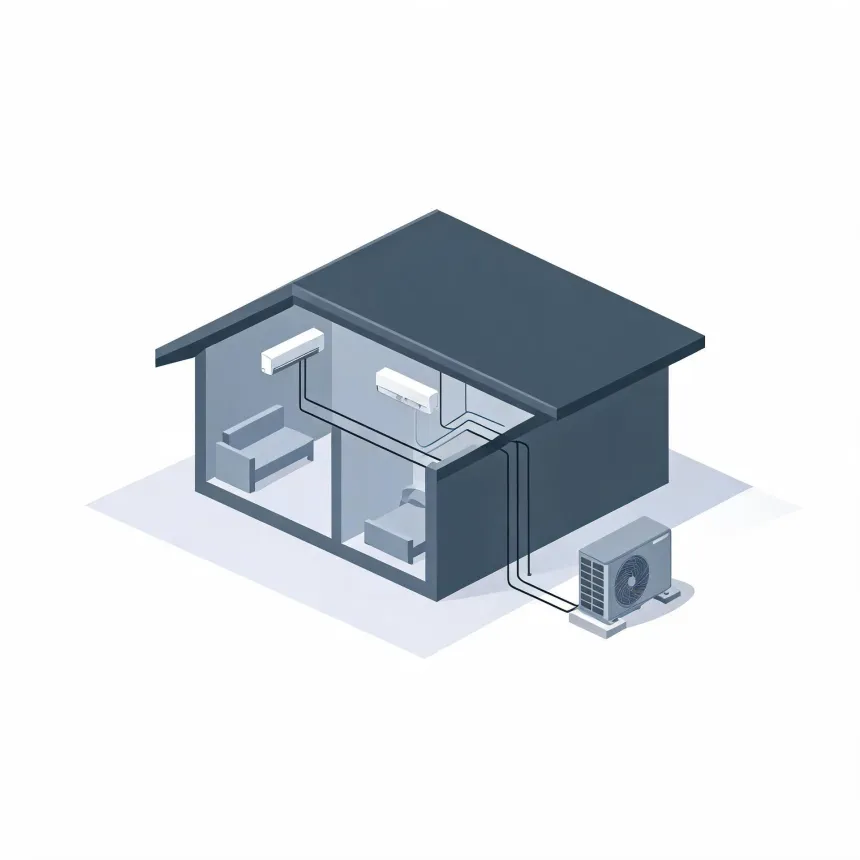
A single room needs one indoor head and one line set run. Add a second or third zone and the outdoor condenser has to be sized for all of them at once, with separate refrigerant lines run to each head. More zones means more line hiding, more wall penetrations, and a bigger outdoor unit to drive them all.
The outdoor condenser needs clear airflow on all sides and a path back to each indoor head that doesn't fight gravity or run further than the system allows. A wall that backs up to the right spot keeps the line set short. One that doesn't means more line hiding, more labor, and a longer job either way.
The SEER2 and HSPF2 numbers on the label tell you how much electricity the system uses to produce cooling or heat, nothing about how big a space it can handle. A high rating on an undersized or oversized unit still wastes power, because the rating only describes the equipment, not the match between the equipment and the room. The cooling rating and the heating rating are separate figures, since a mini split is doing different jobs with different cycles, and a unit can be strong at one and average at the other. A higher rating generally means the compressor can slow down and run at partial output instead of switching fully on and off, and that's what actually cuts electricity use over the season. None of that shows up as its own line on the label, so the rating is a starting point for comparing models, not the whole answer to what a system will cost to run.
Installation starts with the outdoor condenser and the indoor head going up, but most of the day goes into the line set between them. That line set carries the refrigerant lines, a condensate drain and electrical wiring through a wall penetration, and it has to be routed, insulated and sealed before anyone turns the system on. Once the lines are run, the system gets evacuated with a vacuum pump to pull out moisture and air. Any left behind will cut efficiency and can damage the compressor over time. Only after it holds vacuum does the installer release the refrigerant charge and check it against the line length, since longer runs need more charge than the factory amount. Then comes testing. The installer checks the temperature split at the indoor head, confirms the condensate drains properly, and watches the system cycle on and off before calling the job done. A clean installation means no shortcuts on the vacuum or the charge, even though both happen out of sight once the covers go back on.