A two-story brick house with black shutters and a covered porch stands on a mown lawn behind large deciduous trees, with a dry-stacked stone wall running across the foreground.

Mini Split Installation in Trenton, NJ

Tell us about the job

Takes about a minute. No obligation.

New system or replacementMini-splitMercer County, NJ
Step 1 of 2

What ZIP code is the job in?

Electricity here runs 19.34 cents a kilowatthour

New Jersey's electric rates sit well above the national average. A mini split that runs efficiently matters more here than it would in a state with cheaper power, because every kilowatthour it uses or saves shows up bigger on the bill.

Efficiency is a spec you can compare

Mini splits carry a SEER2 rating, and the higher it is, the less power the unit draws to do the same job. In Trenton, where the rate per kilowatthour runs high, that rating is worth checking closely against the other systems you're comparing.

7 months
October through April, your system heats
4 months
June through September, it cools
26°F
the average winter night it heats against
85°F
the average summer afternoon it cools against
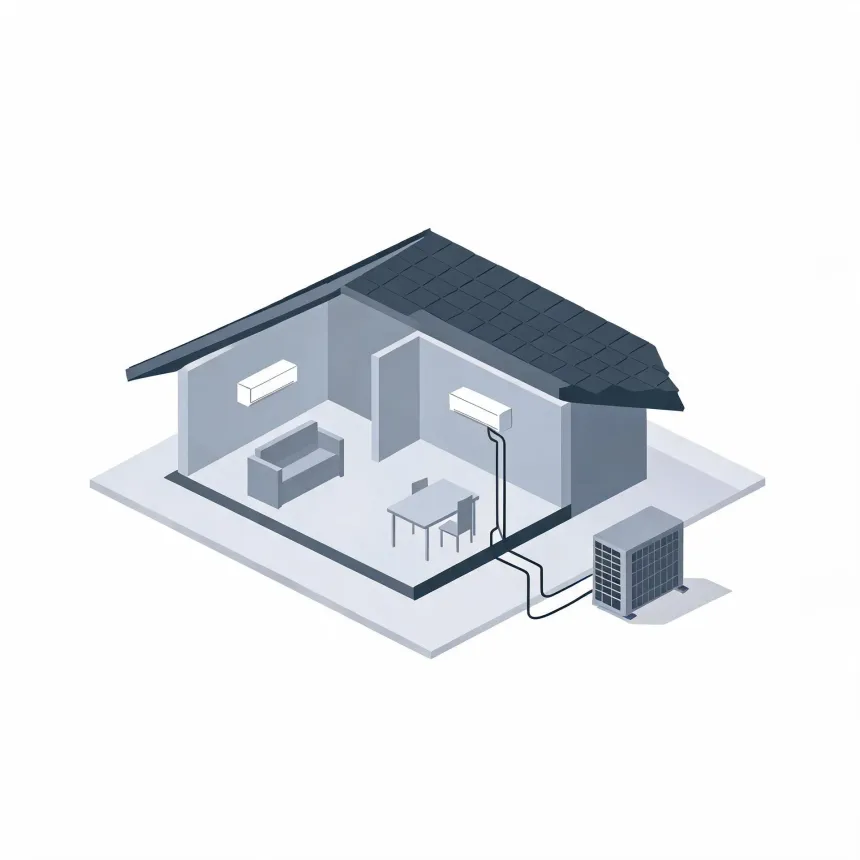
Isometric illustration of a cutaway house interior with sofa, table and chair, two wall-mounted indoor air conditioning units connected by lines to an outdoor condenser unit beside the building.
Your system heats October through April and cools June through September.

NOAA nClimDiv, 1991–2020 normals

In Trenton, cooling runs June through September.

A mini split installed in May is ready before the first hot week, not in the middle of it.

Summers here call for nothing more than a standard mini split

Cooling runs June through September
Summer afternoons average 85°F
112 damaging wind events from 2015 to 2024
Trenton homes run older than mostHalf the homes in Mercer County were built in 1969 or earlier.

Mercer County is in zone 5A, a cool climate where heating is the bigger job over the year. Any mini split installed here has to meet the federal minimum for that equipment, 14.3 SEER2 for cooling and 7.5 HSPF2 for heating. That rule applies whether the heat pump is ducted or ductless. It's a floor, not a ceiling. A unit rated above it costs less to run, through the cooling months and the longer heating stretch after. A mini split that meets this standard can also qualify for the federal tax credit on heat pump equipment. Check the specific model's rating before you decide.

Most Mercer County homes heat with gas. A mini split adds to that, it doesn't replace it.

Gas heats 71.3 percent of homes in Mercer County, the most of any fuel here. A mini split doesn't replace that system, it works alongside it, handling cooling in summer and taking some of the load off the furnace in the shoulder months. Comparing models now means you know going in how it fits with what's already heating the house.

Find a contractor
A man in a cap, dark t-shirt and tan work pants walks up steps toward a dark teal front door carrying a canvas tool bag, with a planter of greenery beside the porch.
A white mini-split air conditioner outdoor condenser unit mounted on metal brackets against a beige stucco exterior wall, with a blue sky and scattered clouds in the background.

Plan the install around the house you have

Half the homes in Trenton were built in 1969 or earlier. That doesn't tell a contractor what's behind your walls, but it does mean the install needs a look before it's scheduled, not after. Where the line set runs, where the condenser sits outside, what wall gives a clean path in. If your system came with the house, that's worth mentioning when you compare contractors, so the one you pick plans the install around your house instead of a standard one.

How many zones you're cooling and heating

A single indoor head handles one room or one open area. Add bedrooms, a finished basement, a converted attic, and you're adding indoor heads, which means a bigger outdoor unit to run them and more labor to mount and connect each one. The install is priced per zone because the work scales that way, not because the sales quote says so.

Where the line set has to travel

The outdoor condenser connects to each indoor head through a line set, and that line runs through a wall, sometimes up through a floor or along an exterior wall to reach a spot that makes sense outside. A short, direct run costs less than one that has to go through brick, around framing, or up multiple stories. The harder the path, the more time it takes to run it clean.

The SEER2 and HSPF2 numbers on the label are what one unit costs to run next to another, nothing more. A higher SEER2 means the compressor moves the same heat using less electricity on a hot afternoon. A higher HSPF2 does the same for heating. Neither number tells you what size unit you need or how many zones it can carry, that's a separate question about the space itself. Mini splits rated for the same room can carry different numbers on that label, and the one rated higher will draw less power doing the identical job, season after season. Set the models you're comparing side by side and read that number before anything else on the spec sheet.

Install day starts outside, mounting the bracket that holds the outdoor condenser, then running the line set through the wall to each indoor head. That line carries refrigerant, so once it's connected, the contractor pulls a vacuum on the system to clear out air and moisture before any charge goes in. Skip that step and the compressor is working against moisture it shouldn't have to, which shortens its life. Each indoor head needs a condensate line too, a small drain that carries off the water the unit pulls out of the air, and that line has to run somewhere with an actual slope so it drains instead of backing up. Once everything's connected, the system gets charged, tested on both heating and cooling, and checked zone by zone before anyone calls it done. None of this is fast work if it's done right, and the wall it goes through matters as much as the unit itself.