




White colonial-style houses with lit windows photographed at dusk along a tree-lined street.

Mini Split Installation in Point Pleasant, NJ

Tell us about the job

Takes about a minute. No obligation.

New system or replacementMini-splitOcean County, NJ
Step 1 of 2

What ZIP code is the job in?

Electricity in New Jersey ran 19.34 cents per kilowatthour in 2024, well above what most states pay. A mini split earns that cost back through how it delivers heating and cooling, since it moves heat instead of generating it, using less power per degree than a furnace or a window unit. That difference shows up every month on the bill, not just in summer or winter but in both. The efficiency rating on the unit you choose matters more here than it would somewhere power is cheap. A system sized and installed correctly for the space will hold that advantage for as long as you run it.

8 months
October through May, your system heats
4 months
June through September, it cools
27°F
the average winter night it heats against
84°F
the average summer afternoon it cools against
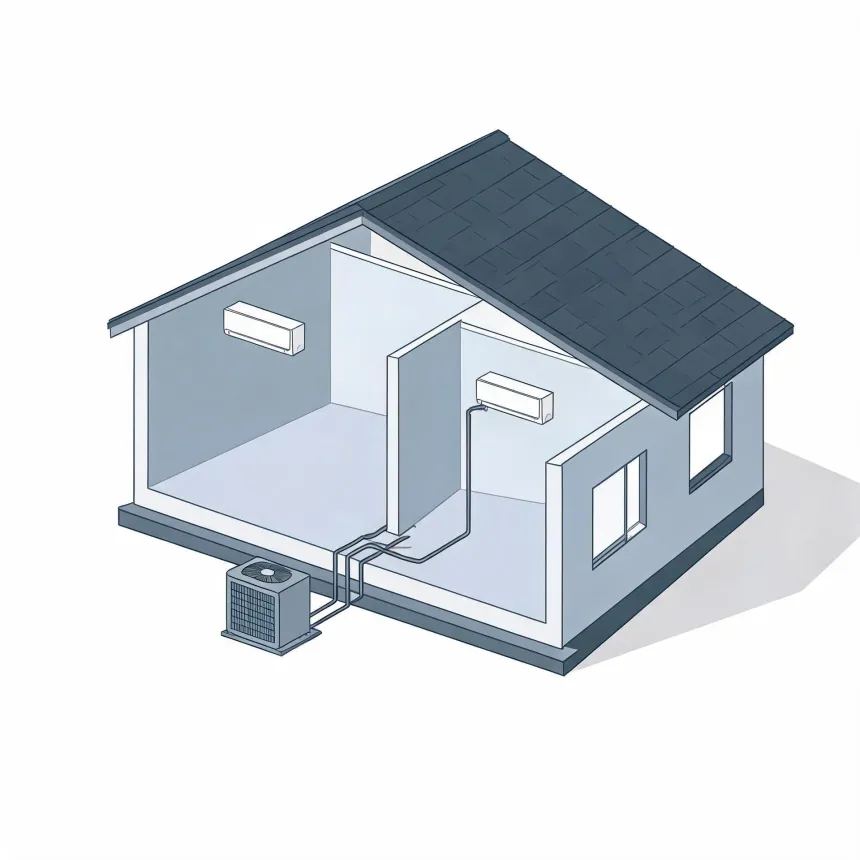
Isometric cutaway illustration of a small house with a dark shingled roof, showing two wall-mounted indoor units connected by lines running to an outdoor condenser unit beside the building.
Your system heats October through May and cools June through September.

NOAA nClimDiv, 1991–2020 normals

Point Pleasant sees its share of wind, hail and winter storms, but none of that changes what a mini split needs to run well here.

A correctly sized system, installed to spec, is what earns back that New Jersey power rate. Nothing about this county asks for more than that.

Cooling starts in June here. Get it installed in May, before the heat does.

Cooling runs June through September
Summer afternoons average 84°F
278 damaging wind events from 2015 to 2024

Gas heats 78.3% of homes in Ocean County, more than any other fuel, and electricity accounts for most of the rest. In a gas-heated house, a mini split isn't replacing the furnace. It's handling cooling and picking up the shoulder months, spring and fall, when running the furnace is more than the house needs. In a home that already heats with electricity, a mini split can take on more of the winter load itself, since it moves heat rather than generating it the way a baseboard or electric furnace does. Either way, knowing what's already heating the house tells you what job the mini split is actually there to do.

Any system installed here has to meet zone 4A's efficiency minimum

Ocean County falls in climate zone 4A, which asks real work of both heating and cooling here. Any mini split installed now has to clear the federal minimum for that job, 14.3 SEER2 for cooling and 7.5 HSPF2 for heating. That floor is what limits which units belong on this page.

Find a contractor
A white mini-split air conditioner outdoor condenser unit mounted on metal brackets against a beige stucco exterior wall, with a blue sky and scattered clouds in the background.

The label is a ceiling, not a guarantee

The rating on the label is measured new, in a lab, with clean coils and a full charge. What it hands you is a ceiling, not a promise. A mini split holds closer to that number when the filter gets cleaned and the outdoor coil stays clear of leaves and dust, because dirt on either one makes the compressor work harder to move the same heat. The rating also assumes the right match between indoor head and outdoor unit, and the right size for the space. A unit too big for the room cycles on and off instead of running the long steady stretch the rating was measured on. Buy for the rating, but keep it with upkeep, because the number on the label is only ever the best that unit can do.

Every zone adds a line item

A mini split system prices out by how many indoor heads it runs, not just the outdoor unit. A single zone covering an open layout costs less than several heads split across separate rooms. Each indoor unit needs its own line set run to the outdoor condenser, and that line set has to be sized correctly, cut, brazed, pressure tested and vacuumed down before it ever gets charged with refrigerant. More heads means more of that work, and more places for a bad joint to cost you a leak later.
Where the outdoor unit sits changes the labor

A condenser mounted at ground level near the wall it serves is a straightforward run. One mounted on a roof, or serving a room on the far side of the house, means a longer line set, more wall penetrations, and in some cases a lift to get the unit into place. The electrical whip from the breaker panel to the disconnect adds to that too. None of this shows up on the unit's spec sheet, but it shows up in how long the install takes and what it takes to do it right.

Sizing a mini split comes down to how much heat the space gains and loses, not how big the room looks. That number comes from a load calculation, which weighs square footage against window area, insulation, ceiling height and how many walls face outside. A contractor measures the room rather than guessing from a chart, because rooms that look alike on paper can carry very different loads depending on what surrounds them. Oversize the unit and it cools the air fast, shuts off, and leaves the room clammy since it never runs long enough to pull moisture out. Undersize it and the compressor runs constantly, straining to hold a temperature it can't quite reach. The right size runs longer, steadier cycles, and that's what keeps both comfort and the equipment itself where they should be.

Installation day starts outside, not in. The crew mounts the outdoor unit on a pad or brackets, runs the line set through a wall penetration, and that hole gets sealed and insulated before anything else happens. Inside, each indoor head mounts to a bracket on the wall, level and clear of obstructions, with its own line running back out to the condenser. Once everything's connected, the whole system gets pressure tested to check for leaks at every joint, then pulled down to a vacuum to clear out air and moisture before refrigerant ever goes in. Only after it holds that vacuum does the system get charged and powered up. The last part of the day is running it, in both modes, checking that each head is pulling the temperature down and holding it, not just blowing air.