Electricity here runs 19.34 cents a kilowatthour
New Jersey's electric rates sit above the national average, and a mini split that holds its efficiency rating earns that back every month it runs.
Takes about a minute. No obligation.
New Jersey's electric rates sit above the national average, and a mini split that holds its efficiency rating earns that back every month it runs.
When you're pricing units for Paterson, put the SEER2 rating next to the price tag. A higher rating costs more upfront but uses less power for the same heating and cooling, and at these rates that difference shows up on the bill.
NOAA nClimDiv, 1991–2020 normals
Gas heats 81.4% of homes in Passaic County.
A mini split works alongside that furnace, taking over the months a furnace runs least efficiently.



A mini split's SEER2 rating only means something if the installer gets the sizing and setup right. An oversized unit cycles on and off instead of running steady, and that costs you the efficiency you paid for. The same goes for a bad line set run or a refrigerant charge that's off from spec. None of that shows up on the spec sheet, it shows up on the bill a few months in. Ask whoever quotes the job how they size it for the room, not just the square footage.
Cooling starts in June here. Get a mini split in during May and the sizing, the line set, the charge, all of it gets done without a heat wave pushing the schedule.
Find a contractor
Half the homes in Passaic County were built in 1956 or earlier. A house that age wasn't built with a mini split in mind, so whatever heating and cooling is in there now was probably added or swapped out well after the house went up. That history matters for a new install. The installer has to work with the walls, the layout and the electrical panel as they actually are, not as a spec sheet assumes. Sizing the unit to the room, not just the square footage, matters more here than it would in a house built around the system from the start.
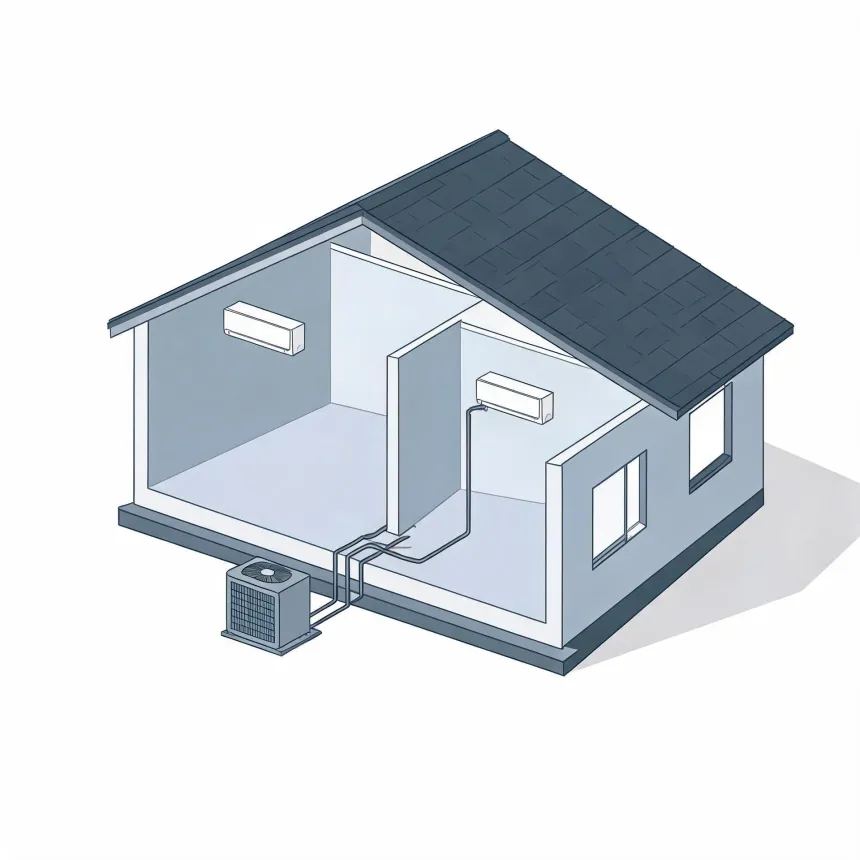
If a window unit or baseboard heat is what's running now, a mini split install can usually happen alongside it with no demolition. The indoor head mounts on the wall, the line set runs through a small hole to the outdoor unit, and the old system keeps working until it's disconnected on its own schedule.
Pulling an old furnace or boiler out means capping gas lines, dealing with existing ductwork or hot water piping, and patching wherever the old equipment was vented. That work has to happen before the mini split install can be called finished, not after.
The SEER2 number on the label comes from a lab test run at a fixed temperature, with the unit holding steady. Your mini split doesn't run that way. It ramps up hard on the worst afternoons, idles when the room barely needs it, and cycles on and off the rest of the time. So the rating is a fair way to compare one unit against another sitting next to it in a showroom. It isn't a promise about what you'll see once it's on your wall. Sizing and setup decide how close you get to that number, which is why the label is a starting point and not the whole story.
Installation starts with a survey, not a drill. The installer walks each room, checks where the outdoor unit can sit, and figures out how the line set gets from one to the other with the fewest bends. Once that's set, the indoor head goes up first. A small hole goes through the wall, and the mounting plate gets leveled and secured to a stud. The line set, a refrigerant line, a drain line and the electrical wiring all run through that one hole and connect to the outdoor unit. After that, the system gets evacuated to pull out moisture and air before any refrigerant moves through the lines. Charging it comes last, and the installer checks that charge against the line length, not just the number on the unit's spec sheet.