




A white wall-mounted split air conditioning unit in a dimly lit modern room, with a full moon visible through the window at night.

Mini Split Installation in Ocean City, NJ

Tell us about the job

Takes about a minute. No obligation.

New system or replacementMini-splitCape May County, NJ
Step 1 of 2

What ZIP code is the job in?

New Jersey homes paid 19.34 cents per kilowatt-hour in 2024, well above what most of the country pays. A mini split runs on electricity, so that rate applies every time it cycles on. The efficiency of the unit you choose matters more here than it would somewhere with cheaper power. A higher SEER2 rating means less electricity for the same cooling or heating, and at these rates that difference shows up on the bill month after month. Sizing matters too. A system too big or too small for the space ends up cycling more than it should, and more cycling means more of that 19.34 cents spent.

7 months
October through April, your system heats
4 months
June through September, it cools
29°F
the average winter night it heats against
83°F
the average summer afternoon it cools against
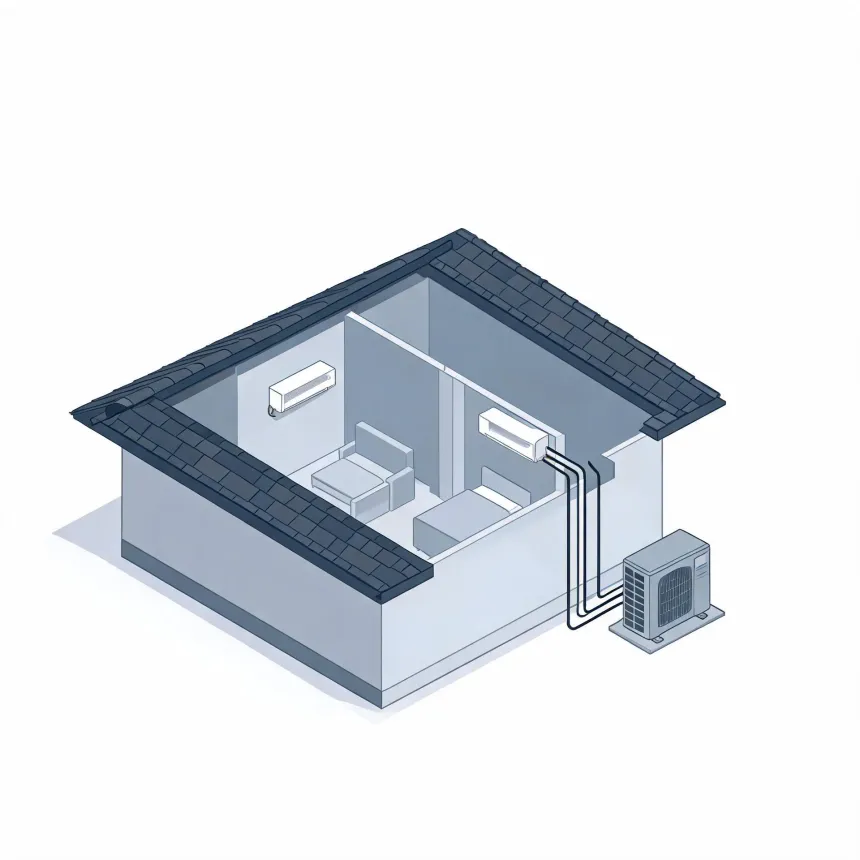
Isometric illustration of a cutaway house with tiled roof showing two wall-mounted indoor mini-split units connected by line sets to an outdoor condenser beside the building.
Your system heats October through April and cools June through September.

NOAA nClimDiv, 1991–2020 normals

Cooling in Ocean City runs June through September.

Install before May ends and the new system is ready on day one instead of mid-breakdown.

Four months of summer here call for a correctly sized system, not a bigger one

Cooling runs June through September
Summer afternoons average 83°F
96 damaging wind events from 2015 to 2024

Cape May County is zone 4A, a climate that asks real work of both heating and cooling. Any mini split installed new here has to meet the federal minimum for a split-system heat pump. That means 14.3 SEER2 for cooling and 7.5 HSPF2 for heating, and the standard makes no exception for ductless systems. A unit that clears that bar can also qualify for the federal tax credit on heat pump installations. Worth checking the paperwork on that against what you're quoted.

Get the mini split sized right before summer gets here

Most homes in Cape May County heat with gas, not electricity. A mini split runs on electricity alone, so putting one in here means adding a system that works differently from what most of your neighbors have. That's not a problem, but it's a reason to get the sizing right from the start, since there's no gas furnace to fall back on if the mini split doesn't fit the space.

Find a contractor
A man in a cap, gray long-sleeve shirt and brown work pants carries a canvas tool bag up porch steps toward a dark blue front door.
A beige split-system air conditioner outdoor condenser unit mounted on metal wall brackets atop a stucco wall.

The install work costs more than the unit does

What drives the cost of putting one in has more to do with the work than the equipment. Running the line set and the wiring between the outdoor unit and each indoor head takes time, and that time goes up with distance and with walls in the way. Every indoor head needs its own line set, its own drain, and its own spot on a wall or ceiling that can take the weight and let air move freely. A single-zone system is a simpler job than a multi-zone system with heads in several rooms, because each extra zone means another run, another mounting point, and another connection back to the outdoor unit. Where that outdoor unit can go matters too. It needs clearance on all sides and a path for condensate to drain, and a tricky spot to mount it adds labor the equipment cost never shows. Electrical work is its own piece. A dedicated circuit sized for the unit has to reach the outdoor condenser, and if the panel doesn't have room or the wiring run is long, that adds its own cost before the mini split itself ever turns on.

Cooling and heating get separate ratings

A mini split heat pump lists a cooling rating and a heating rating, because it does both jobs and can be strong at one without being strong at the other. A system with a great cooling number can still be an average performer in the cold months. If heating matters in your house, look at the heating rating on its own instead of judging the whole unit by the cooling number.
The rating comes from a lab, not your living room

The efficiency number on a mini split is measured under test conditions, not inside your actual walls. The unit reaches that number when it's sized correctly for the room and installed to the manufacturer's spec, with the line set and refrigerant charge done right. The same equipment installed wrong will run below its rated efficiency no matter what the label says.

Ask what the quote actually includes, not just the model number. Contractors can propose the same indoor and outdoor units and still hand you different jobs, because the equipment is only part of it. Ask how many indoor heads the system needs to support, now and with any room you might add later. Ask who handles the line set, the drain, and the electrical, and whether permits and inspection are part of the price or billed separately. Ask about the warranty on the compressor versus the warranty on the labor, since those often run on different terms and come from different places. A quote that's vague on any of this is harder to compare, no matter how good the unit itself is.

Install day starts with the outdoor unit and the indoor heads going in, then the line set run between them carrying refrigerant lines, a power cable, and a condensate drain through a single hole in the wall. That hole gets sealed once the lines are through, so weather doesn't follow them in. The line set gets connected, then pulled down to a vacuum to clear out air and moisture before any refrigerant moves through it. Skip that step or rush it and moisture stays in the lines, which wears on the compressor long after the crew is gone. Once the vacuum holds, the system gets charged, the indoor heads get mounted level and tested for airflow in every direction they're meant to cover, and the whole system runs through both a cooling cycle and a heating cycle before anyone calls it done. A mini split that's installed right gets tested the same day it goes in, not left for you to find out whether it works.