A gray cat sleeps curled up on a dark-made bed in a moody, minimalist bedroom with a wall-mounted air conditioning unit and warm accent lighting.

Mini Split Installation in North Plainfield, NJ

Tell us about the job

Takes about a minute. No obligation.

New system or replacementMini-splitSomerset County, NJ
Step 1 of 2

What ZIP code is the job in?

Electricity here runs 19.34 cents a kilowatt-hour

New Jersey's electric rates are above what most of the country pays. A mini split that runs on electricity all summer and, if you choose a heat pump model, all winter too, is going to show up on the bill at that rate every time it cycles on.

Efficiency is what you're actually buying

Two mini splits can cool the same room and cost very different amounts to run. At this rate per kilowatt-hour, the difference between a mismatched or poorly sized unit and one sized right for the space is worth asking about before you decide, not after it's installed.

8 months
October through May, your system heats
3 months
June through August, it cools
24°F
the average winter night it heats against
84°F
the average summer afternoon it cools against
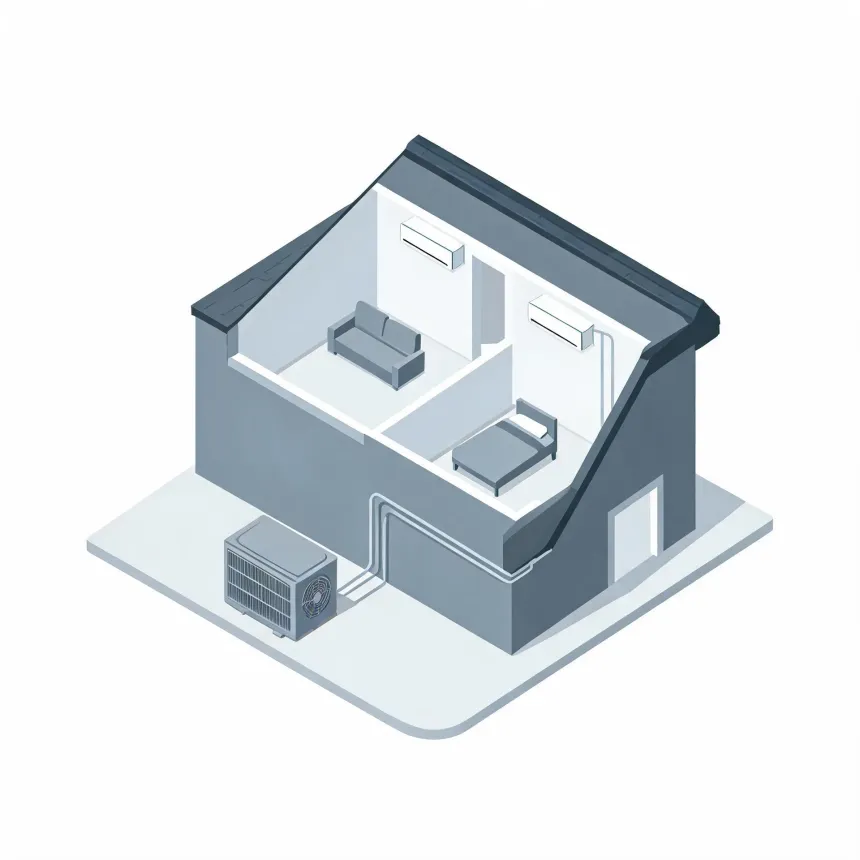
Isometric cutaway illustration of a two-room house showing two wall-mounted indoor air conditioning units connected by line sets to an outdoor condenser unit on the ground outside.
Your system heats October through May and cools June through August.

NOAA nClimDiv, 1991–2020 normals

Gas heats 78.7% of homes in Somerset County.

A mini split here usually works alongside a gas furnace, not instead of one.

Three months of summer, 84 degrees, and a standard mini split handles it

Cooling runs June through August
Summer afternoons average 84°F
153 damaging wind events from 2015 to 2024

Cooling in Somerset County runs June through August, so May is the month to get a mini split installed, not after the heat has already set in. An installer has time to size the unit properly when there's no rush, checking the room and how it holds heat instead of working around whatever's on the truck. If you're adding a mini split to a room your gas furnace doesn't reach well, spring is also when that work is easiest to schedule, before installers are booked with calls from people whose systems already failed. Get it done on your schedule, not in a rush once summer's already here.

Efficiency pays here

Power costs more here, so an efficient system pays you back on every bill.

Find a contractor
A man in a dark jacket, brown pants and cap carries a worn canvas tool bag up porch steps toward a dark teal front door, with a potted shrub in a blue glazed planter beside him.
A white outdoor air conditioner condenser unit mounted on metal wall brackets against gray horizontal siding, with a blue sky and white clouds behind it.

The old unit doesn't just get unplugged

If the old system is a window unit or a through-wall air conditioner, it gets pulled out and hauled off, nothing stays behind in the room. If what's coming out is a central system, the air handler and outdoor unit go, but the ductwork usually stays put since a mini split doesn't use it. Either way, the refrigerant in that old system has to be recovered, not vented, and older systems often ran on a refrigerant that isn't made anymore and has rules around how it's handled. That part isn't work you do yourself, but it's worth asking the installer how the old unit actually leaves the property before the new one goes up on the wall.

The number of rooms sets the cost

A single zone cooling one room costs less than a multi zone system feeding several rooms from one outdoor unit. Each indoor head, the line set running to it, and the labor to mount it all add up per zone. More rooms means more of everything, not just a bigger unit.

Where the outdoor unit can go matters

The outdoor condenser needs a clear spot with room for airflow, and the line set connecting it to the indoor head has to run through a wall, which means patching and finishing on both sides. A straight run through a nearby wall is simple work. A run up multiple floors or around obstacles means more line set, more wall penetrations, and more time on the ladder.

Ask what's actually being compared before you look at a price. A mini split's capacity has to match the room, not the other way around. One sized too big will cool the room fast and shut off before it pulls the moisture out of the air, leaving it cold and clammy. One sized too small runs constantly and never quite catches up. Ask how many indoor heads one outdoor unit is rated to run, and whether that still holds if you add a zone later. Ask about the line set length too, since every system has a limit on how far refrigerant can travel before it starts losing performance, and a long run on a cheap system can undercut a good brand name.

Installation starts with the outdoor unit going up first, usually on a mounting bracket against an exterior wall or a pad on the ground, set level so the compressor inside runs the way it's supposed to. Then comes the hole through the wall for the line set, the refrigerant lines, power cable and drain tube that all run from the outdoor unit to the indoor head. That hole gets sealed tight once everything's through it, since any gap there lets in air and water both. The indoor head mounts next, on a plate screwed to the wall, high enough to spread air across the room. Once everything's connected, the line set gets pressure tested and then evacuated with a vacuum pump to pull out any air and moisture before the refrigerant is released into the lines. Skip that step and moisture left in the line can freeze up the system or wear on the compressor down the road. Last comes the power-up and test run, checking the thermostat response, the airflow at the head, and the drain line actually draining before anyone calls the job done.