A dark, minimalist bedroom with a king-size bed, wall-mounted air conditioning unit, and large windows, with a cat sleeping on the duvet.

Mini Split Installation in Long Branch, NJ

Tell us about the job

Takes about a minute. No obligation.

New system or replacementMini-splitMonmouth County, NJ
Step 1 of 2

What ZIP code is the job in?

Electricity here runs 19.34 cents a kilowatthour

New Jersey power costs more than it does in most states. A mini split moves heat instead of generating it, so it uses less electricity to do the same job, and that difference shows up on every bill it runs through.

Efficiency is what you're buying, not just equipment

Two mini splits can heat and cool the same room and cost very different amounts to run. At this price per kilowatthour, the efficiency rating on the unit matters as much as the brand or the install, since that rate applies every time it cycles on.

7 months
October through April, your system heats
4 months
June through September, it cools
27°F
the average winter night it heats against
84°F
the average summer afternoon it cools against
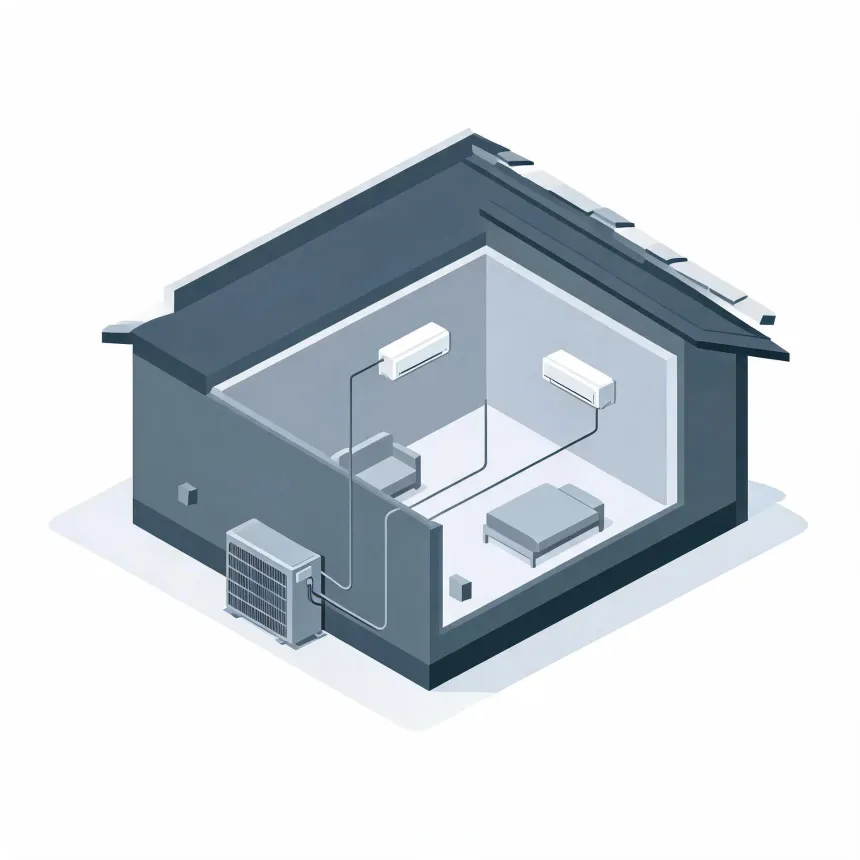
Isometric illustration of a cutaway house interior showing two wall-mounted indoor air conditioning units connected by line sets to an outdoor condenser unit beside the exterior wall.
Your system heats October through April and cools June through September.

NOAA nClimDiv, 1991–2020 normals

Monmouth County homes split evenly between built before 1975 and after.

A mini split sized for the room works the same in either one.

Gas heats most homes here, and a mini split still handles the rooms gas doesn't reach

81.1% of homes heat with gas
Cooling runs June through September
Summer afternoons average 84°F
Install before JuneCooling runs June through September here, so May is when this gets done without a rush.

Monmouth County sees its share of rough weather, 326 severe weather events over the last ten years between wind, hail and winter storms. None of that changes what size mini split a room needs. A unit sized for the square footage works the same whether it's bolted up in a county that sees a lot of storms or a few. Where the weather does matter is the power going out. A mini split needs electricity to run, same as a furnace blower or a central AC, so a storm that knocks out power takes it down too. That's a reason to think about backup power if you don't already have it, not a reason to size the unit differently or spend more on the equipment itself.

Any mini split installed here has to clear 14.3 SEER2 and 7.5 HSPF2

Monmouth County sits in zone 4A, which asks real work of both heating and cooling. Any split system heat pump made from 2023 on has to clear 14.3 SEER2 for cooling and 7.5 HSPF2 for heating. That's the federal floor, not a local add-on. A mini split that meets it also qualifies for a federal tax credit. That narrows the field before you start comparing brands.

Find a contractor
A beige split-system air conditioner outdoor condenser unit mounted on metal wall brackets atop a stucco wall.

Four months of cooling, the rest of the year heating

Cooling runs four months here, June through September, with afternoon highs averaging 84. That's the stretch a mini split earns its keep. Heating covers the other side of the year, in whatever rooms it's assigned to. Zone 4A means neither season is light work, but neither is unusual either. A unit rated for this climate zone is built to handle exactly this kind of year, no more and no less.

Ask what size the room needs, not the brand

A mini split that's too big cools the room fast and shuts off before it pulls the moisture out of the air, so the room feels damp. One that's too small runs constantly and never quite catches up on the hottest or coldest days. The right size comes from a load calculation on the specific room, the windows and the insulation around it, not a rule of thumb based on square footage alone. Any installer worth hiring should walk through that math with you before quoting equipment.

Ask who services it and how far they drive

A mini split needs its outdoor coil cleaned and its refrigerant charge checked like any heat pump, and the indoor filter needs regular washing. If something trips the breaker or the unit stops holding temperature, you want the company that installed it to pick up the phone, not a voicemail. Ask how they handle warranty work on the compressor and who you call if the line set develops a leak. The install is one appointment. The system is a relationship that runs for years after.

Sizing a mini split starts with a load calculation, not a tape measure around the room's perimeter. The calculation accounts for how many windows the room has, which direction they face, how much insulation sits in the walls and ceiling, and what else nearby is generating or losing heat. Square footage alone misses all of that, which is why rooms that look alike on paper can need different size units. Go too big and the unit blasts cold air, hits the thermostat setting, and shuts off before it's run long enough to pull humidity out of the room, so the air feels cool but damp. Go too small and it runs flat out on the hardest days of summer and winter and still can't close the gap. The right size runs long steady cycles instead of short hard ones, which is easier on the compressor over the life of the unit. A good installer walks through this math before talking brand or model.

Install day starts with the walk-through from the quote, confirming where the indoor head goes on the wall and where the outdoor unit sits outside. The crew mounts the indoor unit first, then drills a hole through the exterior wall for the line set, the power wire and the condensate drain, bundled together. That line set carries refrigerant between the indoor and outdoor halves, so it gets run, connected and pressure tested before anyone powers the system on, since a leak at a fitting is far easier to fix before the drywall work is closed up. Once the lines hold pressure, the system gets evacuated with a vacuum pump to pull out moisture and air, because either one left behind will hurt the compressor over time. The outdoor unit goes on a pad or wall bracket, the electrical gets tied in, and the whole system runs a test cycle in both heating and cooling before the crew leaves. Cleanup is a wall penetration and some drywall dust, nothing that keeps the room out of use.