



A row of similar gray-sided houses with gabled roofs and front porches behind a new wooden picket fence, with grass and mature trees along the street.

Mini Split Installation in Jersey City, NJ

Tell us about the job

Takes about a minute. No obligation.

New system or replacementMini-splitHudson County, NJ
Step 1 of 2

What ZIP code is the job in?

New Jersey homes paid 19.34 cents per kilowatthour in 2024, well above the national average. A mini split's efficiency rating matters more here than in a state with cheaper power, because every hour it runs shows up on the bill at that rate. These units pull heat from outside air instead of burning fuel to make it, so they get more warmth or cooling out of each kilowatthour than a system that doesn't. Ask what SEER2 and HSPF2 numbers a unit carries before you settle on one, since those ratings tell you how it will run on your bill for as long as you own it.

7 months
October through April, your system heats
4 months
June through September, it cools
28°F
the average winter night it heats against
84°F
the average summer afternoon it cools against
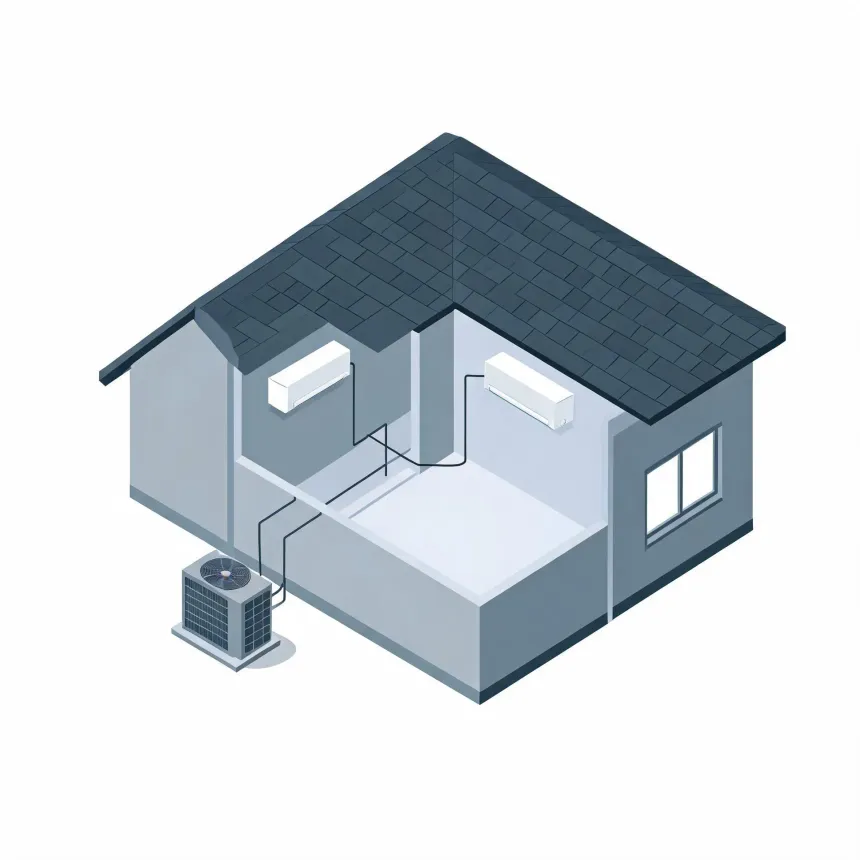
Isometric illustration of a cutaway gray house with a dark shingled roof, showing two wall-mounted indoor air conditioning units connected by lines to an outdoor condenser unit on the ground outside.
Your system heats October through April and cools June through September.

NOAA nClimDiv, 1991–2020 normals

The old system doesn't just vanish when the new one goes in.

Whoever installs the mini split needs to deal with what's already on the wall, whether that's an old unit, a window AC, or baseboard heat that's getting disconnected.

Half the homes in Jersey City were built by 1966. A mini split has to work with that house, not a newer one.

Half the homes here were built by 1966
Cooling runs June through September
Summer afternoons average 84°F

Cooling here runs June through September, about four months. May is the month to get a mini split installed, before that first run starts. Once the heat arrives, every homeowner with a dead window unit or a failing system is calling around, and installers book out fast. Going in a month early means the crew can take its time on the mounting and the line set instead of rushing before a heat wave. It also means the system is already running on day one of the season, instead of you waiting on a crew while the house sits warm.

Any mini split here has to meet zone 4A's efficiency minimum

Jersey City sits in climate zone 4A, which asks real work of both heating and cooling. Any mini split installed here has to clear the federal minimum for that job, 14.3 SEER2 for cooling and 7.5 HSPF2 for heating. A unit that meets those numbers qualifies you for a federal tax credit toward the cost. That's one more reason the rating on the unit matters as much as the brand.

Find a contractor
A beige split-system air conditioner outdoor condenser unit mounted on metal wall brackets atop a stucco wall.

A normal summer, run the way it's built to run

Four months of cooling a year is a normal load for a mini split. Nothing about Jersey City pushes that number up or down. An 84°F afternoon in July asks the same thing of the compressor as it would in most mixed climates. It cycles on, pulls the heat out, cycles off. A unit sized right for the room does that without strain. The time-lapse here shows a day most of the summer looks like, not a machine running flat out from June to September.

How many zones you're running

A single indoor head cooling one room costs less to put in than a multi-zone setup feeding several rooms off one outdoor unit. Each extra indoor head means another line set, another mounting job, another spot on the wall to patch and finish. The outdoor unit also has to be sized for the combined load of every zone it feeds, not just one room.
What the line set has to get through

The refrigerant line and wiring have to travel from the outdoor unit to each indoor head, and what they pass through on the way changes the job. Running them through an open basement or attic is straightforward. Running them through a finished wall, a brick exterior, or up multiple floors means more time opening and closing a path, and sometimes more material to cover the distance.

SEER2 and HSPF2 aren't marketing numbers, they're ratios. SEER2 measures how much cooling you get for the electricity the compressor draws over a season. HSPF2 does the same for heating. A unit with a higher rating moves more heat per kilowatthour than one with a lower rating, the same way a car that gets more miles out of a gallon costs less to drive. That difference doesn't show up on install day. It shows up every month after, on the bill, for as long as the system runs. Mini splits that look identical hanging on the wall can cost very different amounts to operate depending on what's printed on that label.

Install day starts outside, not in. The crew picks a spot for the outdoor unit with room for air to move around it, then runs the line set from there to the wall position for each indoor head. That line carries refrigerant lines, a drain line, and electrical in one bundle, usually through a small hole drilled through the wall. Once the indoor head is mounted and connected, the line gets purged and sealed so no air or moisture is sitting in the refrigerant circuit. Then the system gets charged, and the crew checks that each zone is actually pulling the temperature down or up the way it should before they leave. Nothing about that sequence changes by zone count, it just repeats for every indoor head on the job.