Two white colonial houses with lit windows and black shutters photographed at dusk along a tree-lined residential street.

Mini Split Installation in Hopatcong, NJ

Tell us about the job

Takes about a minute. No obligation.

New system or replacementMini-splitSussex County, NJ
Step 1 of 2

What ZIP code is the job in?

Oil heats most homes here

Fuel oil or kerosene heats 48.4% of occupied homes in Sussex County. Utility gas reaches about a fifth, and electricity heats 15.3%. A lot of houses in Hopatcong were built around an oil furnace or boiler, with no gas line running to them at all.
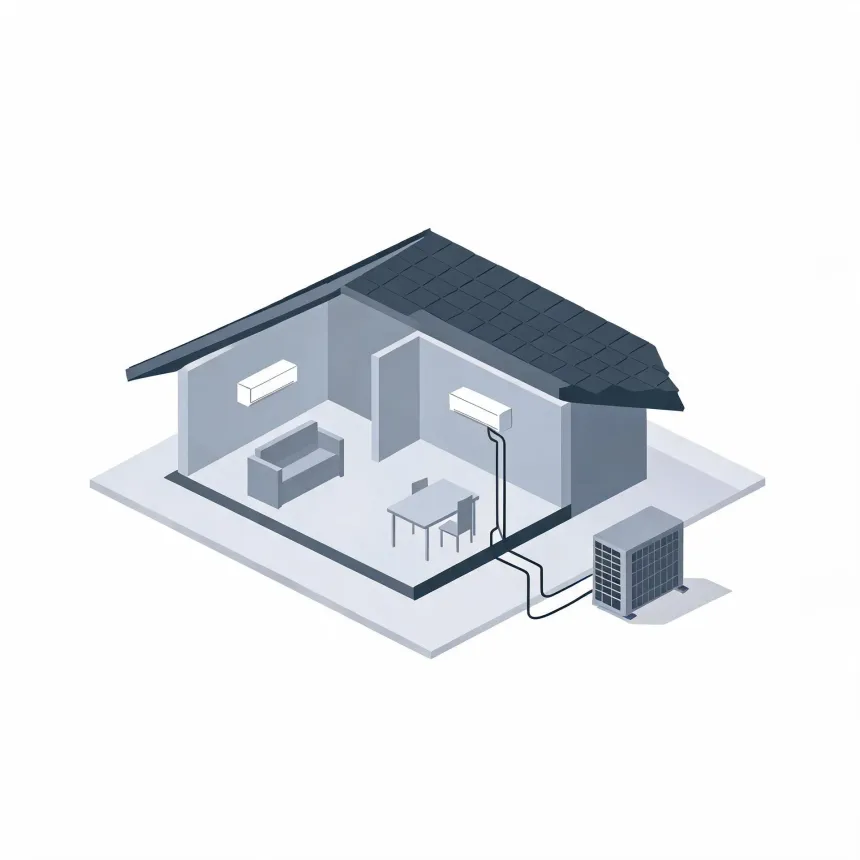

A mini split sidesteps the fuel question

A mini split runs on electricity and does not care what heats the rest of the house. It can add cooling to a home with an oil boiler, or carry heat and cooling in a room a furnace does not reach well, without any work on the oil or gas side of the house.

8 months
October through May, your system heats
2 months
July through August, it cools
20°F
the average winter night it heats against
81°F
the average summer afternoon it cools against
Isometric illustration of a cutaway house interior with sofa, table and chair, two wall-mounted indoor air conditioning units connected by lines to an outdoor condenser unit beside the building.
Your system heats October through May and cools July through August.

NOAA nClimDiv, 1991–2020 normals

New Jersey homes paid 19.34 cents per kilowatthour in 2024.

A standard mini split, sized right for the room, keeps that cost in check without paying for capacity Hopatcong doesn't need.

Sussex County sees its share of wind and winter storms, nothing that changes what you install

197 severe weather events from 2015 to 2024
11% of homes statewide lost power a day or more in 2024
160 damaging wind events from 2015 to 2024
An older county, and a system that has to fit itHalf the homes in Sussex County were built in 1973 or earlier.

Cooling in Hopatcong runs from July through August, about two months a year. June is the month to get a mini split installed, before the first hot stretch hits and every contractor's schedule fills up with calls from people whose systems just failed. Installing before the season means the unit gets set up and tested without anyone sweating through the wait. It also means if something needs adjusting, a refrigerant line, a mounting spot, the condenser placement, there's time to get it right instead of living with a rushed job through August.

Any mini split installed here has to meet the zone 5A minimum

Sussex County falls in climate zone 5A, where winters set the bigger demand on a system. A mini split installed here, ductless or not, has to clear 14.3 SEER2 and 7.5 HSPF2 if it's manufactured from 2023 on. That floor is what keeps a unit sized for Hopatcong from costing more to run than it should. A federal tax credit is available on qualifying equipment, worth checking against before you pick a system.

Find a contractor
A man in a cap, dark t-shirt and tan work pants walks up steps toward a dark teal front door carrying a canvas tool bag, with a planter of greenery beside the porch.
A white mini-split air conditioner outdoor condenser unit mounted on metal brackets against a beige stucco exterior wall, with a blue sky and scattered clouds in the background.

Two months of cooling, not much strain

July and August are the whole cooling job here, with afternoon highs averaging 81°F. That's not a system working against itself all summer. Sussex County sits in zone 5A, where heating is the bigger demand on a system, but even that is a cool-climate load, not the deep cold some places see. A compressor running two months of light cooling a year isn't getting worn down by the weather. When something goes wrong with a mini split here, it's more likely age or a missed service than the climate asking too much of it.

The number of zones sets the cost

A single indoor head tied to one outdoor condenser is the simplest job there is. Add a second or third zone off the same condenser and the price climbs with each one, since every zone needs its own line set, its own mount, and its own point of entry through the wall. A multi-zone system also needs a larger, more capable condenser to run all those heads at once, which costs more than the unit for a single room.

Where the lines have to run decides the labor

The line set carrying refrigerant between the outdoor condenser and the indoor head has to go somewhere, through a wall, up a chase, along an exterior run covered in line hide. A short straight shot is quick work. A run that has to clear framing, turn corners, or travel up multiple floors takes longer and takes more material, and that labor is most of what an installer is charging for.

If this is replacing a window unit or adding cooling where nothing ran before, there's likely no old equipment to deal with. But if a furnace or boiler is staying in place while a mini split takes over part of the load, that system doesn't go anywhere, it keeps heating the rest of the house or backing up the zones the mini split doesn't reach. When a mini split is replacing an older ductless system, the outdoor condenser and indoor head both come down, and whoever installs the new one should pull the old line set rather than leave it in the wall. Old refrigerant has to be recovered, not vented, so plan on the existing unit being removed by the same contractor doing the install rather than left for someone else to haul away later.

Install day starts outside, with the condenser placement, then moves in. The outdoor unit needs clearance on all sides to pull air through the coil, so it goes on a pad or bracket away from gutters and dryer vents, not wherever is closest to the wall. From there the installer drills a single hole for the line set, the refrigerant lines, power cable, and condensate drain bundled together, and runs it to the indoor head. The indoor head mounts on a bracket against a wall, level, with clearance above it so air pulls through properly. Once both ends are connected, the lines get pulled into a vacuum to clear out air and moisture before any refrigerant charge goes in, and that vacuum test is what keeps the system from losing capacity or icing up later. The installer charges the line to the manufacturer's spec, tests the system on both heat and cool, and checks the condensate drain actually carries water away before calling it done.