Electricity here runs 19.34 cents per kilowatthour
New Jersey households paid that rate in 2024, well above the national average. A mini split that runs on electricity all summer and winter will show that rate on every bill.
Takes about a minute. No obligation.
New Jersey households paid that rate in 2024, well above the national average. A mini split that runs on electricity all summer and winter will show that rate on every bill.
Since a mini split is all-electric, how efficiently it converts power into heating or cooling decides what it costs to run month to month. A unit sized and installed correctly for the space will cost less to run than one that is oversized or leaks refrigerant at the lines.
NOAA nClimDiv, 1991–2020 normals
Summer here runs June through August, with afternoon highs averaging 84°F.
A standard mini split sized for the room handles that fine, no need to size up.




Cooling runs June through August here, about three months a year. May is the month to get a mini split installed, before the first warm stretch hits. Installers book up fast once temperatures climb, and a rushed install is how you end up with a line set that's not quite right or a head mounted somewhere it shouldn't be. Going in May means the unit is tested and running before you need it, not while you're waiting on it.
Bergen County falls in climate zone 5A, a cool zone where heating is the bigger job. Any mini split installed here has to meet the federal minimum of 14.3 SEER2 for cooling and 7.5 HSPF2 for heating. That floor is already built into the units on the market now, so meeting it isn't the hard part. Picking a system that clears it by a wide margin, sized right for the room, is what keeps the electric bill down for as long as you own it.
Find a contractorAn install crew sizing the job can't go by the house's age alone. They need to see the room, the wall you want the head mounted on, where the line set will run to the outdoor unit. In a house from 1960 or earlier that's never had ductwork or a mini split before, that walkthrough matters more than it would in a newer build where the last contractor left notes. Ask whoever quotes the job to tell you why they picked the size they picked for your room, not just the brand.
Every mini split has a capacity curve, and output drops as the temperature outside moves further from room temperature. A unit that looks strong on paper can fall off hard at the low end. Ask the installer what the system actually puts out at the temperature extremes this room will see, not just the number on the spec sheet.
A multi-zone system runs several indoor heads off one outdoor unit, and they draw on the same shared capacity when more than one calls for heating or cooling at the same time. If a room gets added later, or several rooms need heat on the same cold night, the outdoor unit has to cover all of them at once, not just the one running right now. Ask whether the unit quoted was sized with that in mind.
The unit and labor are only part of what you're paying for. How many zones run off one outdoor unit changes the job, since each indoor head needs its own line set run through the wall to the outside. Where the outdoor unit can sit matters too. A long distance between it and the indoor heads means more refrigerant line, more wall penetrations, and more work securing that line along the way. The electrical side counts as well. A dedicated circuit may already be there, or it may need to be added, and a job that needs new wiring takes more than one that doesn't. None of this shows up on the spec sheet for the equipment itself, but it's most of what decides what the install takes to finish right.
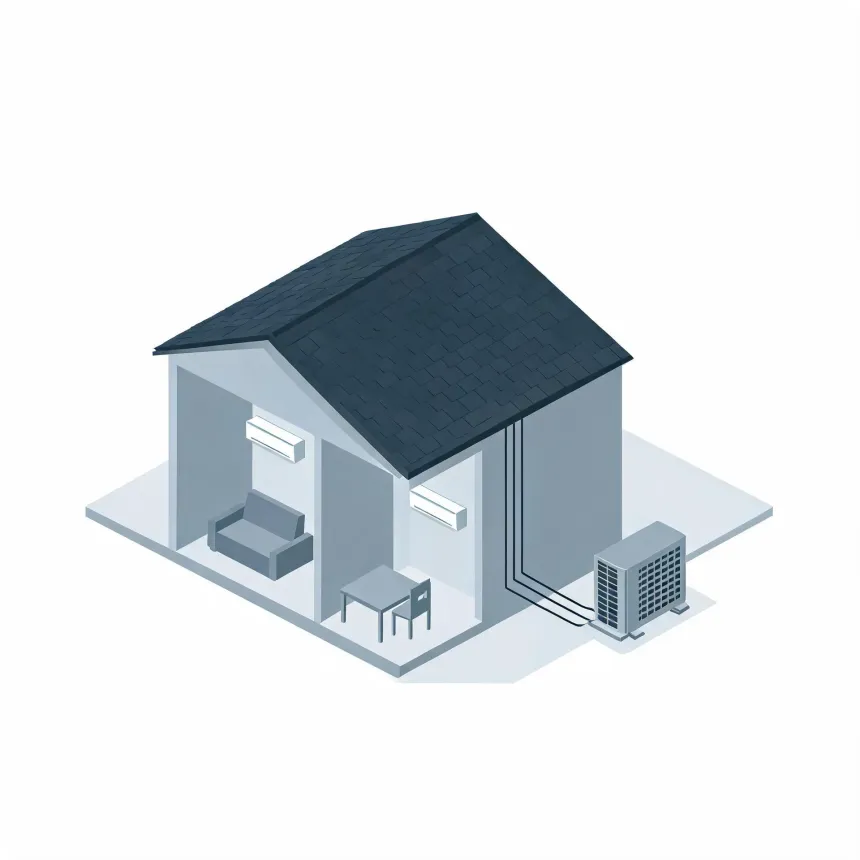
Installation starts with the walkthrough, but the work itself is mostly mounting and running line. The indoor head goes up on a wall bracket, and the crew drills through to the outside for the line set, the refrigerant lines, drain line, and power wire bundled together. That line set runs to the outdoor unit, gets connected, and the whole system is pressure tested before anything is charged with refrigerant. A leak at a fitting shows up here, not after the homeowner is already running the system. Once the test holds, the lines get charged, the outdoor unit gets powered up, and the crew checks that each head is calling for heating or cooling and actually delivering it. The last step is sealing up the wall penetration from outside so water can't get in behind the line set.