Electricity here runs 19.34 cents per kilowatt-hour
New Jersey's electric rates are above the national average, and a mini split draws on that rate every time the compressor cycles on.

Takes about a minute. No obligation.
New Jersey's electric rates are above the national average, and a mini split draws on that rate every time the compressor cycles on.
Two mini splits can heat or cool the same room and still pull very different amounts of power to do it. At this rate per kilowatt-hour, that gap between units shows up on every month's bill, not just at purchase.
NOAA nClimDiv, 1991–2020 normals
Cooling runs June through September in Glassboro.
Get the mini split installed before June, so the first hot day isn't install day too.



Glassboro is in climate zone 4A, which asks real work of both heating and cooling. Any mini split sold here has to meet the federal minimum for that. 14.3 SEER2 for cooling, 7.5 HSPF2 for heating. The rule covers any ductless heat pump manufactured from 2023 on, since the standard treats it as a split system and has no separate ductless category. That minimum is a floor, not a ceiling. Units built above it cost more up front but draw less power doing the same job, month after month.
Power costs more here, so an efficient system pays you back on every bill.
Find a contractorSizing starts with what the room loses in winter and gains in summer, not the square footage on a listing. A load calculation weighs window area, wall exposure, ceiling height and what's on the other side of each wall, because a room with a lot of glass facing west loses and gains heat differently than one with a single small window. Oversize the unit and it cools or heats the room fast, shuts off, then starts again a few minutes later, never running long enough to pull moisture out of the air or settle into a steady draw. Undersize it and the compressor runs flat out trying to reach a setpoint it can't hold, especially on the coldest or hottest days of the year. Either way the compressor wears against a load it wasn't built to carry, and that shows up as a shorter service life, not a sudden failure.
SEER2 and HSPF2 compare the heat a mini split moves against the power it draws to move it, measured in a lab under set conditions. A unit sized wrong for the room, or installed with a refrigerant line that runs too long or isn't sealed right, will draw more than its rating suggests no matter what the label says.
A mini split that both heats and cools carries a separate rating for each, and they aren't graded on the same scale. When comparing units, weigh both ratings against what this room actually needs done, not just whichever figure looks better.
When you're comparing quotes, ask what each installer is proposing to size the unit around, not just what brand they carry. Ask whether they ran a load calculation on the room or sized it off square footage alone, since those can land on different units. Ask where the outdoor unit goes and how long the refrigerant line run will be, because a longer run changes how the system performs no matter what the label promised. Ask what happens to the warranty if the line set gets brazed instead of flared, or if the vacuum test gets skipped. Installers quoting the same unit can still hand you a different system once it's actually on the wall.
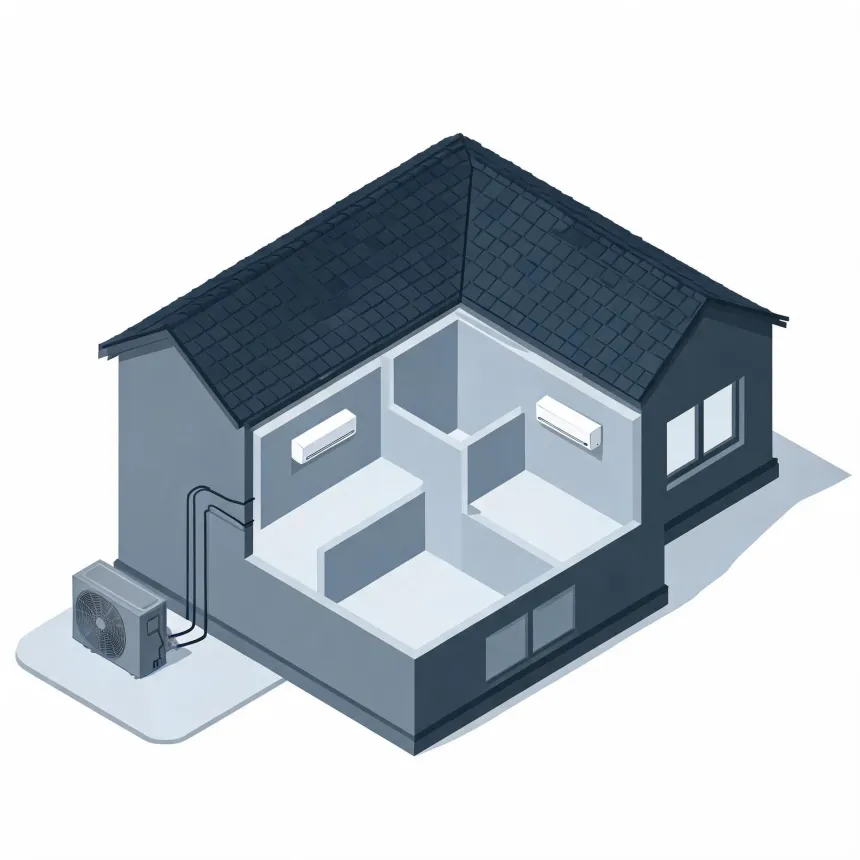
Install day starts with the load calculation, not the drill. The installer walks the room, checks window area, wall exposure and ceiling height, and settles on where the indoor head goes before anything gets mounted. The outdoor unit needs a flat, stable pad with clear airflow on all sides, so that gets set first. Then comes the hole for the line set, drilled at a slight downward slope to the outside so condensate drains out and not back in. The refrigerant lines get connected, and the whole system gets pulled down to a vacuum to clear out moisture and air before any refrigerant moves through it. Skip that step or rush it, and the compressor is working against moisture in the lines from day one.