





A two-story red brick house with black shutters and a dark roof sits behind a mown lawn, large deciduous trees, and a dry-stacked stone wall in the foreground.

Mini Split Installation in Flemington, NJ

Tell us about the job

Takes about a minute. No obligation.

New system or replacementMini-splitHunterdon County, NJ
Step 1 of 2

What ZIP code is the job in?

A mini split runs on electricity, and New Jersey homeowners paid 19.34 cents per kilowatthour for it in 2024. That rate sits well above what most of the country pays, so every hour your system runs shows up on the bill. A mini split earns its keep here because it moves heat instead of generating it, which takes less power to do the same job. The efficiency rating matters more in a state with power prices like this one. A unit sized and installed correctly for the room it serves will cost less to run than one that is oversized, undersized, or set up to short cycle.

8 months
October through May, your system heats
3 months
June through August, it cools
23°F
the average winter night it heats against
83°F
the average summer afternoon it cools against
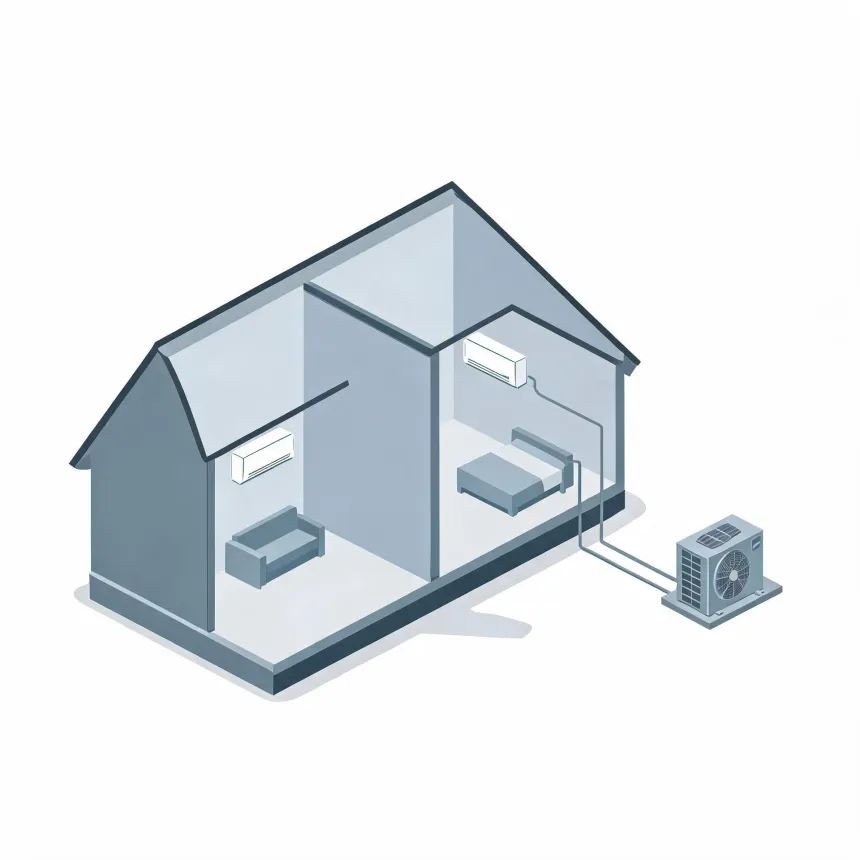
Isometric grey illustration of a cutaway house showing two rooms with wall-mounted indoor air conditioning units connected by lines to an outdoor condenser unit beside the building.
Your system heats October through May and cools June through August.

NOAA nClimDiv, 1991–2020 normals

Cooling here runs about three months, June through August, with afternoons averaging 83°F.

A mini split in Flemington isn't working against heat most of the year, so a well-matched system holds up without needing top-tier gear.

Flemington loses power and sees wind damage like the rest of the county. Neither changes what size mini split you need.

191 severe weather events from 2015 to 2024
11% of homes statewide lost power a day or more in 2024
154 damaging wind events from 2015 to 2024
Flemington Runs on Oil, Not GasFuel oil heats 30% of Hunterdon County homes, more than any county nearby that runs on gas

Hunterdon County falls under zone 5A, a cool, humid climate where heating carries more of the load than cooling. A ductless mini split counts as a split-system heat pump under the federal standard, so any unit manufactured from 2023 on has to hit at least 14.3 SEER2 for cooling and 7.5 HSPF2 for heating. That floor applies here the same as anywhere else in the country, the climate doesn't raise or lower it. What it does is narrow which units make sense to install, since a system has to clear that minimum before you even get to comparing options. A system that meets the standard and is sized right for the space is also likely to qualify for the federal tax credit on heat pump installations.

Get it installed before May runs out

Cooling starts in June here. Get the mini split in during May, while there's no rush to size it right or place it where it belongs, and it's ready the day you need it instead of days after.

Find a contractor
A white outdoor air conditioner condenser unit mounted on metal wall brackets against gray horizontal siding, with a blue sky and white clouds behind it.

The load calculation decides the unit, not the other way around

Size gets worked out before anyone picks a unit off a shelf. A contractor measures the room, the windows, the ceiling height, and figures how much heat that space gains in summer and loses in winter. That number points to a capacity. Pick a unit above it and the system races to temperature, shuts off, then starts again a few minutes later. Pick one below it and the system never really catches up on the hardest days. Either way the compressor spends more of its life starting and stopping instead of running steady, and starting is the part that wears it down fastest. A unit sized right runs longer at a lower output, which is exactly how these systems are meant to work.

Ask what the load calculation found

A contractor should size a mini split off a room by room load calculation, not a guess based on square footage alone. The calculation accounts for window area, ceiling height, and where the room sits in the house. Ask to see the numbers, not just the final unit recommendation. A unit picked without this step can end up oversized, which means it cools or heats the room fast, shuts off, then cycles back on again soon after.
Ask where the line set will run

The line set carries refrigerant between the outdoor unit and the indoor head, and it has to pass through a wall somewhere. Ask where that penetration goes and how it gets sealed. A longer line set run can affect how the system performs, and some installers charge more past a certain length. Ask about this before the quote, not after the wall is already open.

The unit and the line set are only part of what you're paying for. Mounting an outdoor condenser takes a pad or bracket secured to the structure, and that varies with what the wall or ground is made of. Indoors, each head needs a mounting plate set level and a condensate line that drains somewhere useful. Some setups need a pump if gravity won't carry it. Electrical work adds to it too. The outdoor unit needs its own circuit, run and sized to match what the compressor draws. A multi-zone system, where one outdoor unit feeds several indoor heads, costs more to install than a single-zone setup because each added head means another line set run and another mounting job. None of this is padding. It's what makes the system work the way it's rated to.

Installation day starts outside. The condenser goes on its pad or bracket, and the electrical circuit gets run to it. The line set takes the longest part of the day. It has to pass from the outdoor unit to each indoor head through a wall, and that penetration gets sealed once the refrigerant lines, the condensate drain and the wiring are all pulled through. Each indoor head gets mounted level on its plate and checked for drainage before anything gets powered on. Once the lines are connected, the system gets evacuated to pull moisture and air out, then charged with refrigerant to the amount the manufacturer specifies for that line length. Only after that does the contractor power it up and test heating and cooling at each head, checking that air moves where it should and the system answers to the thermostat or remote.