A tabby cat sleeps on a large bed in a dark, modern bedroom equipped with a wall-mounted air-conditioning unit.

Mini Split Installation in Elizabeth, NJ

Tell us about the job

Takes about a minute. No obligation.

New system or replacementMini-splitUnion County, NJ
Step 1 of 2

What ZIP code is the job in?

Electricity here runs 19.34 cents per kilowatthour

New Jersey's electric rates are higher than most of the country, and a mini split draws power every time it runs. That rate makes the efficiency rating on the unit worth reading closely before you buy.

The SEER2 number is the one to compare

A mini split with a higher SEER2 rating uses less electricity to move the same amount of heat. In a state paying this much per kilowatthour, that difference shows up on every bill the system generates, not just the first one.

7 months
October through April, your system heats
4 months
June through September, it cools
26°F
the average winter night it heats against
84°F
the average summer afternoon it cools against
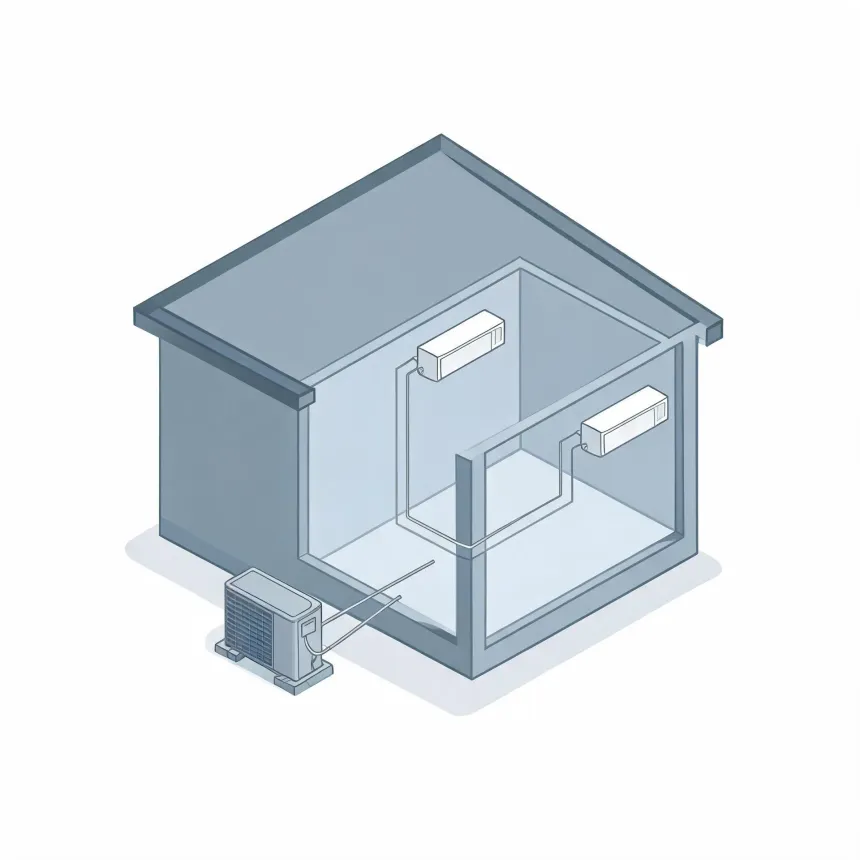
Isometric line illustration of a cutaway building interior with two wall-mounted indoor air conditioning units connected by piping to an outdoor condenser unit on the ground outside.
Your system heats October through April and cools June through September.

NOAA nClimDiv, 1991–2020 normals

Half the homes in Elizabeth were built in 1956 or earlier.

A mini split going into a house that old has to match the rooms and walls it actually has, not a standard layout.

Four months of cooling. 84 degrees most afternoons. A standard system handles this fine.

Cooling runs June through September
Summer afternoons average 84°F
98 damaging wind events from 2015 to 2024
Get it in before JuneCooling in Union County runs June through September.

Elizabeth sits in climate zone 4A, which asks real work of both your furnace and your AC across the year. Any mini split installed here, if manufactured from 2023 on, has to meet 14.3 SEER2 for cooling and 7.5 HSPF2 for heating. That's a federal floor, not a local one, and it applies whether you're cooling one room or running heads through the whole house. A system that clears this minimum also tends to qualify for the federal tax credit, worth checking against the model you're quoted. The rating on the spec sheet is the one that counts, not what the brand name implies.

Add cooling without touching the furnace

Gas heats 81.8% of homes in Union County, and a mini split doesn't replace that furnace. It takes over cooling for the months you need it, and it can carry the heat on its own in the shoulder months, before the furnace has to run at all.

Find a contractor
A white outdoor air conditioner condenser unit mounted on metal wall brackets against gray horizontal siding, with a blue sky and white clouds behind it.

Size it to the room, not the house

An installer sizing a mini split for a house this old should be doing a room by room load calculation, not working off square footage alone. Old walls lose and hold heat differently than new construction, and the head in each room needs to match what that room actually does. Ask to see the calculation before you agree to a layout.

How many heads the job needs

Every indoor head needs its own line set run back to the outdoor unit, and its own spot on the wall or ceiling picked for airflow, not convenience. A system with more heads costs more to install than one with fewer, separate from the equipment itself, because each head is its own refrigerant run, its own power connection, its own mounting job.

What the line set has to cross

The refrigerant lines between the outdoor unit and each head have to get through a wall, and sometimes up a floor or across an attic. A straight shot through one exterior wall is a quick job. A run that has to go up through a chase, around framing, or across a longer distance takes more line and more time, and sometimes more material to hide or protect it.

If a mini split is going in to cool rooms a window unit used to handle, that window unit just comes out, and the room is better for it since nothing is blocking the view or the airflow anymore. If it's replacing central air instead, the old condenser outside and the line set running to it need to come out too, not sit there unused. An installer should say upfront whether hauling that away is part of the job or something the homeowner arranges separately. The old ductwork is a different question. If the furnace is staying on for heat, the ducts stay too, since they're still carrying warm air all winter. What changes is that they stop being asked to carry cooled air, because the mini split heads are handling that room by room instead.

Installation day starts with the outdoor unit, not the indoor one. That goes on a pad or bracket outside, far enough from the wall for air to move through the coil. Each indoor head gets mounted next, and the bracket has to sit level before anything gets hung on it. Then comes the part that takes the longest, running the line set, the power wiring, and the condensate drain from each head back to the outdoor unit, through whatever wall or framing sits between them. Once the lines are run, the system gets evacuated with a vacuum pump to pull out moisture and air before refrigerant ever goes in. Skip that step and the system can run for a while before it fails, which is exactly why it has to be checked, not assumed.