




A white wall-mounted split air conditioner on a blue-grey wall, with a moonlit night sky visible through a nearby window.

Mini Split Installation in Camden, NJ

Tell us about the job

Takes about a minute. No obligation.

New system or replacementMini-splitCamden County, NJ
Step 1 of 2

What ZIP code is the job in?

New Jersey households paid 19.34 cents per kilowatt-hour in 2024, well above what most of the country pays. A mini split runs on electricity, so that rate applies every time it cycles on. A unit that holds its SEER2 rating uses less power to move the same heat than one that doesn't. In a state with power this expensive, that gap shows up on the bill every month the system runs. Worth checking the rating before deciding which system goes in.

7 months
October through April, your system heats
4 months
June through September, it cools
27°F
the average winter night it heats against
85°F
the average summer afternoon it cools against
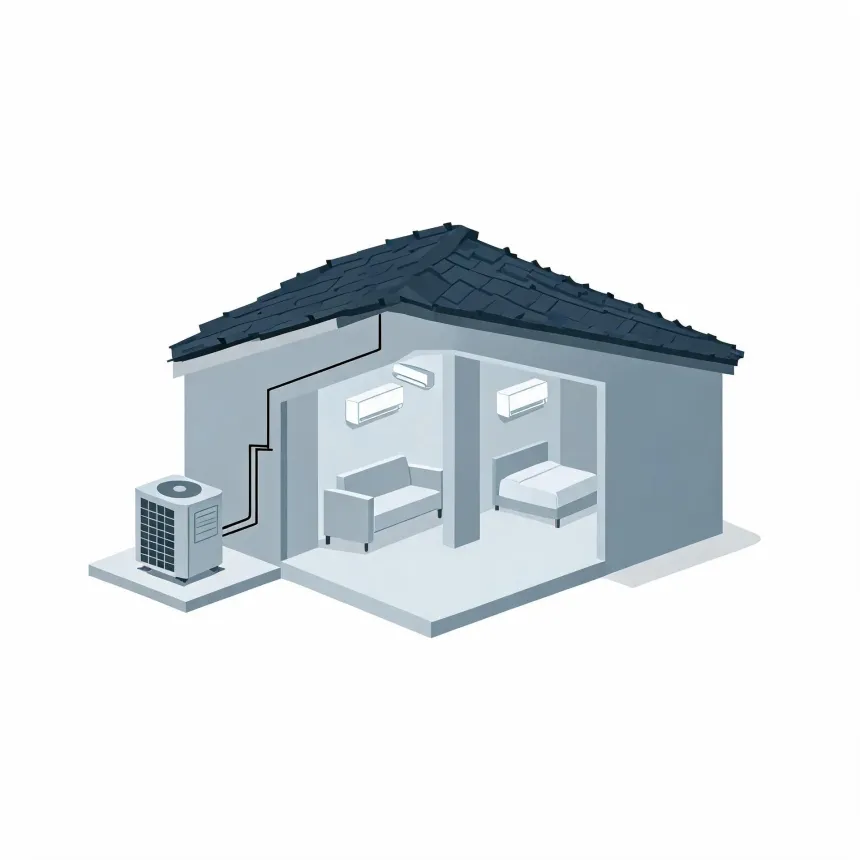
Isometric illustration of a cutaway single-story house with a dark shingled roof, showing three wall-mounted indoor air conditioning units in two rooms connected by lines to an outdoor condenser unit on a pad outside.
Your system heats October through April and cools June through September.

NOAA nClimDiv, 1991–2020 normals

Cooling runs June through September in Camden County.

Get the mini split installed in May and it's ready before the first warm week, not scrambling to catch up.

Four months of real heat, nothing more. A standard mini split handles Camden summers fine.

Cooling runs June through September
Summer afternoons average 85°F
225 damaging wind events from 2015 to 2024

Gas heats 74.4% of homes in Camden County, and most of those homes already have ductwork in place for a furnace. A mini split doesn't need any of that. It runs on its own refrigerant lines, so putting one in doesn't touch the gas furnace at all. That makes it a fit for one room that never gets right, a finished basement, or an addition the ducts never reached. The furnace keeps doing what it does, and the mini split handles the spot it doesn't reach.

Half the homes in Camden County were built in 1967 or earlier

Half the homes in Camden County were built in 1967 or earlier. A mini split going into a house that age has to work with the walls and rooms already there, not the ones a newer build would have. The line set and the indoor unit get sized and placed for the house you have. That's worth getting right before anything goes in.

Find a contractor
A man in a cap, navy long-sleeved shirt and tan work pants carries a worn canvas tool bag up porch steps toward a teal front door, with a potted shrub beside the entry.
A white outdoor air conditioner condenser unit mounted on metal wall brackets against gray horizontal siding, with a blue sky and white clouds behind it.

Built for the house, not a layout

That means a survey of the actual walls and roofline before anyone commits to a spot for the outdoor unit or routes the line set. A contractor doing this job right will walk the house first, not the floor plan it might have had new.

How many zones, and what controls each one

A mini split can run one indoor head or several off the same outdoor unit, and each head cools and heats its own room on its own schedule. Ask whether each zone gets its own thermostat or remote, or whether they're grouped together. A system with shared controls means the rooms on it always move together, warmer or cooler as a block.
What happens if one part fails later

A multi-zone system ties several rooms to one outdoor unit, so a problem with that outdoor unit affects every room on it at once. A single-zone system only affects the one room it serves. Ask what brand and model the indoor and outdoor units are, since replacement parts for one may be easier to find than for another down the road.

What you pay for is mostly the outdoor unit's capacity, the number of indoor heads, and the length of the line set between them. A bigger outdoor unit costs more than a smaller one, and it needs to be sized to the rooms it's serving, not oversized just to be safe. Each indoor head adds cost on its own, so a system with several zones runs higher than one cooling a single room. Line set length matters too, since refrigerant lines run from the outdoor unit to each indoor head, and a longer run or one that has to go through framing or up through floors takes more material and more labor than a straight shot through an exterior wall. The electrical work can add to it as well, if the outdoor unit needs its own circuit or the panel doesn't have room for one. None of that shows up until someone's actually looked at the walls and the roofline and figured out where the line set has to travel.

Install day starts outside, not in. The outdoor unit gets mounted on a pad or brackets, then the crew runs the line set from there to each indoor head, usually through a single hole drilled through the exterior wall. That hole gets sealed once the lines are through, so weather isn't getting in around it. Indoor heads mount high on a wall or into a ceiling cassette, wherever the layout called for them, and once they're set the lines get connected, the system gets charged with refrigerant, and everything gets tested room by room before anyone leaves. A vacuum pump pulls air and moisture out of the lines before the charge goes in, since either one left behind will keep the system from running right. The whole job is mechanical and electrical, not structural, so nothing about the house's framing has to change for it to go in clean.