




A tabby cat sleeps on a dark quilted bed in a moody, minimalist bedroom with a black wall-mounted air conditioning unit.

Mini Split Installation in Atlantic City, NJ

Tell us about the job

Takes about a minute. No obligation.

New system or replacementMini-splitAtlantic County, NJ
Step 1 of 2

What ZIP code is the job in?

Electricity in New Jersey ran 19.34 cents per kilowatthour in 2024, and that's what a mini split draws from to run. A mini split still costs less to operate than baseboard heat or window units, because it moves heat instead of generating it, but the efficiency rating on the unit you choose matters more here than it would somewhere with cheaper power. Look at the SEER2 and HSPF2 numbers before you decide on equipment. A higher-rated system costs more going in and less on every bill after that, for as long as you run it.

7 months
October through April, your system heats
4 months
June through September, it cools
27°F
the average winter night it heats against
84°F
the average summer afternoon it cools against
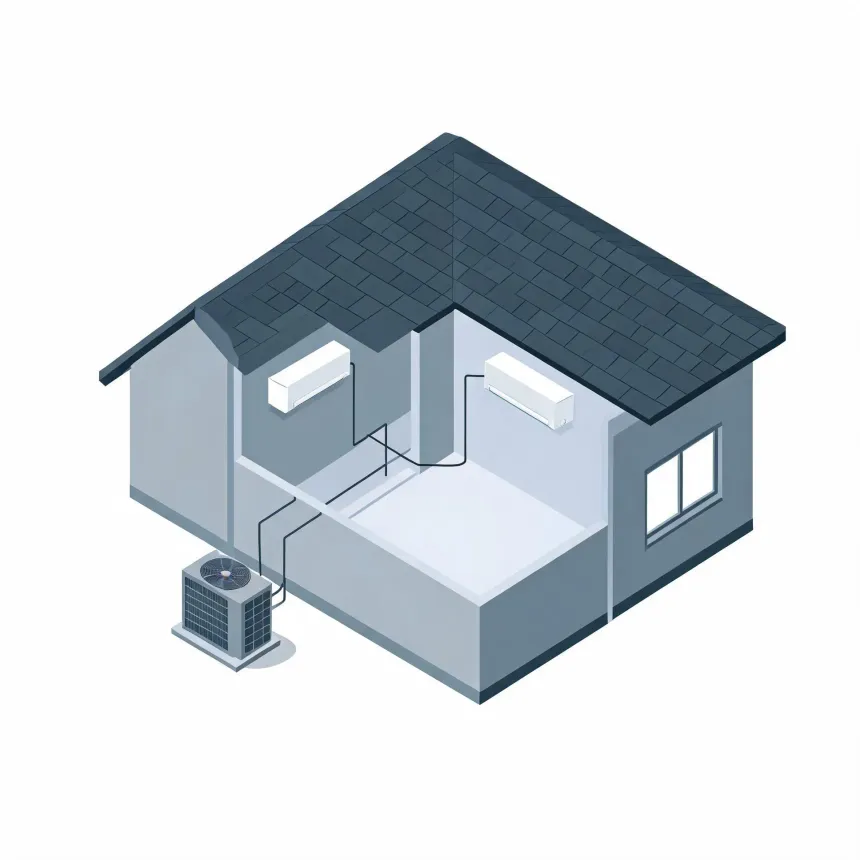
Isometric illustration of a cutaway gray house with a dark shingled roof, showing two wall-mounted indoor air conditioning units connected by lines to an outdoor condenser unit on the ground outside.
Your system heats October through April and cools June through September.

NOAA nClimDiv, 1991–2020 normals

Cooling runs June through September here.

A mini split installed in May is already running before the first hot week hits.

Most homes here run on gas. A mini split doesn't replace that, it covers what the furnace can't.

71.3% of homes heat with gas
Cooling runs June through September
Summer afternoons average 84°F

Half the homes in Atlantic County were built in 1978 or earlier, half since then. That split doesn't call for a bigger unit or a different one. A mini split sized to the room it's heating and cooling works the same no matter when the house around it went up. What matters is the room it's going into, not the age of the walls. If your ductwork or wiring came with the house, that's worth having a contractor look at, but it's a separate question from what size system this job needs.

A standard mini split handles Atlantic City summers fine

Cooling here runs four months a year, with afternoon highs averaging 84°F through June, July and August. That's a normal load for a mini split to handle at standard size and efficiency. Nothing about this county asks a bigger unit or a higher-tier one to keep up, so there's no reason to pay for more than the room needs.

Find a contractor
A man in a cap, dark jacket and tan work pants climbs concrete steps toward a teal front door, carrying a canvas tool bag in his right hand, with a potted fern beside the porch.
A beige split-system air conditioner outdoor condenser unit mounted on metal wall brackets atop a stucco wall.

The rating is a seasonal average, not a peak number

SEER2 and HSPF2 are both averages. SEER2 covers cooling, HSPF2 covers heat, and each one is measured across a full season of starts, stops and partial loads rather than a single moment of running flat out. A unit cycles on, holds steady, throttles back, and shuts off, over and over through the day, and the rating reflects all of that. This is why the number on the box matters more over a long run than a short one. A mini split that sits idle most of the year barely draws on the rating at all. One that runs for months on end, the way cooling equipment does through a full summer, spends enough hours working that the efficiency it was built with actually shows up on the power bill. The rating does not change what the unit can handle in a given moment. It changes what all those hours cost you added up.

The furnace stays right where it is

A mini split doesn't replace a gas furnace, it works alongside it. There's no reason to disconnect or remove the furnace as part of this job. It keeps doing what it's always done, and the new system handles cooling and shoulder season heat on its own line set.
Window units come out before the new head goes in

Any window AC or through wall sleeve being replaced should come out ahead of installation, not during it. The old bracket or sleeve usually sits exactly where the new line set and condensate drain need to pass through the wall. Clearing it first gives the crew a clean path to work with.

When you're comparing systems, ask what the manufacturer rates the line for in both directions, not just cooling. Some units are built mainly to cool and heat only as a backup, others hold their output down into real cold. Ask how many indoor heads the outdoor unit can run and whether it's rated for that many, because a condenser pushed to its limit on paper performs worse in practice than one with some room to spare. Ask what refrigerant it uses, since that affects what service and parts look like years from now. Ask about the warranty on the compressor specifically, not just the system as a whole, and whether it requires a specific contractor to do the install to stay valid. A contractor who answers these without hesitation knows the equipment. One who only talks about price is selling a box, not a system.

Installation starts outside, with the condenser. The crew picks a spot with clear airflow on all sides and room to service it later, then mounts it on a pad or wall bracket set level, because a unit that sits tilted strains the compressor over time. Indoors, each head goes high on a wall or ceiling, away from direct sun and clear of furniture that would block the airflow. A small hole gets drilled through the wall for the line set, the refrigerant lines, power wire and condensate drain bundled together and run between indoor and outdoor units. Once everything's connected, the lines get pulled down to a vacuum to clear out air and moisture before refrigerant ever flows, since either one left behind can damage the compressor down the road. The crew checks refrigerant charge, confirms the condensate drains properly, and runs the system through both heating and cooling before calling the job done.