





White colonial houses with lit windows photographed at dusk along a tree-lined residential street.

AC Repair in Paterson, NJ

Tell us about the job

Takes about a minute. No obligation.

RepairCentral ACPassaic County, NJ
Step 1 of 2

What ZIP code is the job in?

Before you call anyone, check the thermostat is set to cool and the temperature is actually below room temperature. Go to the breaker panel and make sure the breakers for the air handler and the outdoor unit haven't tripped. Look at the outdoor unit itself and clear away any leaves, grass clippings or mulch blocking the sides. Pull the air filter and hold it up to a light. If you can't see light through it, that filter is choking airflow and needs to be swapped before anyone diagnoses anything else. Check that the vents inside are open and nothing is sitting in front of them. None of this fixes a bad capacitor or a refrigerant leak, but it rules out the simple stuff first.

3 months
June through August, your air conditioner is on duty
82°F
the average summer afternoon it cools against
6 hail events
in ten years, and hail bends the fins on outdoor coils
42 wind events
in ten years, and wind drives debris into outdoor units
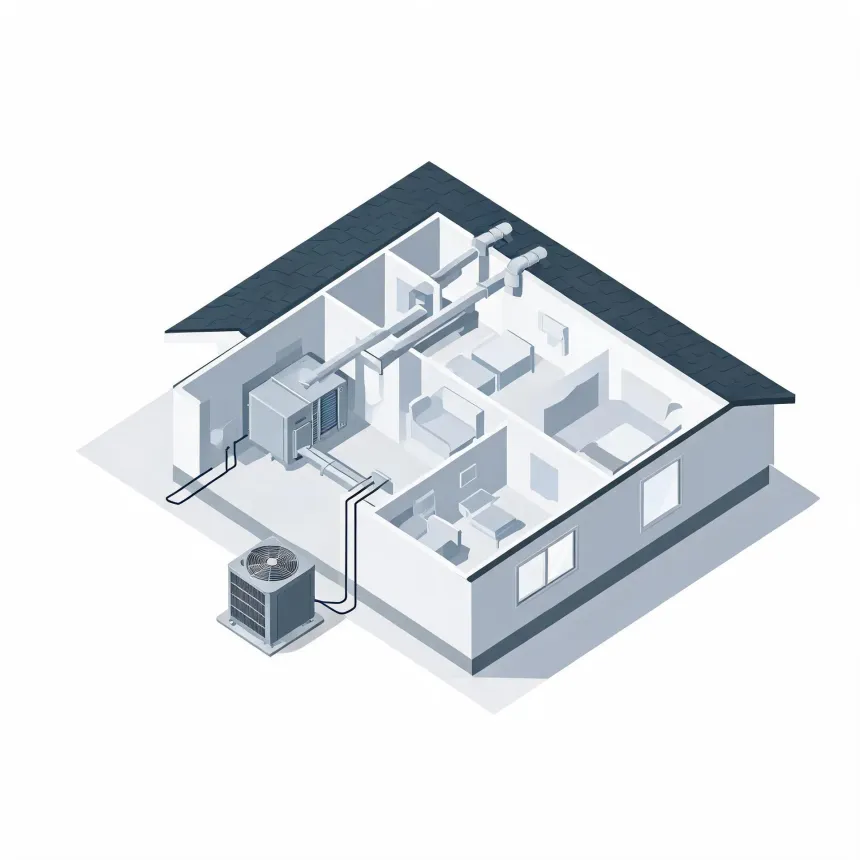
Isometric cutaway illustration of a single-story house showing interior rooms, ceiling ductwork, an indoor air handler, and an outdoor condenser unit connected by lines, in gray and white tones on a white background.
Your air conditioner works hardest from July through August.

NOAA nClimDiv, 1991–2020 normals

Paterson cools for about three months a year, June through August, with afternoon highs around 82.

A system that only works hard three months a year usually isn't worn out, so a repair is likely to hold.

At 19.34 cents a kWh, a struggling AC wastes money every day you wait

Power costs 19.34 cents a kWh statewide
Cooling runs June through August
Summer afternoons average 82°F

A system low on refrigerant cools worse than it should, and the instinct is to let it keep running while you wait for a repair slot. That's how a compressor gets damaged. Refrigerant carries the oil that lubricates the compressor, so running it low starves the compressor of lubrication at the same time it's working harder to make up for the lost cooling. A weak capacitor causes a similar problem. If it's not delivering a clean, strong start, the compressor draws more current trying to start anyway, and that heat adds up over every cycle. A dirty coil or blocked airflow pushes the whole system to run longer to hit the same temperature, and a compressor that runs long and hot wears out faster than one that gets fixed early. None of these start out as compressor problems. Left alone, they can turn into one, and the compressor is the hardest part in the unit to replace.

Get it repaired, not replaced

A unit that only runs hard three months a year has had an easy few years. Getting it fixed usually makes more sense than replacing it.

Find a contractor
A man in a dark long-sleeve shirt and worn tan work pants walks up porch steps toward a dark teal front door, carrying a weathered canvas tool bag in his right hand, with a potted shrub in a blue planter beside the door.
A gray residential air conditioning condenser unit mounted on a concrete pad outdoors, surrounded by green grass under a partly cloudy blue sky.

Hours of actual run time, not years on the pad, is what wears this out

A compressor that starts and runs steady every afternoon for years is doing exactly what it's built for. The wear that matters isn't how long the unit sits outside, it's how many hours the compressor actually spends running against the heat. Short mild stretches barely touch it. Long runs on hot afternoons are what wear down a capacitor or stress a weak coil. A unit that gets regular use but not constant hard use tends to fail one part at a time, not all at once, which is exactly the kind of failure a repair fixes well.

A capacitor is usually the first thing to go

The capacitor gives the compressor and the fan motor the jolt they need to start. It weakens with heat and age, and when it goes, the outdoor unit either hums without starting or doesn't turn on at all. It's a small part, and it's often the whole problem.

A low charge means a leak, not just lost refrigerant

An AC doesn't use up refrigerant the way a car uses gas. If the charge is low, it's leaking out somewhere, usually at a coil or a fitting. Adding refrigerant without finding the leak just means doing it again next season.

Aerial view of a gray outdoor air conditioning condenser unit mounted on a concrete pad next to a house with vinyl siding.

A new air conditioner would save little on running costs in Passaic County, so the repair decision comes down to the unit's condition.

  • A new one at the federal minimum, 13.4 SEER2$230 a year
  • An older air conditioner$250 a year

Estimates for a typical Passaic County home, compared with an older unit built to the previous federal minimum, from EIA household energy data, New Jersey fuel prices and NOAA climate normals. Your home will differ.

Repair makes sense when a part like a capacitor or contactor has failed.

Replacement makes sense when the compressor has failed or the system uses R-22 refrigerant, which is no longer made.

A diagnostic starts outside at the unit, with the panels off and the tech watching the compressor and fan actually try to start. From there it's gauges on the refrigerant lines to check the charge, and a meter on the capacitor and the wiring to see what's holding voltage and what isn't. Indoors, the tech checks the coil and the airflow coming off the blower. A system can have good refrigerant and still cool poorly if air isn't moving through it. Most of this goes faster than people expect, because the symptoms usually point to a likely part before the tools even come out. What the visit ends with is a straight answer about which part failed, why, and whether fixing that part is enough or something else is close behind it.