Get matched with an air conditioner pro in Essex County
AC can't keep up on hot days in Newark, NJ
On the worst days, your AC runs nonstop and the house still sits at 78. That usually means the system is undersized for the heat and humidity, low on refrigerant, or struggling to move enough air through the ducts. Instead of calling around Essex County for someone who can look at it, answer a few questions here and a contractor who handles this will reach out to you.
Get a local proWhen your AC can't keep up on the hottest days, it's almost always one of a few things. The unit may be too small for your house, so it runs the whole afternoon and never catches up. The refrigerant charge may be low, which means it's pulling heat out of the air slower than it should, and the house creeps up a degree at a time. Or the air isn't moving through the ducts the way it needs to, so cold air never reaches some rooms. Humidity makes all of this worse. A system that struggles at 85 degrees with low humidity will fall further behind once the air gets sticky, because it has to pull moisture out of the air before the house feels any cooler. None of this means the unit is broken. It means something specific is working against it, and that part can be found and fixed.
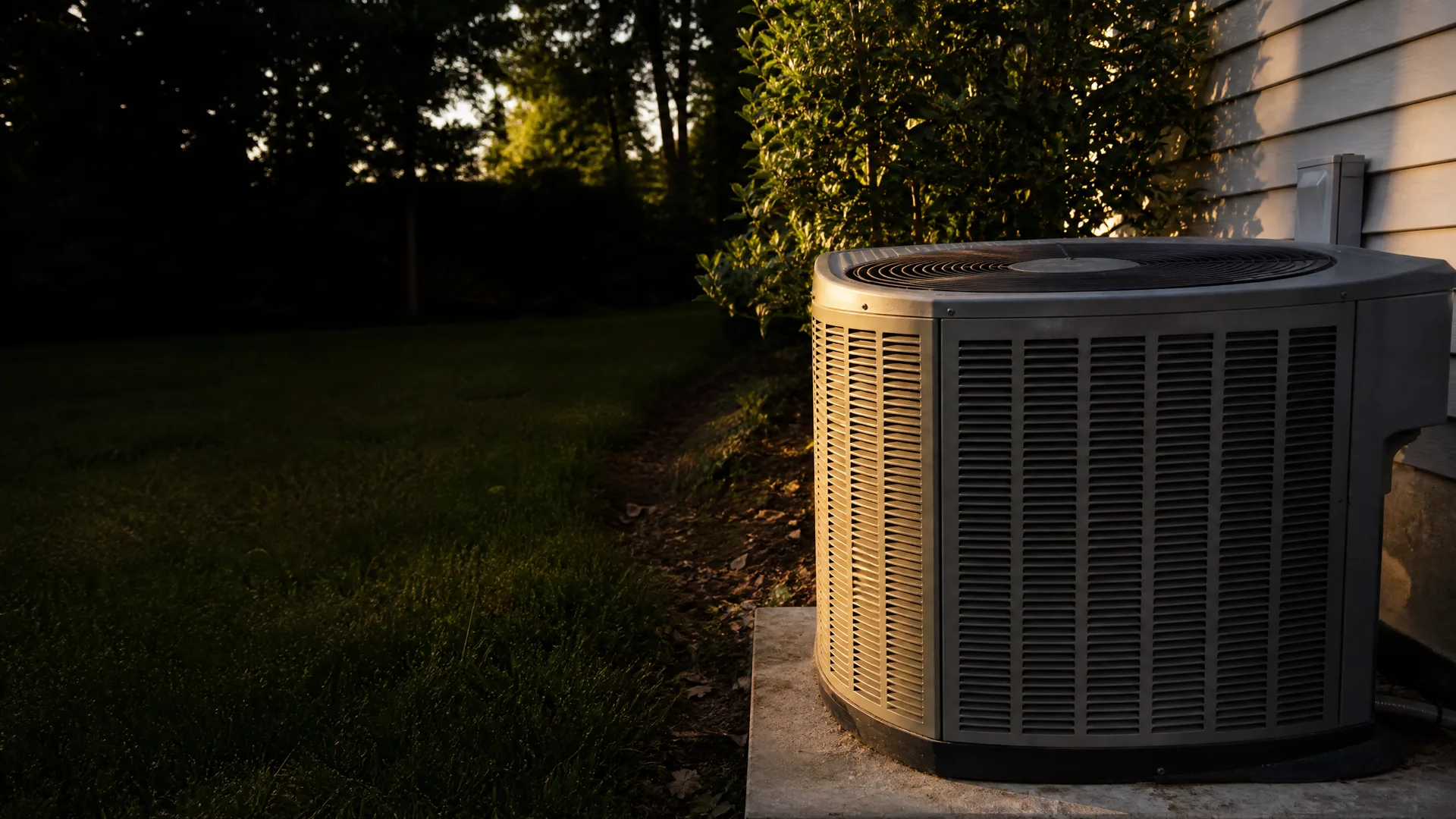
You're out back around seven, grass still warm underfoot, and you notice the quiet first. The condenser sits there against the fence and the fan isn't spinning. No hum, no rush of air off the top, just the cicadas going in the next yard. Inside, the house has been stuck at 80 since lunch and you'd blamed the heat, the kind of thick Essex County evening where the air doesn't move on its own either. You crouch down near the unit and the panel is warm to the touch. Somewhere behind you a window unit is laboring away in the den. The sun's going down orange over the rooftops and the yard is finally cooling off, but the house behind you isn't.
Repair the System or Replace It
Call for repair
- A contractor can check the refrigerant charge and add what's missing if the system is low.
- If the outdoor fan isn't spinning, a technician can tell you whether it's the capacitor, the motor, or a wiring problem.
- A dirty condenser coil outside or a clogged filter inside can choke airflow, and both get cleaned or replaced in a single visit.
- Repair makes sense if the system is cooling some of the house, just not keeping up on the worst afternoons.
- A technician can also check whether your ductwork is actually delivering enough air to every room.
- If the unit was sized for a smaller house or a different layout, a repair visit will tell you that too.
Consider replacement
- If the unit is too small for your house, no repair fixes that. It will keep running nonstop on hot days no matter what gets fixed.
- A system that needs refrigerant added more than once likely has a leak, and patching the same leak repeatedly costs more over time than replacing the unit.
- An older unit working harder every summer to do the same job is a sign the compressor is wearing out.
- Replacement lets you size the new system to your house instead of working around a unit that was never right for it.
- If repair costs keep piling up summer after summer, a new system stops that cycle.
- A newer system also gives you the chance to fix duct or airflow problems at the same time, instead of working around them.




Why does your house stay warm upstairs by late afternoon
By mid afternoon the upstairs rooms run warmer than the thermostat shows, sometimes by several degrees, while the air coming out of the vents feels only cool, not cold. The system may short cycle, shutting off after a few minutes and starting again before the house has actually cooled. You might notice the condenser outside running for hours straight without the house catching up, or the return air feeling barely different from room temperature. Left alone, a system working this hard on the hottest days wears down its compressor faster and pushes electric bills higher for a house that still isn't comfortable. On a 95 degree day in Essex County, that gap between the thermostat setting and how the rooms actually feel is the clearest sign something underneath isn't working the way it should.

What refrigerant charge actually does
The refrigerant inside your AC absorbs heat from the air in your house and carries it outside. If the charge is even a little low, the system still runs, the fan still spins, but it's pulling less heat out with every pass. A gauge check on the lines tells a technician the charge in minutes. It's one of the fastest things to confirm and one of the most common reasons a system runs all day without getting the house down to temperature.
Why duct size sets the limit
A furnace blower and an AC coil can both be sized right for your house and the system still underperforms if the ducts feeding the rooms are too narrow or too long a run. Air takes the path of least resistance, so rooms far from the air handler, often upstairs, get less of it. No amount of extra refrigerant or a bigger compressor fixes that. A technician can measure airflow at the vents to see if the ducts are the bottleneck.
Why does my AC run constantly but never cool the house?
You've checked the thermostat a dozen times and the number never moves. The outdoor unit is running, the vents are blowing, but the house stays warm straight through the afternoon and into the evening. On a muggy Essex County day that's not just annoying, it's the kind of thing that makes you start wondering if something inside the system is actually broken or if it's just losing a fight with the heat.
Your system is moving air without moving enough heat
An AC cools by pulling heat out of the air inside your house and carrying it outside through the refrigerant. When that process is working, the air coming off the vents feels cold and the house loses a degree or two an hour. When it runs nonstop and the house doesn't cool, the unit is still moving air, but it isn't pulling out much heat. A refrigerant leak is a common reason. So is a condenser coil caked with dirt, since that coil has to release the heat outside, and a blocked one can't let go of it fast enough. On a humid Essex County afternoon, a system already running at its limit has nothing left in reserve.


Find an air conditioner repair pro in Essex County

Explain the air conditioner problem once instead of to every shop in Essex County.
No charge to send it. You decide if you hire them.

Warm air from the house passes over the indoor coil, where refrigerant pulls the heat out of it.
The refrigerant carries that heat to the compressor, which pressurizes it and sends it outside.
The outdoor fan blows air across the condenser coil, releasing the heat into the yard.
Cooled refrigerant returns inside to the indoor coil to absorb more heat.



NOAA's averages for Essex County put the summer dew point at 61°F across June, July and August. That's heavy, sticky air, and it changes what your AC is actually up against. A dry 90 degree day and a muggy one aren't the same job: the system has to pull moisture out of the air before the house feels cool at all, and that work doesn't show up on the thermostat. You'll notice it as a house that reads 76 or 77 but still feels damp, air coming off the vents that's cool but not crisp, and a unit that runs long stretches without ever seeming to finish the job.
NASA POWER T2MDEW


Where the airflow actually goes wrong
- Static pressure that's too high makes the blower work harder and move less air than the system is rated for.
- A return duct that's too small for the system starves the blower no matter how strong the motor is.
- A thermostat set to Auto instead of On can mask a duct problem since the fan stops drawing air between cycles.
- Flex duct that's crushed or kinked behind a wall or in a crawlspace cuts airflow at that one point in the run.
- A coil iced over from restricted airflow will blow warm air until it fully thaws, even with the system running.
- Leaky supply ducts in an attic can lose a meaningful share of the cooled air before it ever reaches a vent.
Your AC can be sized right and charged right and still lose the fight on a hot day if the air can't move the way it's supposed to. The blower pushes a set amount of air through the ducts, and anything that restricts that path makes the whole system work harder for less result. Static pressure is the resistance the blower has to push against, and when it's too high, the motor strains and still delivers less air than the system was built to move. A return that's undersized has the same effect from the other end, starving the blower before it even gets started. The thermostat setting matters too. On Auto, the fan shuts off between cycles, which can hide a duct problem that would otherwise show up as weak airflow at the vents all day. Physical damage counts just as much as design. A section of flex duct crushed behind a wall or kinked in a crawlspace chokes airflow at that exact spot, and nowhere else. When airflow drops low enough, the indoor coil can ice over, and once that happens the system blows warm air no matter how hard it runs until the ice melts. Even a well-built duct system loses some cooled air through leaks before it reaches a vent, and in an attic run that loss adds up fast. A technician can measure static pressure and duct leakage directly, rather than guessing from how warm the house feels.
Cooling runs June through August
Three months a year is a short window to find out your AC can't handle it. With June through August the only real test it gets, a system that's losing ground can run all summer before anyone outside your house would notice something's wrong.
NOAA nClimDiv 1991-2020

If your AC still can't keep up, that's the answer
When an AC runs all afternoon and the house still sits at 78, the cause is almost always one of a handful of things: a system too small for the house, a low refrigerant charge, a fan or capacitor that's failing, or ducts that can't move enough air. None of those get better on their own, and running the unit harder doesn't fix any of them. A technician can check the charge, test the fan and capacitor, and measure static pressure in the ducts to see which one is at work in your house.
You don't have to figure out which of those it is before you call someone, and you don't have to be the one who sorts through contractors, explains the problem on the phone three times, and compares quotes to find out who's actually free this week. Once you're matched with a contractor who takes on jobs like yours, they'll reach out to you directly. What's true is that Essex County summers ask a lot of these systems, and a unit that's losing ground in July won't start winning in August.

Get the right pro for your air conditioner