A row of similar two-story houses with gray siding and dark shingled roofs stands behind a long white vinyl fence, with mown grass in the foreground and large trees behind.

AC Repair in Ocean City, NJ

Tell us about the job

Takes about a minute. No obligation.

RepairCentral ACCape May County, NJ
Step 1 of 2

What ZIP code is the job in?

Four months of real work

AC here runs June through September, with afternoon highs averaging 83°F. That's a shorter stretch than a lot of places get, but the system works hard through it. A unit struggling in July is dealing with the same strain any AC faces in a hot, humid summer, nothing more unusual than that.

Wind and storms aren't the likely cause

Ocean City sees its share of wind events and the occasional tropical storm. If an outdoor unit has visible damage or debris from a recent storm, that's worth mentioning to whoever comes out. But most AC trouble has nothing to do with weather. A capacitor wears out, a coil gets dirty, a charge runs low. Start with the common cause before assuming the uncommon one.

4 months
June through September, your air conditioner is on duty
83°F
the average summer afternoon it cools against
3 hail events
in ten years, and hail bends the fins on outdoor coils
96 wind events
in ten years, and wind drives debris into outdoor units
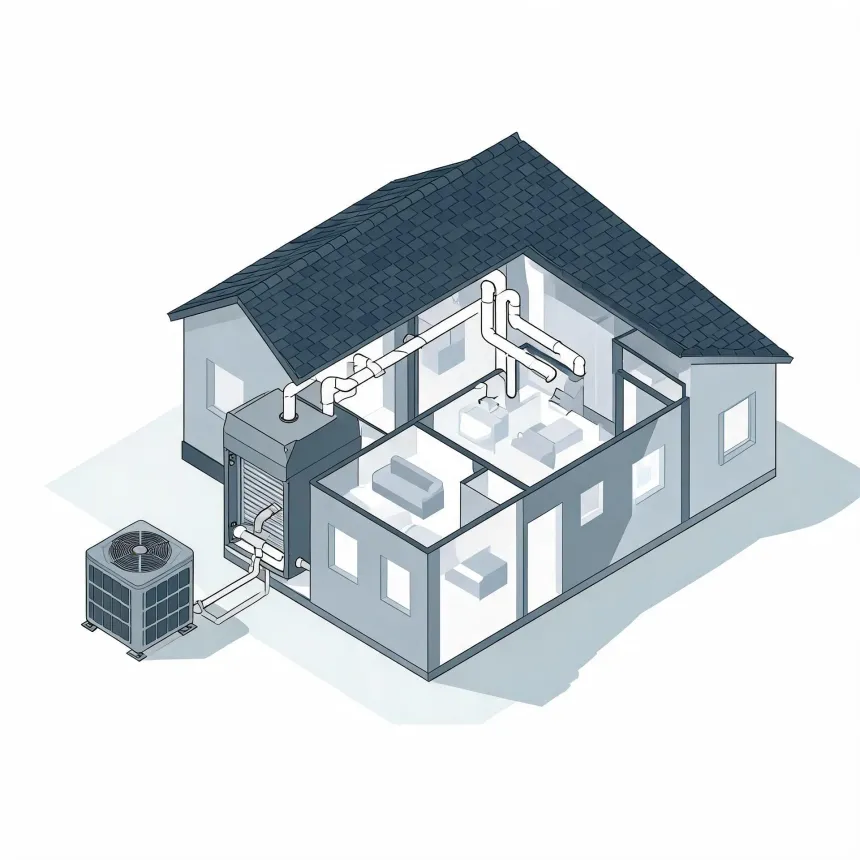
Isometric illustration of a cutaway single-story house showing interior rooms, ductwork running from an indoor air handler, and an outdoor condenser unit on a pad beside the building.
Your air conditioner works hardest from June through August.

NOAA nClimDiv, 1991–2020 normals

AC in Ocean City starts running in June after sitting idle since September.

Whatever was already wearing thin shows up that first hot week, not while the system was off.

New Jersey homes paid 19.34 cents per kilowatthour in 2024, among the higher rates in the country. An AC that's low on charge or running on a weak capacitor has to work harder to do the same job, and that shows up on the electric bill before it shows up as a breakdown. The longer a struggling system runs like that, the more it costs to keep it going. Fixing what's actually wrong is what stops the extra cost, not just living with it.

Half the homes here were built in 1981 or later, yours may be one of them

Half the homes in Cape May County were built in 1981 or later. If yours is one of them, the AC likely isn't old enough to be worn out on its own. That points to a fixable problem, not a system at the end of its life.

Find a contractor
A gray residential air conditioning condenser unit mounted on a concrete pad outdoors, surrounded by green grass under a partly cloudy blue sky.

What to check before you call

Check the thermostat first. Make sure it's set to cool and set below room temperature, and swap the batteries if it's been a while. Next, look at the outdoor unit. It should be running and clear of leaves, grass clippings or anything blocking the sides. Inside, check the air filter. A filter clogged with dust chokes off airflow and can ice up the coil behind it. If the vents are blowing warm, go to the breaker panel and see if anything's tripped, AC units pull a fair amount of power and a loose breaker will trip before anything else fails. Look under the indoor unit too. A full condensate pan or a tripped float switch will shut the system down on purpose, and that's not a sign of damage, just a safety switch doing its job. None of this fixes a bad capacitor or a low charge, but it rules out the easy stuff before anyone drives out.

A weak capacitor doesn't fail all at once

A capacitor that's starting to go still gets the compressor running, just slower and with more strain. Every cycle after that pulls the motor closer to a hard stop, usually on the hottest day it's asked to work.

A dirty coil makes the whole system work against itself

A coil caked with dust can't pull heat out of the air the way it should. The system runs longer to hit the same temperature, and that extra runtime is what pushes a low refrigerant charge or a tired compressor toward real damage.

Overhead view of an outdoor AC condenser unit on a concrete pad next to a house with a dark shingle roof.

A new air conditioner would cut about $30 a year off cooling for a typical Cape May County home.

  • A new one at the federal minimum, 13.4 SEER2$340 a year
  • An older air conditioner$370 a year

Estimates for a typical Cape May County home, compared with an older unit built to the previous federal minimum, from EIA household energy data, New Jersey fuel prices and NOAA climate normals. Your home will differ.

Repair makes sense when a part like a capacitor or contactor has failed.

Replacement makes sense when the compressor has failed or the system uses R-22 refrigerant, which is no longer made.

Once a compressor or a coil has failed outright, age starts to matter more than the repair bill. A young system with one bad part is worth fixing every time. An old system with a failed compressor is a different conversation, because that repair costs real labor and the rest of the unit isn't far behind it. Refrigerant type matters too. Older systems use a refrigerant that's being phased out, and a low charge on one of those is worth asking about before paying to have it topped off. Frequency is the other tell. A repair every several years is normal wear. A system that needs a tech out summer after summer is telling you something the next repair won't fix either.