






White colonial houses with lit windows and dark shutters line a tree-lined street at dusk, bordered by dry-stacked stone walls.

AC Maintenance in Hackensack, NJ

Tell us about the job

Takes about a minute. No obligation.

Tune-up, service, or cleaningCentral ACBergen County, NJ
Step 1 of 2

What ZIP code is the job in?

A dirty coil or a low charge makes the compressor work harder to move the same amount of heat out of your house. That extra draw shows up on the meter. New Jersey households paid 19.34 cents per kilowatthour in 2024, well above what most of the country pays, so a system working harder here costs more than the same neglect would somewhere cheaper. A unit that's been checked over, with clean coils and the right charge, moves heat the way it was built to and nothing more.

3 months
June through August, your air conditioner is on duty
84°F
the average summer afternoon it cools against
42 hail events
in ten years, and hail bends the fins on outdoor coils
155 wind events
in ten years, and wind drives debris into outdoor units
Isometric grayscale illustration of a cutaway house with the roof lifted, showing interior rooms, ductwork, an indoor air handler, and an outdoor condenser unit beside the building.
Your air conditioner works hardest from June through August.

NOAA nClimDiv, 1991–2020 normals

Cooling runs June through August in Bergen County.

May is the month to get the AC checked, before it has to work a full day in the heat.

Half the homes here were built by 1960, and the AC has had that long to pick up small problems

Half the homes here were built by 1960
Cooling runs June through August
Summer afternoons average 84°F
One visit a yearThree months of cooling a year is enough to need a check, not enough to need more than one.

A quick visit means someone glances at the outside unit, checks that it runs, and leaves. A real tune-up means the coil gets washed clean, not just looked at, because dirt packed into those fins blocks airflow even when the unit still turns on. It means the refrigerant charge gets measured against what the system actually calls for, not assumed fine because the air coming out feels cold. The contactor and capacitor get checked under load, since a weak capacitor can still let the unit start and still fail a month later. The condensate drain gets cleared, not just glanced at, so it doesn't back up the first humid week. Ask what was actually measured. If the answer is a number off a gauge, that's a tune-up. If it's just that the unit was running when they left, it wasn't.

A tune-up pays for itself here

A neglected system uses more power, and power costs more here. A tune-up pays for itself.

Find a contractor
An outdoor air conditioning condenser unit mounted on a concrete pad surrounded by gravel, photographed against a partly cloudy blue sky.

What skipping it does to the compressor

A coil caked with dust and a dirty filter both choke off airflow across the evaporator coil. The system starts pulling in air that's too warm. The refrigerant inside the coil runs colder to compensate. Left long enough, that coil ices over. Once ice forms, airflow drops further and the ice builds on itself. Run it like that and liquid refrigerant can make it back to the compressor instead of boiling off as gas first. A compressor isn't built to handle liquid. It's usually not the part that failed first, but it's the part that fails hardest.

The signs you can hear and feel

A unit that shuts off a few minutes after it starts, then kicks back on, is telling you something before it fails outright. So is a system that runs longer than it used to without the house feeling any cooler. Warm air out of the vents is a sign. So is a hissing sound near the indoor coil, or water pooling near the furnace. Any of these is a reason to get it looked at.

Why early is easier

A refrigerant leak found early is a small repair. Left alone, the compressor runs low on charge for months, and the compressor is the part that fails hardest. A failing capacitor works the same way. It can start the unit right up until the day it can't. A check catches both while the fix is still simple.

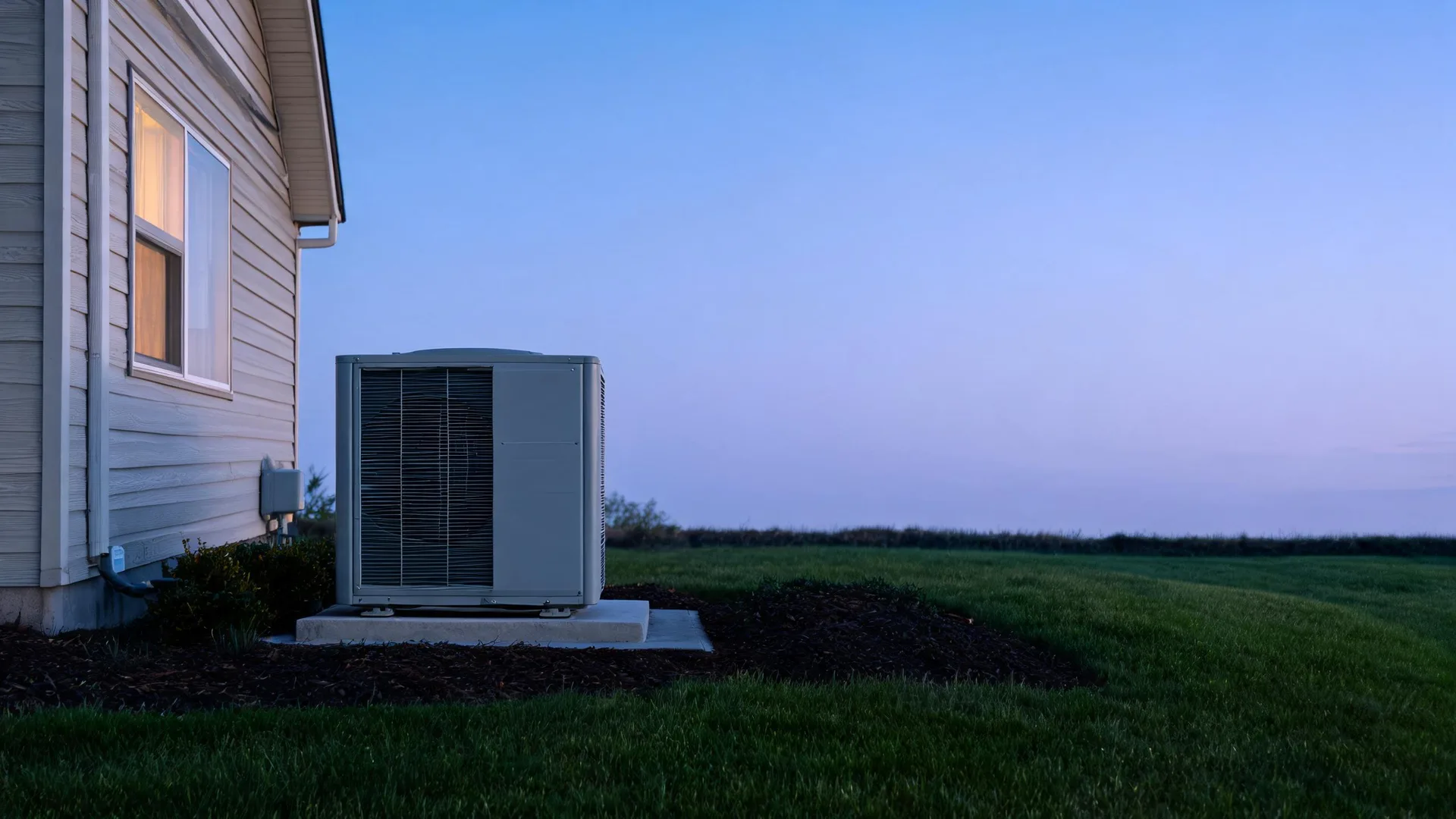
An outdoor air conditioning condenser unit positioned beside a blue-sided house at sunset.

Book your AC tune-up in May, before homes here start needing cooling in June.

  1. Jan
  2. Feb
  3. Mar
  4. Apr
  5. May
  6. Jun
  7. Jul
  8. Aug
  9. Sep
  10. Oct
  11. Nov
  12. Dec

A tune-up checks the refrigerant charge, cleans the coils, tests the capacitor and tightens the electrical connections.

A tune-up isn't one task, it's a sequence, and skipping steps defeats the point. Static pressure gets checked across the filter and coil, because a system can be clean and still choke if the ductwork can't move enough air. The blower wheel gets looked at too, not just the coil, since a wheel coated in dust moves less air even spinning at the same speed. Electrical connections get tightened, since a loose lug heats up under load and that heat damages the connector further over time. The outdoor fan motor gets checked for play in the bearing, because a motor that wobbles on its shaft is partway to seizing. None of this shows up by looking at the unit from across the yard. It shows up when someone opens the panels and checks each part against what it's supposed to do.