







A two-story red brick house with a dark roof and white-trimmed windows sits on a lawn behind a stone retaining wall, framed by large leafy trees under an overcast sky.

AC Maintenance in Elizabeth, NJ

Tell us about the job

Takes about a minute. No obligation.

Tune-up, service, or cleaningCentral ACUnion County, NJ
Step 1 of 2

What ZIP code is the job in?

Electricity in New Jersey ran 19.34 cents per kilowatthour in 2024, well above what most states pay. Your air conditioner feels that rate every time it cycles on. A dirty coil or a low charge makes the compressor work harder to do the same job, and it draws more power doing it. None of that shows up as a visible problem. The unit still cools the house. It just costs more to get there, month after month, for as long as it runs that way.

4 months
June through September, your air conditioner is on duty
84°F
the average summer afternoon it cools against
3 hail events
in ten years, and hail bends the fins on outdoor coils
98 wind events
in ten years, and wind drives debris into outdoor units
Isometric grayscale illustration of a cutaway house showing interior rooms, ductwork, an indoor air handler, and an outdoor condenser unit on a pad connected by lines.
Your air conditioner works hardest from June through August.

NOAA nClimDiv, 1991–2020 normals

A dirty filter or coil doesn't stop your AC from running, it just makes the compressor work harder to get the same result.

A compressor run that way for years can fail outright, where a cleaned one would have lasted.

Half the homes in Union County were built in 1956 or earlier. A system in a house that old is worth checking every year.

Half the homes here were built by 1956
Cooling runs June through September
Summer afternoons average 84°F
Get it checked before JuneCooling runs June through September here. May is the month to get it checked.

A tune-up checks the coil, the refrigerant charge and the airflow across the filter, since those are what make a compressor strain when they're off. None of that takes long to check. Catching a dirty coil or a low charge before the heat sets in means the compressor runs the way it was built to run, not harder than that. At 19.34 cents per kilowatthour, that difference lands on the bill every cycle the unit runs.

Find out before it fails, not after

If your AC came with the house, there's no way to know how many summers it's already run. A yearly check is how you catch a weak capacitor or a losing coil before it leaves you without cooling in the middle of summer.

Find a contractor
A person in a dark jacket, knit cap and tan work pants climbs porch steps toward a dark green front door, carrying a canvas tool bag, with a potted shrub beside the entry.
An outdoor air conditioning condenser unit mounted on a concrete pad surrounded by gravel, photographed against a partly cloudy blue sky.

What you can check, and what you can't

The filter is the one thing that's really on you between visits. Pull it out, hold it up to a light. If you can't see through it, swap it or wash it, depending on which kind you have. A clogged filter starves the coil of airflow, and a coil that can't shed heat makes the compressor behind it work harder for the same cooling. Outside, keep the area around the condenser clear. Grass clippings, leaves, a stack of patio furniture pushed too close, all of it blocks the airflow that unit needs to dump heat. A hose rinse on the outdoor coil fins, pointed straight down, not at an angle that bends them, is safe to do yourself. Beyond that, leave it alone. Refrigerant charge and electrical connections aren't a between-visits job.

The drain line clogs where you can't see it

The evaporator coil pulls moisture out of the air as it cools, and that water has to go somewhere. It runs down a drain line, usually out through a PVC pipe near the indoor unit. Algae and dust build up inside that line over time, same as a kitchen drain. When it blocks, the water backs up into a pan under the coil. Some units shut themselves off when that pan fills. Others just overflow, and that shows up as a stain on the ceiling below or water pooling near the furnace.

The coil has to give up heat to work at all

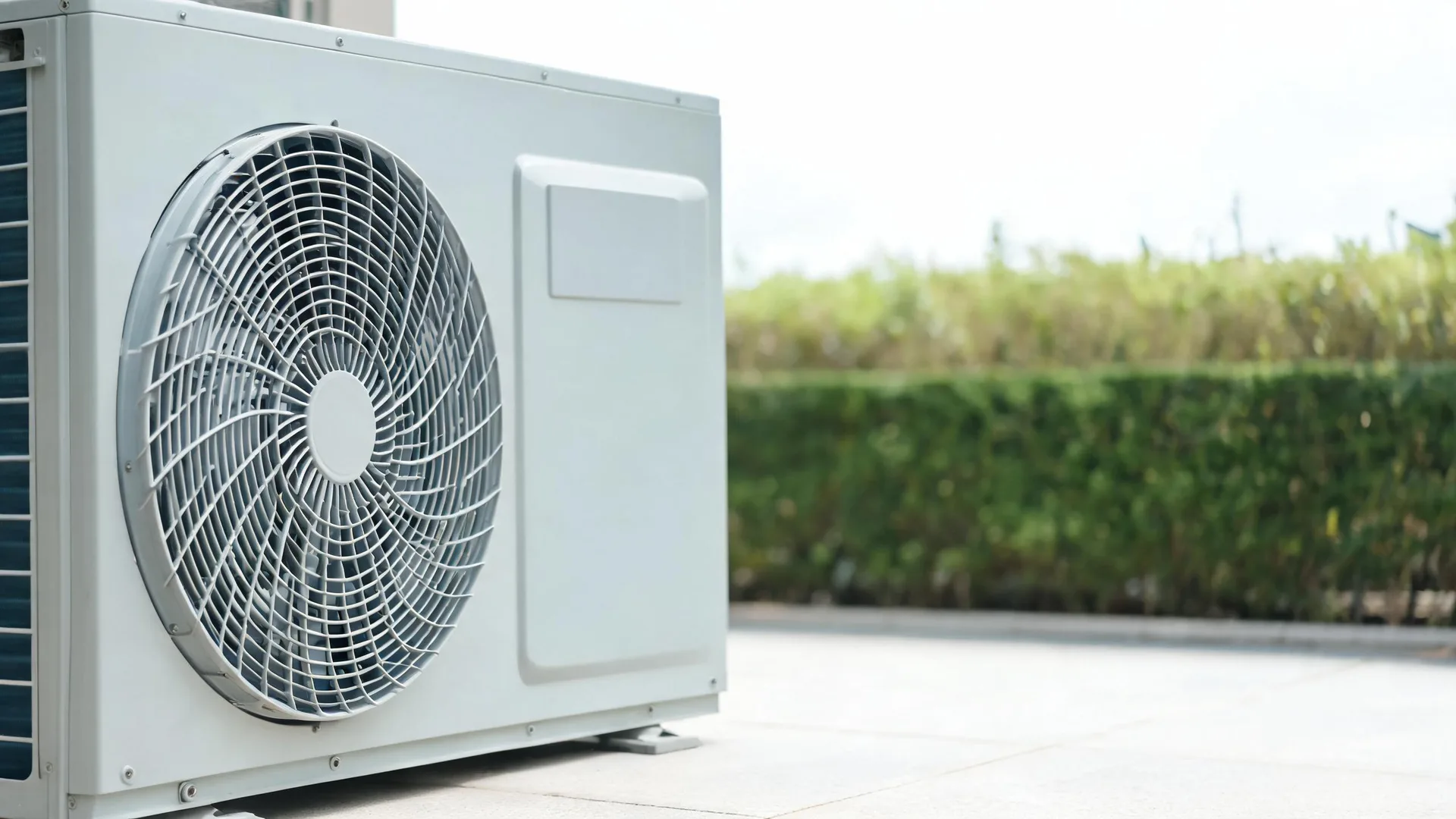
Your air conditioner doesn't make cold air so much as move heat out of the house. The indoor coil absorbs it, the outdoor coil releases it. Both depend on airflow to do that. Dust across the indoor coil or debris packed against the outdoor one is like a blanket thrown over a radiator. The system still runs, the compressor still turns on, but the heat has nowhere to go, so the whole cycle takes longer and strains harder to reach the same temperature.

An outdoor air conditioning condenser unit positioned on a concrete pad next to a blue-sided house, surrounded by green shrubs and flowering hydrangeas at sunset.

Book your AC tune-up in May, before homes here start needing cooling in June.

  1. Jan
  2. Feb
  3. Mar
  4. Apr
  5. May
  6. Jun
  7. Jul
  8. Aug
  9. Sep
  10. Oct
  11. Nov
  12. Dec

A tune-up checks the refrigerant charge, cleans the coils, tests the capacitor and tightens the electrical connections.

A tune-up is more than a filter check. The tech pulls the panel and tests the capacitor and contactor, the parts that get the compressor started and keep it running without drawing more current than it should. A weak capacitor still starts the unit most days, right up until the day it doesn't. They'll check refrigerant charge against what the system is supposed to hold, not just top it off, since too much is as hard on the compressor as too little. The condensate line gets checked for a clog before it backs up into the pan. Electrical connections get tightened, since a loose one heats up under load and that heat breaks the connection down further. None of this is guesswork. Each reading gets compared against what the manufacturer specifies for that unit, so the tech knows whether it's running the way it was built to or just running.